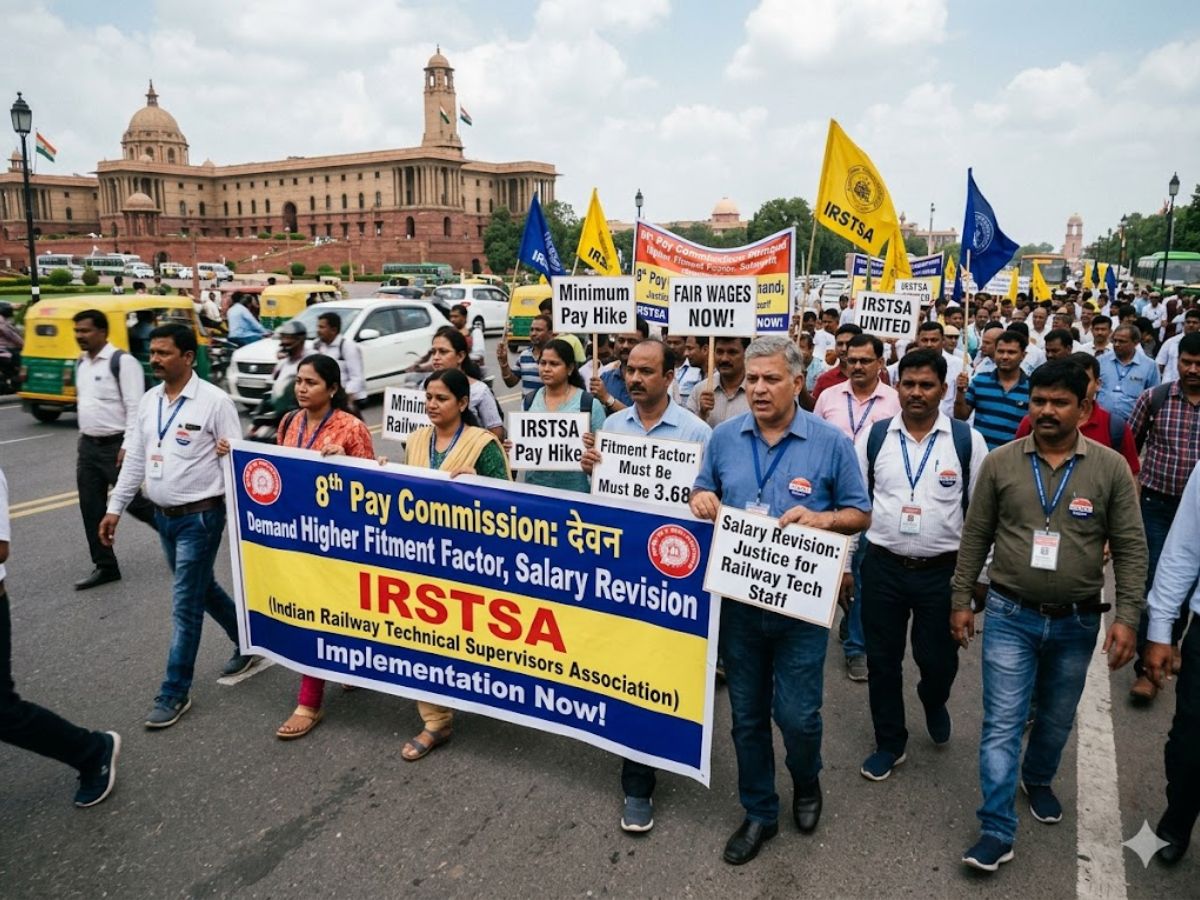
8th Pay Commission IRSTSA Demands (Image: AI-generated)
The Indian Railways Supervisors’ Federation (IRSTSA) has once again established a focus on the 8th Pay Commission. The IRSTSA has made their demands known for a higher fitment factor and meaningful salary revision for central government employees. This demand is due to the increased expectation from employees and pensioners, who are looking for better pay scales with increased cost-of-living. This proposal goes beyond just salary increases; it will ensure that employees are compensated fairly and maintain parity between all pay levels. As the discussions regarding the 8th Pay Commission are underway, millions of government workers from all over the country will be watching closely to see if they see significant revisions from the previous pay cycle.
IRSTSA is demanding an increase in the fitment factor, as well as a complete salary revision, through the 8th Pay Commission, because the current pay amounts do not keep up with inflation and changes in the economy. It has called for a new structure to provide employees and pensioners with better financial security. In addition to these demands, it has also requested that allowances be improved and that there are no wage disparities between the various employee groups outlined by the 8th Pay Commission.
The fitment factor plays an important role in modifying the basic salary during the 8th Pay Commission process as it is used to convert basic salaries from their current amounts to new ones. Essentially, the fitment factor is a multiplier that is used to take the current basic salary and generate a new pay schedule. The IRSTSA is arguing that the current fitment factor cannot support workers due to their increasing costs, so they will be pressing for a higher fitment factor to yield a larger increase in salary through the 8th Pay Commission than if no increase were made to the existing fitment factor, and as such represents a very high priority issue at this time in ongoing negotiations.
| Pay Level | Proposed Fitment Factor |
|---|---|
| L-1 to L-5 | 2.92 |
| L-6 to L-8 | 2.92 × 1.2 = 3.50 |
| L-9 to L-12 | 2.92 × 1.3 = 3.80 |
| L-13 to L-16 | 2.92 × 1.4 = 4.09 |
| L-17 & L-18 | 2.92 × 1.5 = 4.38 |
Even though an official number hasn’t been announced, it is assumed that the upcoming 8th pay commission will result in substantial salary increases if the fitment factor is approved. The amount will be adjusted based on how much employees have gained from the prior adjustment (the previous pay commission) compared to their last increased salary. Ultimately, how much or little the government weighs fiscal concerns versus employee needs will determine what happens with the 8th pay commission.
The 8th pay commission has not yet been officially implemented, and discussions are at the beginning stages. Persistence and pressure are being provided by employee groups, such as IRSTSA, to urge government action toward a decision regarding employee demands. The timeline on the approval of the 8th pay commission is uncertain, however, it is expected that the 8th pay will be implemented with a plan for phased implementation like the prior commissions.
Directly affecting serving employees and pensioners, the new regulations being put forth through the 8th Pay Commission will provide an increase in salary for employees and a modification to the pension for those currently retired. Through improved financial security from salary increases, as well as modifications in pensions, retirement income will be enhanced. Additionally, the push for improved compensation can be viewed as an issue of maintaining an acceptable level of quality of living. The 8th Pay Commission has the potential to provide a broad range of financial relief to the working and retired employee population if it is successful in implementation.
There will be significant changes made when transitioning from the 7th Pay Commission to the 8th Pay Commission. The previous Commission provided a well-structured pay matrix and a fitment factor of 2.57; however, we will soon see additional enhancements due to the implementation of a new commission.
Khalid Qasid is a media enthusiast with a strong interest in documentary filmmaking. He holds a Master’s degree in Convergent Journalism from AJK MCRC. He has also written extensively on esports at Sportsdunia. Currently, he covers world and general news at NewsX Digital.
Christopher Nolan’s The Odyssey trailer unveils a dark, brutal retelling of Homer’s epic, with Matt…
Delhi Capitals youngster Sameer Rizvi delivered a crucial 40* vs CSK in IPL 2026, reviving…
Iran launched fresh missile and drone attacks on the United Arab Emirates, even as the…
