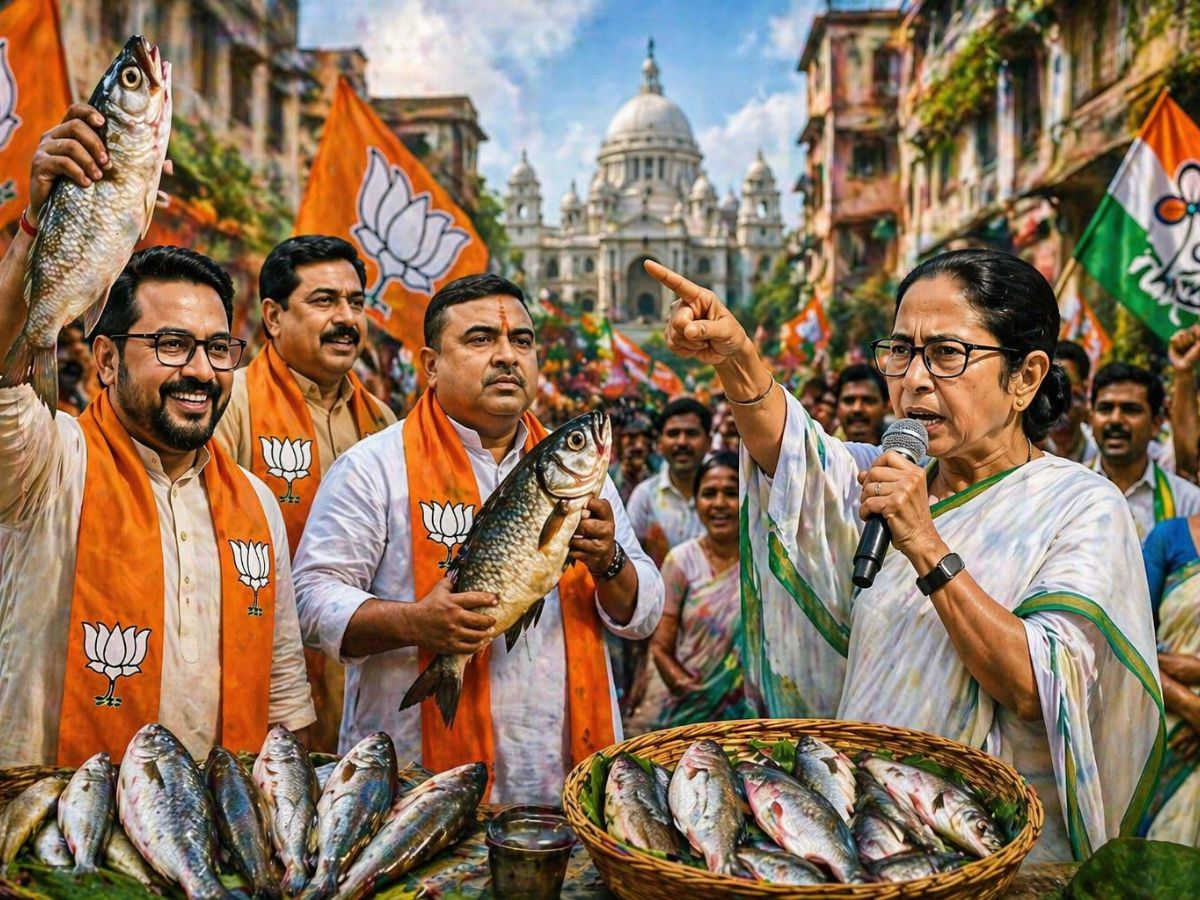
Fish emerges as a key poll symbol in Bengal 2026. (Photo: AI)
West Bengal Election 2026: As the high voltage 2026 West Bengal Assembly polls are underway, there has been an unusual, yet impactful symbol that has made the rounds fish. From election rallies to street level campaigning, political leaders and especially those from the BJP have been seen embracing Bengal’s all-time favourite food to woo the voters. What appears to be a novelty or gimmick, is actually a calculated political strategy to counter a long-standing narrative that has been pushed by the incumbent Trinamool (TMC). With elections happening in two phases, the contest is no longer about development or governance, but also about people’s identity, culture, and what they eat. But the big question remains, will this ‘machh bhaat’ strategy actually work?
Fish is not just food, it is an emotion, cultural symbol, and part of everyday life in Bengal. From meals to religious rituals, fish has some profound social significance. And that is why, it has become a powerful political symbol. In every election, when identity politics heat up, the cultural and social aspects that surround it become tools of persuasion.
But this year, it has gone a step further. The TMC has repeatedly accused the BJP of threatening Bengal’s food culture by allegedly promoting vegetarianism. BJP leaders have taken fish as a symbol and visual to counter, telling the voters that they respect and share their culinary traditions.
The BJP’s campaign in Bengal has become very local. Anurag Thakur has been seen eating machh bhaat during his visits and Himanta Biswa Sarma once challenged the Chief Minister Mamata Banerjee to a fish-eating contest.
Union Minister Sukanta Majumdar said that he had seen BJP leaders in Bengal eating non-vegetarian food and that the future chief minister of the party in the state would be a non-vegetarian.
Even Prime Minister Narendra Modi talked about fish in his campaign speeches and promised to make Bengal self-sufficient in fish. India is, it seems, using food to cross a cultural divide with Bengali voters.
TMC Chief Minister Mamata Banerjee has weaponised the BJP’s fish play. She has warned voters that the party would restrict fish, meat and eggs if they voted for her party and she has repeated the claim that the BJP would do so and that it denied the claim.
She and other TMC leaders have highlighted alleged double standards by the BJP by singling out states where the party‑ruled government had restricted meat consumption. They used social media and campaign speeches to question BJP leaders who had suddenly revealed their love of fish during the campaign.
The fish politics of Bengal is really about perception, not food. It’s a campaign by the BJP to brush off its image of being a party associated with a north-centric, vegetarian cultural framework. By publicly eating fish, it is trying to project cultural inclusiveness, local’s belongingness.
On the other hand, TMC is playing a narrative that the identity of the Bengal is being endangered and it is the party to protect the locals. It is a contest of who will be the protector of local culture, and is a sales pitch for trust.
This symbolism may not have a direct impact on voting behaviour, but it is hard to ignore the importance of cultural identity which is even more intertwined with food. The electorate is not going to invest heavily in a party based on its food culture but has always been influenced by factors such as welfare schemes, governance, regional identity among others.
It will be interesting to see if the ‘machh bhaat’ strategy of BJP can win over the skeptical voters but TMC’s narrative of protecting the culture is also powerful. In the end, fish may be the star of the show in the 2026 election, but voters will consider other factors as well before they head to the booths. But till then, it is clear that fish won’t just be on the plates of the Bengal’s voters in 2026, but also on the political agenda.
Sofia Babu Chacko is a journalist with over five years of experience reporting on Indian politics, crime, human rights, gender issues, and stories about marginalized communities. She believes journalism plays a crucial role in amplifying unheard voices and bringing attention to issues that truly matter. Sofia has contributed articles to The New Indian Express, Youth Ki Awaaz, and Maktoob Media. She is also a recipient of the 2025 Laadli Media Awards for gender sensitivity. Beyond the newsroom, she is a music enthusiast who enjoys singing. Connect with Sofia on X: https://x.com/SBCism
India Holds Back Starlink Clearance
India has reportedly delayed final approval for Starlink over security concerns linked to its reported…
Guns N' Roses 2026 India Tour: Check Bengaluru And Guwahati Concert Details
Guns N' Roses are returning to India in 2026 with concerts scheduled in Bengaluru and…
Jacqueline Fernandez Moves SC Against Framing of Charges in Rs 200-Crore Case
Jacqueline Fernandez has approached the Supreme Court challenging the framing of charges against her in…
