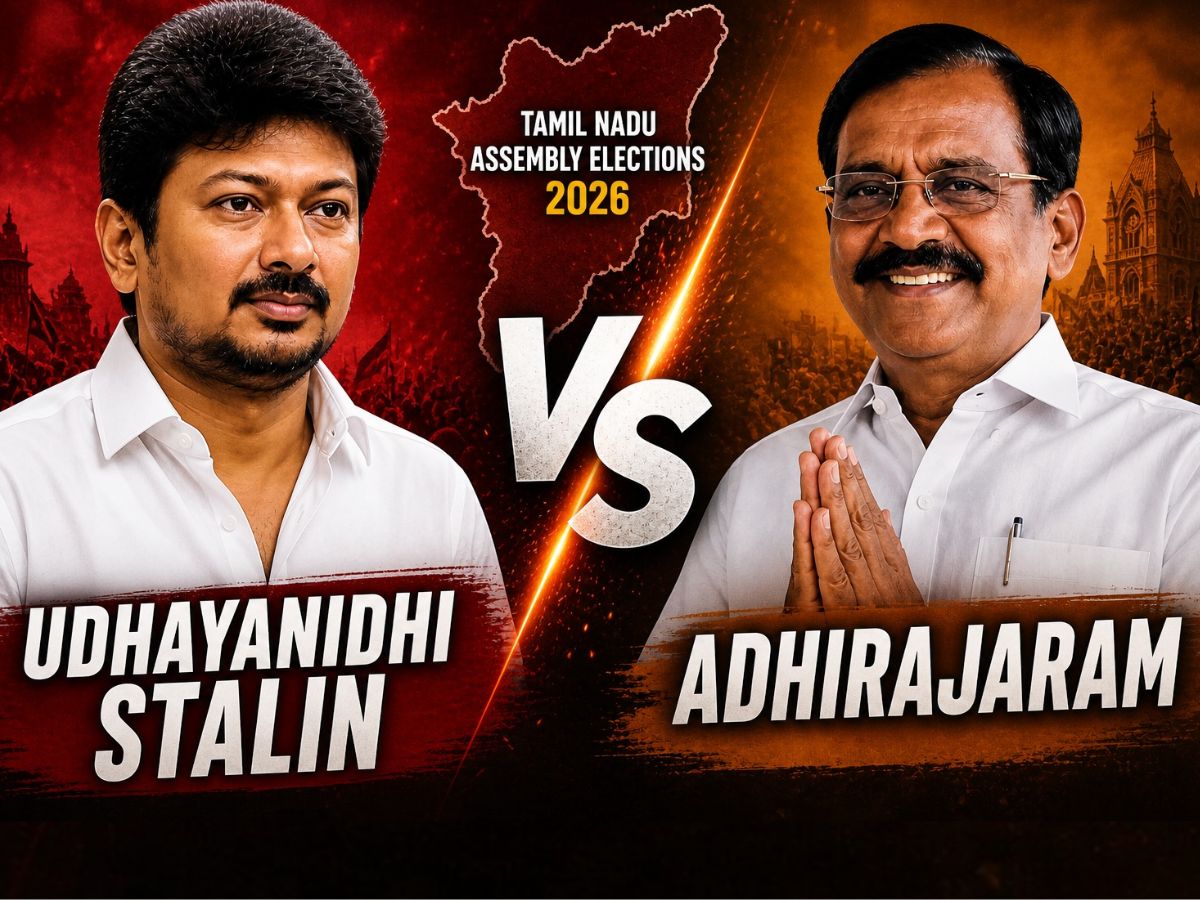
Udhayanidhi Stalin vs Adhirajaram: Who Will Win High-Stakes Tamil Nadu Political Clash As Regional Power Battle Intensifies? (Picture Credits: AI)
The political heat in Tamil Nadu is hard to miss right now, and one contest that’s drawing serious attention is the face-off between Udhayanidhi Stalin and Adhirajaram. With counting set for May 4, this isn’t just another routine result day. There’s a curiosity around how this particular battle will play out.
What makes this contest interesting is the contrast. On one side, you have a well-established political figure backed by a strong party setup. On the other, a challenger trying to make his presence felt by tapping into local concerns. The campaign period saw both sides pushing hard, and now it comes down to how voters have actually responded inside the polling booth.
Udhayanidhi Stalin has, over the past few years, become one of the most visible faces in Tamil Nadu politics. As a minister in the state government, he carries both administrative responsibility and the advantage of being part of a powerful political network.
His campaign this time has been fairly consistent. The focus has largely been on continuity. He has spoken about ongoing development work, welfare schemes, and the need to keep things moving in the same direction. This kind of messaging usually works well with voters who prefer stability over uncertainty.
In terms of elections, he comes in with a clear advantage. His previous win helped him build a solid base, especially among party loyalists and urban voters. Younger voters too seem to relate to his style, which has given him an added edge.
That said, being in power always brings scrutiny. There are areas where voters have raised concerns, but so far, it doesn’t seem to have significantly dented his overall support. His campaign has stayed focused on achievements rather than getting dragged into too many direct confrontations.
Adhirajaram’s campaign has taken a different route. Without the scale or visibility of his opponent, he has relied more on direct outreach and local-level engagement. His approach has been simple, talk about issues people deal with daily and present himself as someone who will be more accessible.
He may not have a strong electoral record compared to Udhayanidhi Stalin, but that hasn’t stopped him from building momentum in certain pockets. His support appears to come from voters who are either undecided or looking for a change.
A big part of his campaign has been about accountability. He has raised questions around local issues and tried to position himself as a candidate who will stay connected with people beyond election season. This kind of messaging can sometimes strike a chord, especially in closely contested seats.
Whether that translates into enough votes is the big question. His challenge is not just gaining attention but converting that into actual numbers on counting day.
The constituency itself adds another layer to this contest. It’s not the kind of seat where results are always predictable. There’s a mix of urban and semi-urban voters, and that usually means different expectations from candidates.
The voter base is quite large, and turnout has reportedly been steady this time. That often makes things tricky to read because both sides tend to claim strong participation from their supporters.
This constituency has seen competitive fights. It doesn’t always stick firmly with one side, which is why candidates need to work harder to hold onto their base while also convincing undecided voters.
Local issues have played a big role this time. From infrastructure and employment to everyday civic concerns, voters have had plenty on their minds. How each candidate addressed these issues could end up being the deciding factor.
At this point, it’s still not a straightforward call. Exit polls have given mixed signals. Some suggest that Udhayanidhi Stalin is ahead, largely because of his established support base and stronger party machinery. Others hint that the gap might not be as wide as expected.
In elections like this, small things matter. Voter turnout in key areas, last-minute swings, and even silent voters can influence the final result. That’s why predictions often fall short in closely fought contests.
For Udhayanidhi Stalin, it’s about holding on to his advantage and ensuring his core voters have turned up. For Adhirajaram, it’s about whether the energy seen during campaigning has actually translated into votes.
The final answer will come on May 4, when counting concludes.
Take a look at the IPL 2026 points table as of May 3. Here's a…
Iran Reviews US Response To 14-Point Proposal, Says Iranian Media
Iran’s Foreign Ministry spokesperson Esmaeil Baghaei said, Iran has received the United States response to…
India Dismisses Nepal’s Lipulekh Claim, Calls Territorial Expansion ‘Unacceptable’
India rejected Nepal’s recent claim over the Lipulekh Pass, calling it “untenable” and saying such…
