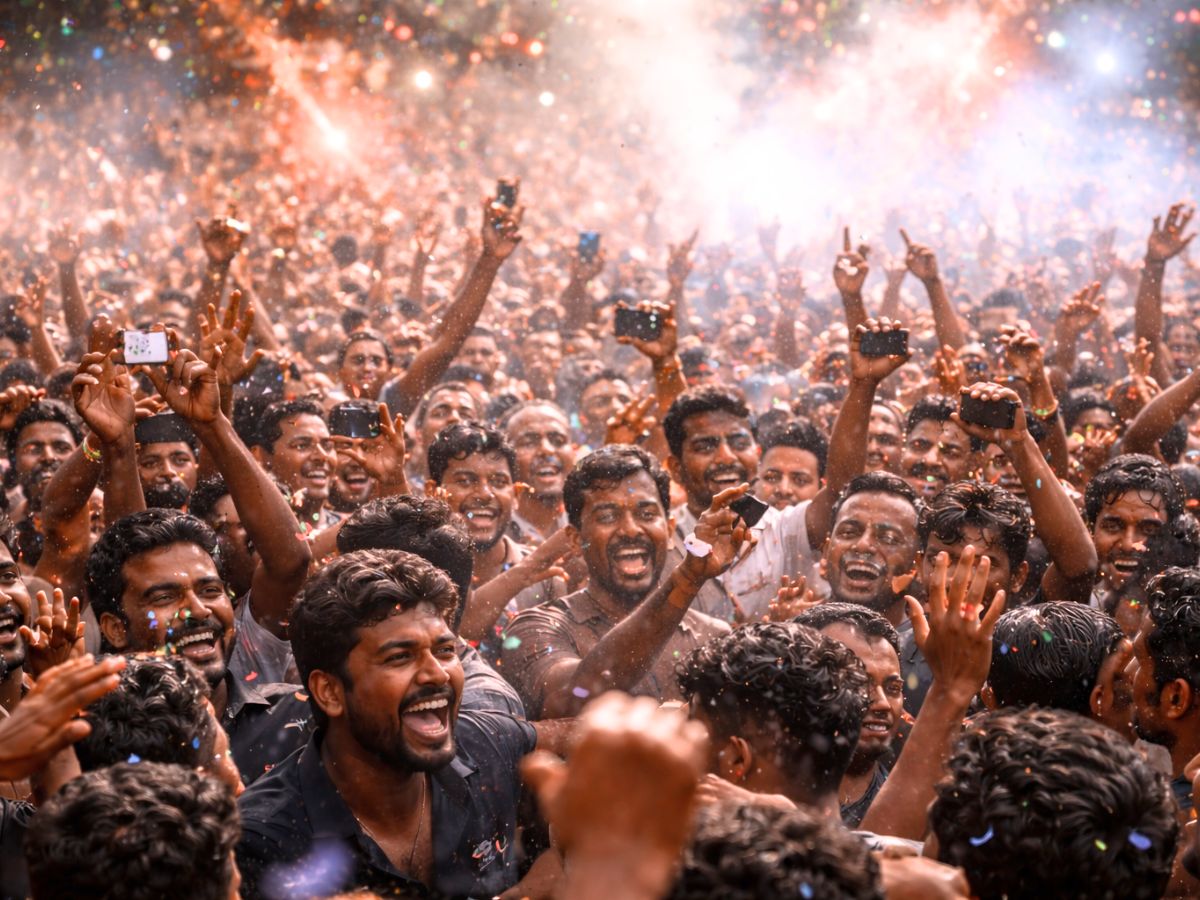
Superstar culture in South India is going crazy among fans. (Photo Credits: AI)
In recent weeks, a series of incidents involving popular South Indian film stars have once again brought the region’s intense fan culture under the spotlight.
From Telugu actress Nidhhi Agerwal being allegedly mobbed during a public event to actress Samantha Ruth Prabhu struggling to navigate crowds in Hyderabad, and actor Allu Arjun shielding his wife amid a fan surge in a café, these episodes underline a phenomenon that goes far beyond cinema.
The question many are asking is simple yet complex: why is fan culture in the South Indian film industry so much bigger, louder, and more emotionally charged than in other parts of the country?
Liking a film star is universal. However, in parts of South India particularly in Tamil and Telugu-speaking states admiration often transforms into devotion. Fans celebrate actors’ birthdays like festivals, erect towering cut-outs, pour milk over posters, and organise mass events that resemble political rallies.
While this deep emotional investment strengthens the bond between stars and their audience, it also has a darker side. The recent incidents involving mobbing and breaches of personal space show how unchecked fandom can turn toxic.
What begins as love and loyalty sometimes escalates into entitlement, where fans feel they have unrestricted access to their heroes.
One of the strongest reasons behind South India’s intense fan culture is the powerful sense of cultural and linguistic ownership. Film industries like Kollywood (Tamil) and Tollywood (Telugu) primarily cater to linguistically homogenous audiences. Stars are not just entertainers; they are seen as representatives of the language, culture, and pride of the state.
This “our own” sentiment creates a possessiveness that is less visible in industries like Bollywood, which caters to a diverse, multi-state audience. In the South, a superstar often symbolises regional identity, making criticism or perceived disrespect feel deeply personal to fans.
South Indian cinema is deeply rooted in emotion. Songs, dialogues, background scores, and larger-than-life narratives are designed to evoke strong feelings be it pride, anger, sorrow, or hope. Over decades, this emotional storytelling has conditioned audiences to form personal connections with on-screen heroes.
Actors are often portrayed as saviours, rebels, or moral crusaders, blurring the line between reel and real life. When audiences repeatedly see a star standing up for justice on screen, it becomes easier to project those qualities onto the individual behind the role.
Unlike much of North India, South Indian cinema has historically been intertwined with politics. Leaders like M.G. Ramachandran (MGR) and N.T. Rama Rao (NTR) successfully transitioned from cinema to chief ministerial roles, while figures like M. Karunanidhi shaped political narratives through screenwriting.
Political parties such as the DMK, AIADMK, and TDP have long used cinema as a tool to reach the masses. Films often carry subtle or sometimes overt political messaging. As a result, fandom is not just emotional but also organisational, supported by grassroots networks that function much like political cadres.
This overlap explains why events such as audio launches resemble political meetings. The recent audio launch of actor Vijay’s film Jana Nayagan in Malaysia saw overwhelming emotional scenes, as fans reacted to what is believed to be his final film before entering Tamil Nadu politics ahead of the 2026 Assembly elections.
Tamil and Telugu film industries are among the strongest regional industries in India, with massive budgets, global reach, and dedicated overseas audiences. Their scale allows stars to cultivate larger-than-life images that sustain intense fan loyalty.
While Bollywood also has iconic superstars, its audience is spread across multiple states and cultures, diluting the sense of exclusivity. In contrast, South Indian industries operate within tighter cultural ecosystems, enabling deeper fan engagement.
Chennai has historically been the nerve centre of South Indian cinema. Even today, many actors, technicians, and producers live in and around the city, reinforcing a close-knit industry culture. This concentration has helped shape a unified cinematic identity that influences audience behaviour and fan practices.
As the hub of Kollywood, Chennai’s audiences often set trends that ripple across other regions, further strengthening collective fan identity.
The issue gained renewed attention after a case was registered against a mall management and event organisers in Hyderabad following the alleged mobbing of actress Nidhhi Agerwal during a song launch for The Raja Saab. Police said the event was held without prior permission, leading to overcrowding. Videos showing the visibly distressed actor went viral.
Similarly, Samantha Ruth Prabhu faced an overwhelming crowd during a store inauguration in Jubilee Hills, despite security and police presence. In another incident, actor Allu Arjun and his wife Sneha Reddy were surrounded by fans at a café, prompting security concerns.
These episodes highlight how fandom, when unchecked, can pose serious safety risks not just for celebrities, but also for fans themselves.
South India’s fan culture is a product of history, emotion, politics, and identity. It has created legendary stars and unforgettable cinematic moments. However, recent incidents show the urgent need for better crowd management, responsible event planning, and a collective rethinking of celebrity worship.
Admiration does not have to come at the cost of dignity or safety. As cinema continues to evolve, so must the culture around it finding a balance between passion and restraint.
Sofia Babu Chacko is a journalist with over five years of experience covering Indian politics, crime, human rights, gender issues, and stories about marginalized communities. She believes that every voice matters, and journalism has a vital role to play in amplifying those voices. Sofia is committed to creating impact and shedding light on stories that truly matter. Beyond her work in the newsroom, she is also a music enthusiast who enjoys singing.
Prince William and Kate Middleton did not stop to speak with the media and proceeded…
BAFTA Awards 2026 Winner List: The 79th BAFTA Awards 2026 turned into a memorable night…
Mahieka Sharma’s reaction after Hardik Pandya was dismissed in India vs South Africa T20 World…
