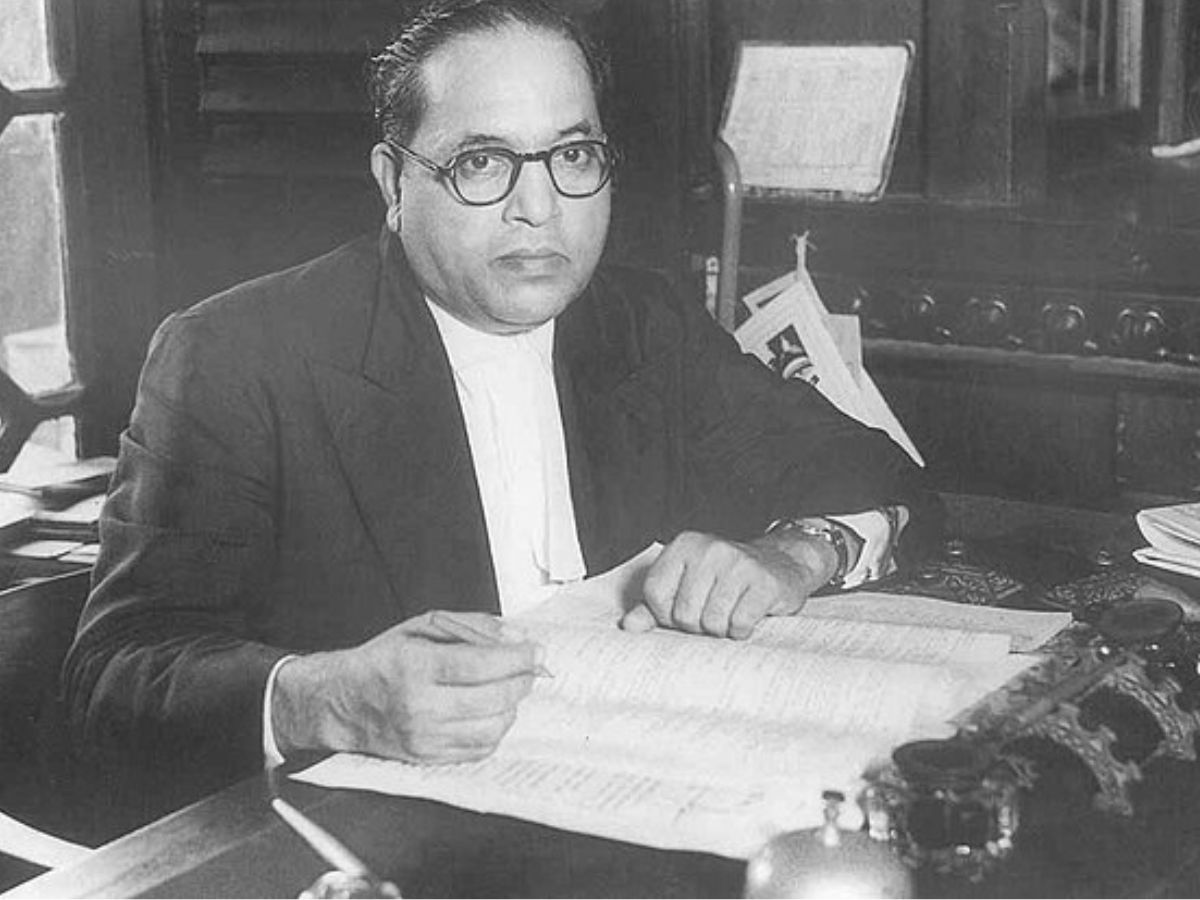
(Image credit: WikiMedia Commons)
In the context of India’s battle for social justice, Ambedkar takes center stage as not only a supporter of caste equality but also a great thinker for gender justice and women’s liberation. His legacy is not only about the caste system but also about the overcoming of gender discrimination and women’s liberation. His intellectual influence which cut across the domains of law, politics, and social change was and still is very powerful, and his commitment to women’s rights was evident in his important position as the chairman of the drafting committee of the Hindu Code Bill when women were still treated as ‘second class citizens’.
The Hindu Code Bill, which was introduced and debated in the late ’40s and ’50s, aimed to change Hindu personal laws, especially regarding marriage, inheritance, and property, in order to give equal legal rights to Hindu women. Today, in a situation where the mainstream Indian feminism often tries to speak for the urban, elite, or upper caste women, Ambedkar’s comprehensive view is an alert that reminds us of the necessity to give priority to women of the historically marginalized communities such as Dalit, Adivasi, Bahujan, Muslims, working class, and queer whose oppression due to their gender is further intensified by caste and class.
Ambedkar’s initial research showed a great acquaintance with the link of caste and patriarchy. In 1916 he wrote the essay Castes in India, Their Mechanism, Genesis and Development during his studies in foreign countries in which he maintained that caste is not an occupational or class system but a biologically divided institution that assures the controlling of reproduction, sexuality, and kinship relations, etc. He illustrated how caste enforcement through endogamy completely curtailed the freedom of women while men enjoyed such freedom comparatively. Later, in his influential book The Annihilation of Caste (1936), Ambedkar made an unreservedly ruthless criticism of the religious and social roots of caste based oppression, indicating that the susceptibility of Brahminical patriarchy was as much affected by the critique as was the caste hierarchy. He openly repudiated the canon of texts like the Manusmriti and even incinerated it as a quasi cultural act of defiance, thus he drew attention towards the necessity of eliminating the religious based gender and caste oppression. This two fold attack on patriarchy and caste represented the beginning of what we refer to today as feminist movements based on social reality rather than abstract ideals intersectional feminism.
The Hindu Code Bill was one of Ambedkar’s advocacy through which he established gender justice in the law. The Bill suggested besides other rights equal property rights for daughters and widows, the right for women to inherit ancestral property, and the right to divorce on grounds like cruelty, desertion or mutual consent. For Ambedkar, changing personal law was not merely a matter of legal technicalities it was about creating a base for constitutional morality where women would be recognized as full citizens instead of being pushed down the hierarchy. The entire Bill was not enacted during his lifetime, yet after laws such as the Hindu Marriage Act, Hindu Succession Act, Hindu Minority and Guardianship Act, and Hindu Adoptions and Maintenance Act many of his suggested reforms were accepted. With these reforms, Ambedkar was seeking to transfer women’s rights from the sphere of traditional or religious norms to that of secular, democratic law.
But Ambedkar’s feminism was not only a legal one. He realized very well that emancipation would not be complete if the threefold oppressions, caste, gender, and class were not properly and especially in the case of Dalit and marginalized women dealt with. In the acknowledgment of the Dalit women as being in a double bind caste discrimination plus patriarchal oppression Ambedkar granted the very basis of what is now termed Dalit feminist thinking. His insistence on the education of the whole society, economic independence, and political representation has demonstrated that gender equality is a social equality issue.
In the contemporary Indian feminist movements, which are often criticized for being led by upper caste, urban voices and, therefore, having the experiences of marginalized women ignored, Ambedkar’s principles seem to be calling for action again. His demand for ‘structural change’ rather than just symbolic victories puts pressure on feminism to deal with caste and class rather than to be silent about them. By means of constitutional guarantees such as equality before law (Article 14), non discrimination (Article 15), equal opportunity in employment (Article 16), and special provisions for women and children (Article 15(3)), he embedded gender justice into the very framework of national law this way, he made the constitution a feminist document by giving it the character of the feminist document.
Fact Check: Who Was The Girl Who Committed Suicide Over 19 Minute 34 Second Viral MMS?
19 Minute 34 Second Viral MMS: A video allegedly depicting a couple indulging in explicit…
Indian rapper Badshah has recently made headlines over his latest song “Tateeree.” The Haryanvi hip-hop…
IND vs NZ: Pitch Details Emerge Ahead of T20 World Cup 2026 Final — Trouble For Sanju Samson?
IND vs NZ T20 World Cup final: Here’s a look at the Ahmedabad pitch report…
