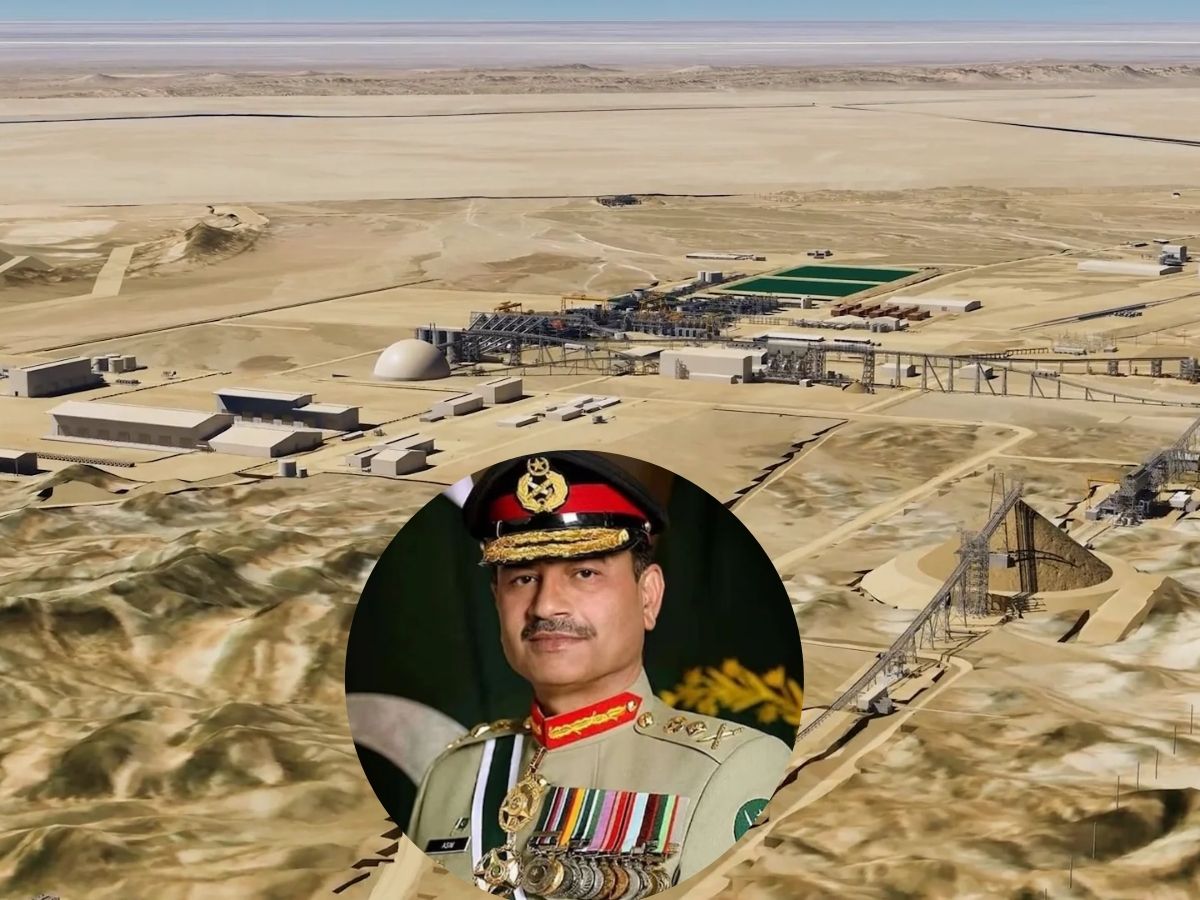
Asim Munir says Reko Diq mine could yield $2B yearly, but security, politics, and global rivalries cloud Pakistan’s hopes. Photos/X.
Pakistan’s Army Chief, General Asim Munir, has said that the country’s economic future lies in the ‘vast gold and copper reserves’ buried in Balochistan’s Reko Diq mine. In an interview with Pakistan’s Jang media group, the newly minted field marshal said that China’s continued support could be the decisive factor in turning the project into a multibillion-dollar success.
Munir claimed the mine would begin producing revenue next year.
“Pakistan is sitting on a treasure of rare minerals,” he said. “We will soon reduce our debt and become one of the most prosperous societies in the world.”
Munir projected annual revenues of at least $2 billion once operations start, saying that the project is a solution to Pakistan’s spiraling debt crisis.
The Reko Diq mine, located in the Chagai district of Balochistan, according to Pakistan media reports, is estimated to hold 12.3 million tonnes of copper and more than 20 million ounces of gold. The estimates can be taken with a pinch of salt, given the exaggerated claims of Pakistan administrations dully regurgitated by its pliant media.
Also Read: Asim Munir Issues Big Statement After Oil Deal With US: ‘Pakistan Has A Rare Earth…’
Pakistan has previously made bold claims about underground riches. In 2019, then-Prime Minister Imran Khan announced the possibility of a “massive oil discovery,” which ultimately proved unviable after drilling results. That history fuels skepticism about Munir’s optimistic projections.
Reko Diq lies in the Tethyan Belt, a metallogenic zone that stretches from Eastern Europe through Anatolia to Iran and into Balochistan. Known as one of the richest belts for gold and base metals such as copper and zinc, it likely makes Reko Diq among the world’s largest undeveloped deposits.
China’s involvement in Pakistan’s infrastructure and resource projects under the China-Pakistan Economic Corridor (CPEC) places Beijing at the center of the Reko Diq equation. Analysts say the mine could become a new node in China’s regional influence.
Munir, however, avoided naming China directly, instead highlighting “balanced partnerships” with both Beijing and Washington. “Both are equally important,” he said.
Despite his confidence, the project faces political and security challenges. Baloch separatist groups have repeatedly opposed resource extraction in the province, calling such efforts exploitative. The ongoing insurgency in Balochistan, combined with Pakistan’s fragile economy, raises doubts about whether the billions Munir promises will materialize.
However, Pakistan received a favour from the US recently that could help the country stabilize the region. The US State Department declared the Balochistan Liberation Army and its Majeed Brigade as terrorist organisations.
Munir’s remarks come as the United States sharpens its focus on Pakistan’s mineral wealth, particularly rare earth elements crucial to electronics and defense.
The Washington Post reported that US President Donald Trump’s outreach to Islamabad is “less about oil than minerals.”
The shift in American interest coincides with growing trade tensions with India. Washington recently imposed 50 percent tariffs on Indian goods, while Pakistan received its first-ever crude shipment from the US under a new trade deal.
Despite doubts, the Reko Diq project has recently reached a milestone. On April 8, the mine’s updated feasibility study and conditional approval for phase one development capital were finalized.
The mine is currently owned by Canadian company Barrick Gold (50%), the Government of Pakistan (25%), and the Government of Balochistan (25%). Meanwhile, Saudi Arabia’s Manara Minerals is preparing to purchase a 10–20 percent stake valued between $500 million and $1 billion from Pakistan’s share.
Project manager Tim Cribb, speaking at the Pakistan Minerals Investment Forum (PMIF), expressed optimism about the next stage.
“The good thing about the project is that we have buy-in at the federal as well as the provincial level. Now that the feasibility study is complete, we have a pathway forward and can focus on the delivery of the construction and mobilising people,” he said.
Also Read: Asim Munir To Replace Asif Ali Zardari As Next President? Here’s What Pakistan Army Chief Said
Zubair Amin is a Senior Journalist at NewsX with over seven years of experience in reporting and editorial work. He has written for leading national and international publications, including Foreign Policy Magazine, Al Jazeera, The Economic Times, The Indian Express, The Wire, Article 14, Mongabay, News9, among others. His primary focus is on international affairs, with a strong interest in US politics and policy. He also writes on West Asia, Indian polity, and constitutional issues. Zubair tweets at zubaiyr.amin
Check your upcoming weekly direction, lucky number, and lucky colour to make the most of…
New Aadhaar rules limit name changes to twice and DOB once. Here’s how to update…
A disturbing road rage incident in Jhansi has gone viral after a video showed a…
