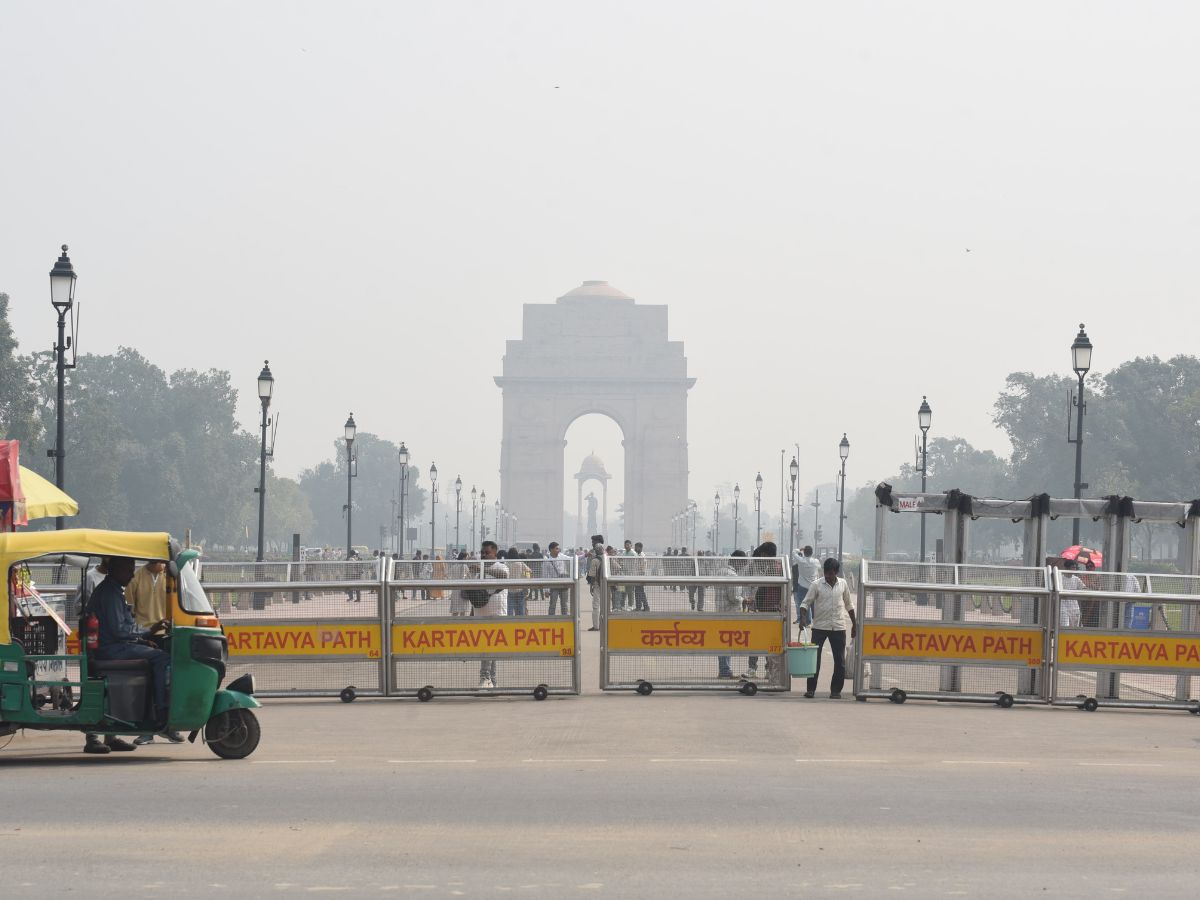
Delhi Air Quality Drops From 'Poor' To 'Very Poor' Category, Overall AQI Stands At 312 (Photo Credit: ANI)
Diwali Air Pollution Delhi: As India celebrated Diwali, the national capital woke up to another familiar crisis – a toxic haze blanketing its skyline. Pollution levels in Delhi soared to alarming levels, with several people reporting Air Quality Index (AQI) figures nearing or even exceeding 1,000, far beyond the “severe” category.
Throughout Monday night and early Tuesday, Delhi residents flooded social media with screenshots and photos showing extreme pollution readings.
Aam Aadmi Party (AAP) leader Saurabh Bharadwaj posted late-night AQI readings from various Delhi localities. According to the screenshots he shared, the Defence Colony area recorded an AQI of 1,074 at 10:30 pm, while Naraina Village reached an astonishing 1,768 at 11:14 pm on Monday.
Despite these alarming figures, official data from the Central Pollution Control Board (CPCB) showed Delhi’s overall AQI at 350 at 8 am on Tuesday, still classified as “very poor.”
Also Read: AQI Update A Day After Diwali: Delhi Wakes Up Under Toxic Smog, AQI Levels Up
In response to deteriorating air quality, the Commission for Air Quality Management (CAQM) had already invoked Stage 2 of the Graded Response Action Plan (GRAP) across the National Capital Region on Sunday.
An official CAQM order stated, “Actions under Stage I and II of the extant GRAP shall be implemented, monitored, and reviewed in earnest by all concerned agencies in the entire NCR to ensure that AQI levels do not slip further. All implementing agencies shall maintain a strict vigil and intensify measures to the extent specified in the GRAP schedule. Citizens may be requested to strictly adhere to the citizen charter under GRAP Stage-I & II.”
Just days before Diwali, the Supreme Court lifted the four-year ban on firecrackers in Delhi-NCR, allowing the sale and use of certified green crackers between October 18 and 21. The decision was seen as an attempt to strike a balance between protecting public health and supporting the fireworks industry.
The court’s order specified that each firecracker must carry a QR code verifying certification, and bursting would only be allowed between 6:00 am to 7:00 am and 8:00 pm to 10:00 pm.
The Supreme Court had first imposed a ban on firecrackers in Delhi-NCR in 2014-15, in response to rising pollution levels. Yet, year after year, the city has continued to record “very poor” to “severe” AQI levels during the festive season.
This year’s reintroduction of green crackers, touted as producing 30% less pollution, appears to have made little difference. Environmentalists have long questioned their efficacy, arguing that the distinction between regular and “green” fireworks is marginal when the baseline pollution is already extreme.
Environmental activists have sharply criticized the idea that green crackers were a viable solution.
Also Read: Diwali Evening Brings Sudden Spike In Delhi Pollution, 24 Zones Turn Red
Zubair Amin is a Senior Journalist at NewsX with over seven years of experience in reporting and editorial work. He has written for leading national and international publications, including Foreign Policy Magazine, Al Jazeera, The Economic Times, The Indian Express, The Wire, Article 14, Mongabay, News9, among others. His primary focus is on international affairs, with a strong interest in US politics and policy. He also writes on West Asia, Indian polity, and constitutional issues. Zubair tweets at zubaiyr.amin
Realme may soon launch the Realme 16T 5G and Realme P4R 5G in India, as…
Barcelona maintain their lead at the top of La Liga with a dominant 5-2 victory…
Government reports state that Mojtaba Khamenei is in good health and yet he has not…
