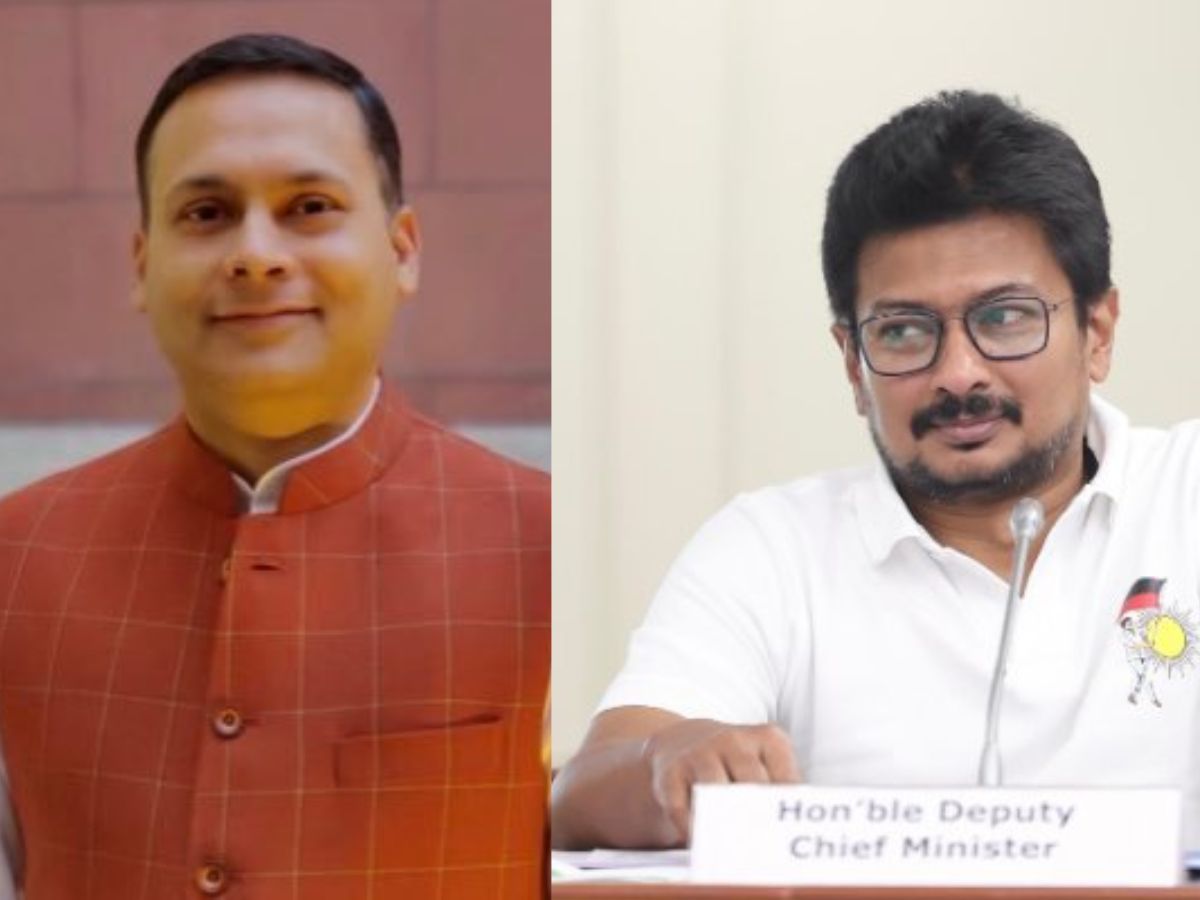
BJP leader Amit Malviya and Udhayanidhi Stalin back in controversy after making derogatory remarks. (Photo: X/ @amitmalviya/ @Udhaystalin)
Udhayanidhi Stalin: The Madras High Court Justice S. Srimathy of the Madurai Bench, while allowing head of BJP IT Cell, Amit Malviya’s petition, ruled that describing the Deputy Cheif minister of Tamil Nadu Udhayanidhi Stalin’s 2023 remarks as a call for genocide did not amount to any criminal offence.
The court observed that Udhayanidhi’s speech was directed against followers of Sanatana Dharma and that Malviya, being a follower himself, could be considered a victim of such remarks. The judge further held that Udhayanidhi Stalin’s comments amounted to “hate speech.”
The controversy dates back to 2023, when Udhayanidhi Stalin, the minister of the Dravida Munnetra Kazhagam (DMK), made the remarks while addressing a conference titled ‘Sanatana Abolition Conference,’ organised by the Tamil Nadu Progressive Writers and Artists Association. During the event. In his speech, the minister drew a line between Sanatan Dharma and diseases such as dengue and malaria. Pointing at the Hindu religion, he said that certain things cannot merely be resisted but must be eradicated.
“Sanatana Dharma should not be resisted or opposed, but it has to be abolished/eradicated.” Subsequently, Malviya, , shared a video clip of the speech on social media platform X. In his post, Malviya stated that Udhayanidhi’s remarks amounted to a call for the “genocide” of nearly 80 percent of the population that follows Sanatana Dharma.
Following Amit Malviya’s tweet, Udhayanidhi Stalin responded firmly, asserting that he had never called for the genocide of people who follow Sanatana Dharma. He further argued that Sanatana Dharma is a principle that divides people on the basis of caste and religion.
“Uprooting Sanatana Dharma is about upholding humanity and human equality. I stand firmly by every word I have spoken. I spoke on behalf of the oppressed and marginalised, who suffer due to Sanatana Dharma. I am ready to present the extensive writings of Periyar and Ambedkar, who carried out in-depth research on Sanatana Dharma and its negative impact on society, in any forum,” Stalin said.
I never called for the genocide of people who are following Sanatan Dharma. Sanatan Dharma is a principle that divides people in the name of caste and religion. Uprooting Sanatan Dharma is upholding humanity and human equality.
I stand firmly by every word I have spoken. I spoke… https://t.co/Q31uVNdZVb
— Udhay – தமிழ்நாட்டை தலைகுனிய விடமாட்டேன் (@Udhaystalin) September 2, 2023
Referring to a key portion of his earlier remarks, Stalin quoted himself as saying, “I believe that, just as diseases such as COVID-19, dengue, and malaria are spread by mosquitoes, Sanatana Dharma is responsible for many social evils. I am prepared to face any challenge, whether in a court of law or in the people’s court. Stop spreading fake news.”
Following Malviya’s social media post, a case was registered against him under Sections 153A (hate speech) and 505 (statement conducting public mischief) of the Indian Penal Code, 1860. Malviya later approached the High Court seeking the quashing of the FIR.
While setting aside the case, the court expressed concern that legal action had been initiated only against those who reacted to the speech and not against the person who made the original remarks.
“The courts are questioning those who reacted, but the law is not being set in motion against the person who initiated the hate speech,” Justice Srimathy observed.
Justice Srimathy said that the prosecution rested completely on the meaning of the word “Ozhippu” used by Stalin in his speech. It noted that even according to the State, the word translates to “abolish.”
The Madras High Court highlighted that the synonyms for the word ‘abolish’ are ‘eradicate,’ ‘eliminate,’ ‘exterminate,’ ‘destroy,’ ‘annihilate,’ and ‘wipe out.’ Referring the meaning to a religion, the court reasons that such language extends beyond abstract ideas. “If Sanathana Dharma should not be there, then the people following Sanathana Dharma should not be there,” the Court said.
Citing the submission by Malviya’s counsel that the minister’s party had repeatedly spoken against Sanatan Dharma, the judge said, “There is a clear attack on Hinduism by the Dravida Kazhagam, and subsequently along with the DMK, for the past 100 years, to which the minister belongs. While considering the overall circumstances, it is seen the petitioner had questioned the hidden meaning of the minister’s speech.”
“The speech of the minister would clearly indicate that it is totally against 80% of Hindus, which comes within the mischief of hate speech. The petitioner, who is a sanathani is a victim of such hate speech and has only defended the Sanatana Dharma from hate speech,” the judge said.
Dubai Blast: Dubai International Airport briefly halted operations after missile and drone threats. UAE air…
ISL 2025-26: Imran Khan Strike Hands Chennaiyin FC 1-0 Win Over Kerala Blasters
Chennaiyin FC beat Kerala Blasters 1-0 in ISL 2025-26 as Imran Khan’s first-half goal sealed…
AFC Women’s Asian Cup 2026: Japan Decimate India 11-0 in Record-Breaking Rout
Japan's Nadeshiko outclass India’s Blue Tigresses with an 11–0 victory at the Perth Rectangular Stadium.…
