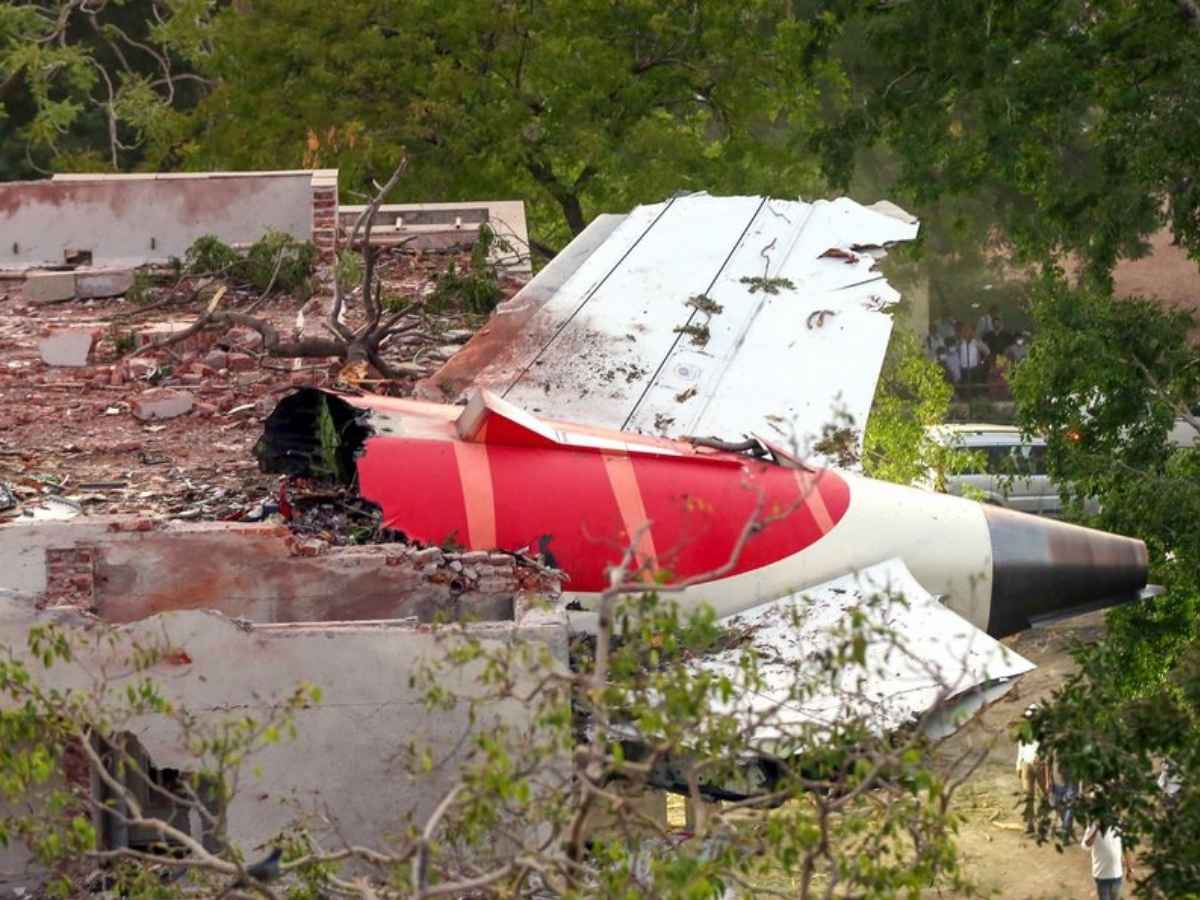
The AAIB report on AI171 crash reveals fuel switches were moved to CUTOFF mid-air, leading to the crash that killed 260. Investigators are analyzing pilot actions and system faults.
The preliminary report on the Air India AI171 crash, prepared by India’s Aircraft Accident Investigation Bureau (AAIB), has led to a chilling discovery both fuel switches were moved to the “cut off” position shortly after takeoff, as revealed through the cockpit voice recorder data.
The tragic crash resulted in the deaths of 260 people and left 67 others injured, marking one of the worst air disasters in India in recent decades.
However, the recording does not clarify who said what whether it was the pilot or co-pilot.
According to the AAIB report:
“The aircraft had reached an airspeed of 180 knots when both engines’ fuel cutoff switches were transitioned from RUN to CUTOFF position, one after another, with a time gap of one second.”
As per the Electronic Aircraft Flight Recorder (EAFR) data, the aircraft crossed the takeoff decision speed (V₁) and reached 153 knots at 08:08:33 UTC. The V-speed of 155 knots was achieved at 08:08:35 UTC, and the aircraft’s air/ground sensors transitioned to air mode, confirming liftoff at 08:08:39 UTC.
ALSO READ: ‘We Are Unable To Comment,’ Says Air India On AAIB Report As It Hints Double Engine Shut Down
At 08:08:42 UTC, the aircraft hit its maximum recorded airspeed of 180 knots. Immediately after that, Engine 1 and Engine 2 fuel cutoff switches were moved from RUN to CUTOFF within a second of each other. Following this, the engine N1 and N2 speeds started dropping as fuel supply was cut off.
In the cockpit voice recording, one of the pilots is heard asking the other, “Why did you cut off?” The other pilot responds that he didn’t do it.
The report also stated that both engines’ N2 values dropped below minimum idle speed, and the RAT hydraulic pump began supplying hydraulic power at around 08:08:47 UTC.
Ten seconds later, the pilots attempted to restart the engines.
“As per the EAFR, the Engine 1 fuel cutoff switch transitioned from CUTOFF to RUN at 08:08:52 UTC. The APU Inlet Door began opening at about 08:08:54 UTC, consistent with the APU Auto Start logic. Thereafter, at 08:08:56 UTC, the Engine 2 fuel cutoff switch also transitioned from CUTOFF to RUN. When these switches are moved from CUTOFF to RUN while the aircraft is in flight, the Full Authority Dual Engine Control (FADEC) system automatically manages the relight and thrust recovery process,” the report explained.
Normally, fuel switches are set to cut off only after landing to shut down the engines.
The London Gatwick-bound AI171 had remained airborne for just 39 seconds after taking off from Ahmedabad’s Sardar Vallabhbhai Patel International Airport. The Boeing 787-8 Dreamliner crashed into the BJ Medical College hostel building and exploded just around 2 km from the runway.
The black boxes were recovered and brought to Delhi for detailed examination.
Sources on Saturday said that investigators will now focus on analysing the cockpit audio to identify which pilot said what and when. They will also determine whether the fuel switches were toggled manually or automatically.
ALSO READ: Ahmedabad Air India Plane Crash: Here Are 10 Key Takeaways From The Prelim Report Released By AAIB
Investigators admit that decoding the brief conversation in the cockpit to understand what truly happened during those 39 seconds is a challenging task.
The team will also assess the functionality of the Dreamliner’s fuel switch system and its overall software mechanism before arriving at any final conclusions on what led both engines to shut down mid-air on June 12.
The Director General of AAIB has appointed a dedicated investigation team led by Investigator-in-Charge Sanjay Kumar Singh, along with Chief Investigator Jasbir Singh Larhga and team members Vipin Venu Varakoth, Veeraragavan K, and Vaishnav Vijayakumar.
To support the investigation, AAIB has also brought in experienced pilots, engineers, aviation medicine specialists, psychologists, and flight recorder experts as Subject Matter Experts (SMEs) to assist in their respective domains.
ALSO READ: What Are Fuel Switches At The Heart Of The Air India Crash Probe? Explained
Chandrika Dixit’s husband, Yugam Gera is now linked to another mystery woman who did not…
New Delhi [India], March 19: Arvore Healthcare, a long-established and trusted name in the Indian…
Nifty 50 leads crash, falls to 23,002 as Sensex tanks 2,500 points; ₹11.5 lakh crore…
