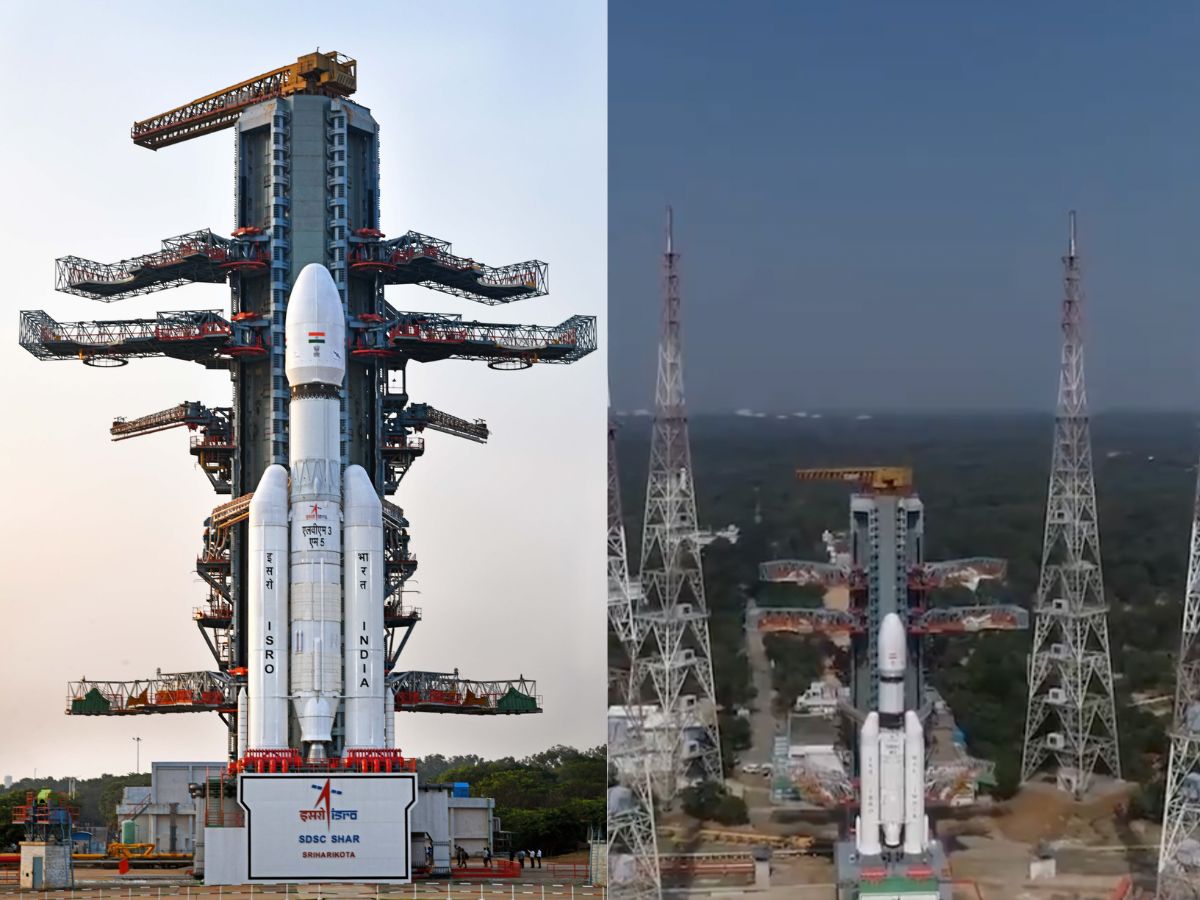
CMS-03 is here. Bigger bandwidth, secure comms, and stronger seas. (Photo: X/ISRO)
India will take a giant leap in maritime defence communication today with the Indian Space Research Organisation launching CMS-03, the country’s heaviest military communication satellite, from the powerful ‘Bahubali’ rocket – Launch Vehicle Mark-3 (LVM-3).
The launch is scheduled for 5:26 pm from the Satish Dhawan Space Centre in Sriharikota, Andhra Pradesh.
The CMS-03, also known as GSAT-7R, has been launched to a Geosynchronous Transfer Orbit weighing about 4,400 kg, making it India’s heaviest communication satellite ever.
The satellite is especially configured for the Indian Navy to ensure secure communication of voice, data, and video information over C, extended C, and Ku bands.
It will provide seamless connectivity within 2,000 km of India’s coastline, thus strengthening surveillance, naval coordination, and network-centric warfare capabilities.
The CMS-03 will replace the Navy’s first dedicated communications satellite, the GSAT-7 “Rukmini”, which has been in operational service since 2013. Rukmini played an important role in various naval operations, including Operation Sindoor, by linking naval warships, aircraft, and command centers.
The LVM-3 stands 43.5 metres tall, as high as a 15-storey building.
Weighs 642 tonnes equivalent to around 150 adult Asian elephants.
Known for a 100% success record in its previous seven launches.
Carried the historic Chandrayaan-3 mission in 2023, making India the first country to land near the Moon’s south pole.
This is the eighth flight of LVM-3 and the fifth operational mission of this rocket model.
CMS-03 is expected to provide expanded bandwidth and stronger encryption;
Enhance real-time coordination amongst naval vessels, submarines, aircraft, and ground stations.
Improve maritime surveillance in the Indian Ocean and critical sea lanes.
Strengthen India’s presence in the Indo-Pacific amidst growing geopolitical tensions.
The Indian Space Research Organisation confirmed that the rocket has been integrated with the spacecraft and placed on the launch pad on October 26. The 16-minute flight will largely run on India’s homegrown cryogenic engine.
A Step Toward Gaganyaan The human-rated version of LVM-3 is set to carry Indian astronauts into space under the Gaganyaan mission, placing India among an elite group of countries capable of crewed spaceflight.
ALSO READ: Raj Thackeray Stuns Politics: Joins Opposition Alliance In Shocking ‘March For Truth’ Move
Sofia Babu Chacko is a journalist with over five years of experience reporting on Indian politics, crime, human rights, gender issues, and stories about marginalized communities. She believes journalism plays a crucial role in amplifying unheard voices and bringing attention to issues that truly matter. Sofia has contributed articles to The New Indian Express, Youth Ki Awaaz, and Maktoob Media. She is also a recipient of the 2025 Laadli Media Awards for gender sensitivity. Beyond the newsroom, she is a music enthusiast who enjoys singing. Connect with Sofia on X: https://x.com/SBCism
Bengaluru Weather Today June 16: Rain Triggers Waterlogging Across City
Heavy rainfall has led to waterlogging at more than 100 locations across Bengaluru, affecting traffic…
Indian-origin footballer Sarpreet Singh started for New Zealand against Iran in the FIFA World Cup…
Stocks To Watch Today: HCL Tech, SBI, Adani Enterprises, Vedanta In Focus
Stocks to watch today: HCLTech, SBI, Adani, Airtel, Vedanta, GIC Re, Waaree and more amid…
