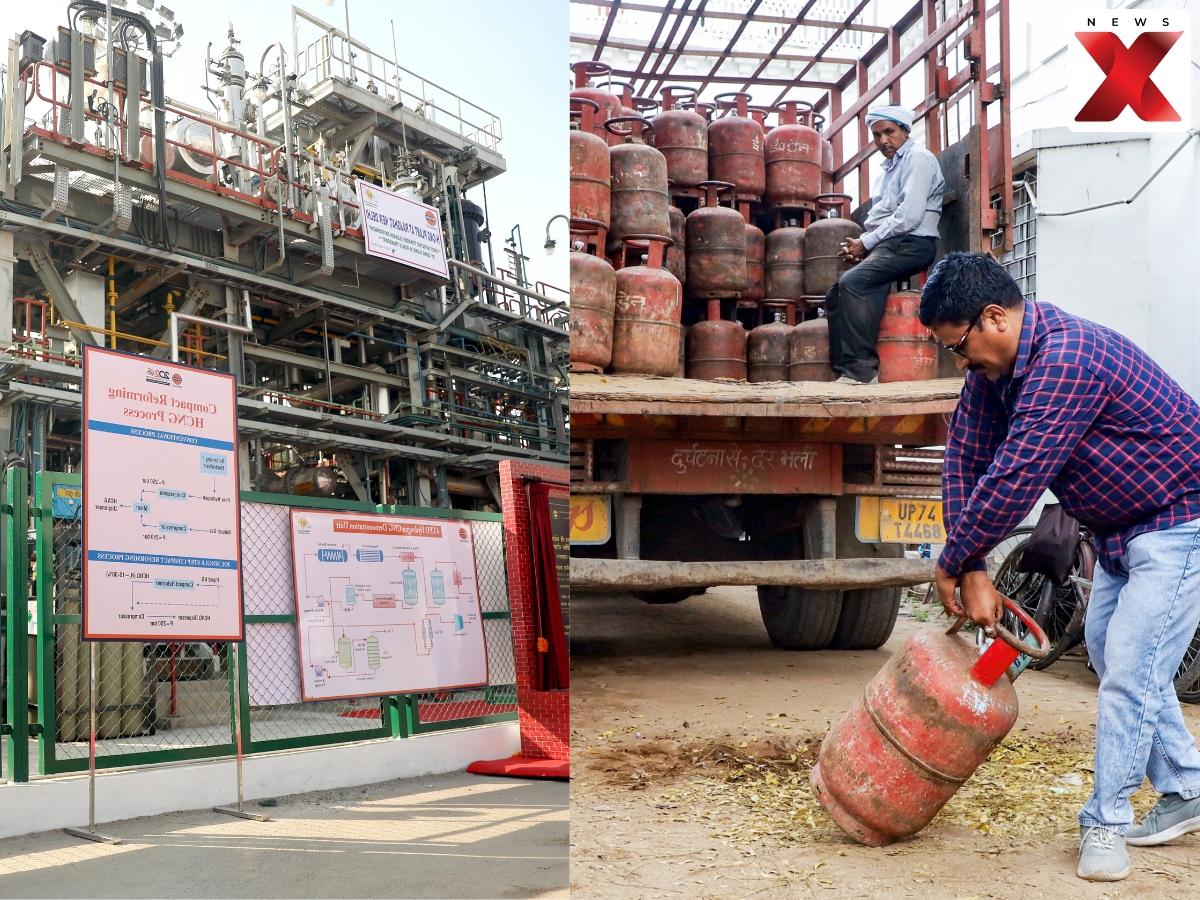
LPG crisis raises questions about LNG, PNG and CNG as Iran–US–Israel conflict disrupts supplies via the Strait of Hormuz. Photos: ANI.
A sudden disruption in commercial LPG supplies has forced hotels and restaurants in several major Indian cities to shut their kitchens, as the war between Iran and the US-Israel continues on Day 12.
Union Minister Piyush Goyal attempted to calm concerns over the situation, stating that there is “absolutely no shortage of fuel” and that further details are being worked out. However, the disruption has already begun to affect businesses across cities such as Bengaluru, Mumbai, Chennai and Jaipur, where commercial kitchens have reportedly been forced to halt operations.
India is facing an LPG shortage due to shipping routes through the strategically vital Strait of Hormuz.
India relies heavily on LPG imports, bringing in roughly 62% of the 31.3 million tonnes of LPG it consumes annually. A significant portion of these imports passes through the Strait of Hormuz.
Compounding the situation, Iraq has reportedly cut production at its southern oilfields by 70%, while Kuwait has declared force majeure, further tightening global supply conditions.
In response to the emerging supply pressure, the Indian government has invoked the Essential Commodities Act (ECA) to prioritise household LPG distribution over commercial consumption.
Authorities have directed refineries across the country to operate at full capacity and channel increased production specifically toward domestic consumers.
To prevent panic buying and hoarding, officials have also extended the mandatory booking interval for LPG cylinders from 21 days to 25 days.
The situation has also highlighted an important question – what are the various gas-based energy sources used across India, and why are they critical to the country’s energy security?
Most Indian households are familiar with the red LPG cylinder used in kitchens. Many urban commuters rely on CNG to power vehicles, while several cities have increasingly shifted toward PNG pipelines for cooking gas supply. Meanwhile, LNG shipments arrive at India’s coastal terminals to fuel industries and power plants.
Although the names, LPG, LNG, PNG and CNG, sound similar, they represent different forms of fuel designed for specific uses. Together, these fuels form a crucial part of India’s gas economy.
One of the biggest advantages of Piped Natural Gas (PNG) during a supply disruption is its largely invisible supply chain.
Unlike LPG, which depends on an extensive logistics network of trucks, bottling plants and delivery personnel, PNG flows continuously through an underground pipeline network.
This means PNG users are not affected by the newly imposed 25-day inter-booking rule that many LPG consumers are currently facing. While cylinder users monitor delivery apps and stand in queues, PNG consumers continue receiving a steady supply based on their six-month average consumption.
Because PNG is delivered through fixed infrastructure, it is largely insulated from road transport disruptions and last-mile delivery problems that often occur during national emergencies.
From a safety perspective, PNG also offers certain advantages, particularly during periods of heightened stress and emergency response constraints.
Natural gas is lighter than air. In the event of a leak, it rises and disperses quickly provided there is sufficient ventilation. LPG, on the other hand, is heavier than air and tends to accumulate near the floor, increasing the risk of fire hazards in confined spaces.
PNG is also supplied at relatively low pressure, about 21 millibars. In contrast, LPG cylinders store gas in a highly compressed and liquefied state.
While LPG, CNG and PNG are fuels used directly by consumers, Liquefied Natural Gas (LNG) plays a different role in India’s broader energy ecosystem.
LNG is natural gas cooled to extremely low temperatures, around minus 162 degrees Celsius, which converts it into liquid form. This process dramatically reduces its volume, allowing it to be transported efficiently across long distances by ship.
India imports LNG from several countries through coastal terminals operated by companies such as Petronet LNG.
Once LNG cargo arrives at these terminals, the liquid fuel is regasified, converted back into natural gas, before being supplied to industries, power plants and city gas distribution networks.
In practical terms, LNG is rarely used directly by households. Instead, it feeds the broader gas infrastructure that powers multiple sectors of the Indian economy.
Zubair Amin is a Senior Journalist at NewsX with over seven years of experience in reporting and editorial work. He has written for leading national and international publications, including Foreign Policy Magazine, Al Jazeera, The Economic Times, The Indian Express, The Wire, Article 14, Mongabay, News9, among others. His primary focus is on international affairs, with a strong interest in US politics and policy. He also writes on West Asia, Indian polity, and constitutional issues. Zubair tweets at zubaiyr.amin
Neena Gupta laughed off viral rumours claiming she was pregnant at 66 after photos from…
IPL 2026 will begin on March 28 with Royal Challengers Bengaluru facing Sunrisers Hyderabad at…
Monalisa Bhosle, the viral “Kumbh Mela girl,” married her Muslim boyfriend Farman Khan in Thiruvananthapuram…
