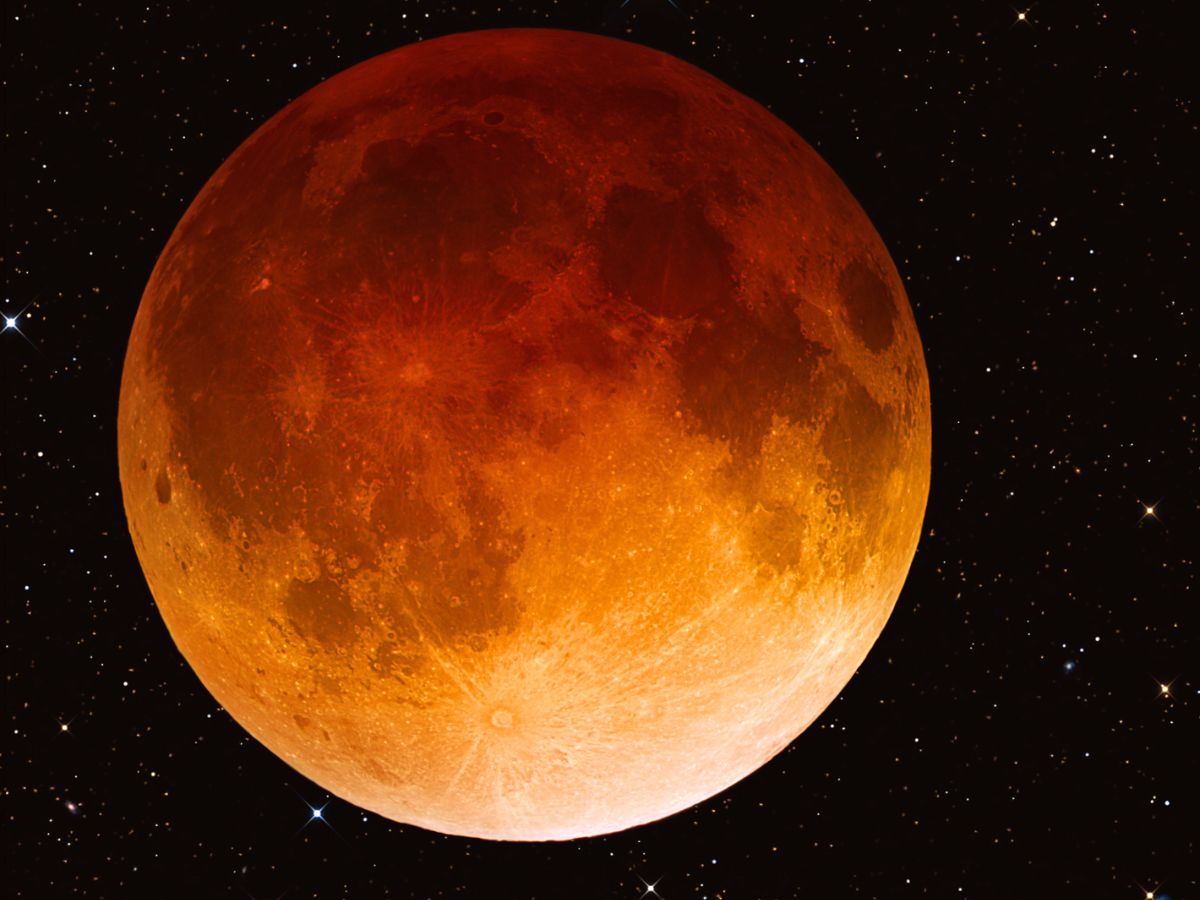
Total Lunar Eclipse 2026 on March 3 visible in India. (Photo: Wiki, Canva)
India will witness its first Total Lunar Eclipse of 2026 on March 3, and the celestial event coincides with the festival of Holi, adding cultural significance to astronomical excitement.
The eclipse will be visible across many parts of the country, with Northeast India getting the best view.
Here’s a complete guide to city-wise timings, visibility details, Sutak Kaal, and safe viewing tips.
According to Drik Panchang, the eclipse will unfold in multiple phases:
Penumbral Eclipse Begins: 2:14 PM
Partial Eclipse Begins: 3:30 PM
Total Eclipse Begins: 4:58 PM
Maximum Eclipse: 5:25 PM
Total Eclipse Ends: 5:32 PM
Partial Eclipse Ends: 6:47 PM
Penumbral Eclipse Ends: 7:53 PM
However, since the Moon rises in the evening in India, most cities will witness only the later stages of the eclipse.
Yes, the March 3 Total Lunar Eclipse will be visible in India.
Northeast India will witness the most dramatic phase, including totality at moonrise.
Eastern, Northern, Western, and Southern regions will mostly see the partial eclipse.
In many cities, the Moon will rise already partially or totally eclipsed a phenomenon known as a Grastodaya Eclipse.
City-Wise Moonrise Timings and Visibility in India
Guwahati – 5:45 PM: Total eclipse at moonrise
Dibrugarh – 5:40 PM: Deep totality visible
Itanagar – 5:35 PM: Total eclipse at moonrise
Shillong – 5:44 PM: Blood Moon visible
Residents here may see a striking copper-red Moon rising in the eastern sky.
Kolkata – 6:00 PM: Late total or partial phase
Bhubaneswar – 6:05 PM: Partial eclipse
Patna – 6:12 PM: Partial eclipse
New Delhi – 6:26 PM: Ending partial phase
Jaipur – 6:28 PM: Partial eclipse
Lucknow – 6:18 PM: Partial eclipse
Bhopal – 6:24 PM: Partial eclipse
In several northern cities, totality may end before moonrise.
Mumbai – 6:30 PM: Late partial phase
Ahmedabad – 6:35 PM: Brief partial phase
Pune – 6:32 PM: Final partial phase
Chennai – 6:15 PM: Partial eclipse
Bengaluru – 6:28 PM: Partial eclipse
Hyderabad – 6:22 PM: Partial eclipse
Thiruvananthapuram – 6:23 PM: Partial eclipse
A Grastodaya eclipse occurs when the Moon rises while it is already eclipsed. On March 3, many Indian cities will not witness the beginning of the eclipse. Instead, the Moon will appear above the horizon already darkened or partially covered by Earth’s shadow.
During a total lunar eclipse, the Moon can appear red or copper-colored, earning the name “Blood Moon.”
This happens because:
Earth blocks direct sunlight from reaching the Moon.
Earth’s atmosphere filters out blue light.
Red light bends and reaches the Moon.
This is the same reason sunsets appear red.
As per Drik Panchang, the Sutak Kaal for a lunar eclipse begins approximately 9 hours before the eclipse starts.
Sutak Begins: 6:20 AM on March 3, 2026
Sutak Ends: After the eclipse concludes in the evening
Those observing religious customs may follow specific restrictions during this period, depending on regional traditions.
A lunar eclipse is completely safe to watch with the naked eye.
Unlike a solar eclipse, no special glasses or protective filters are required.
You can also use:
Binoculars
A telescope
A smartphone camera for photography
Step outside around your city’s moonrise time.
Look towards the eastern horizon.
Choose a location with minimal light pollution.
Check local weather forecasts for clear skies.
If cloudy, live streams may be available from global space agencies like NASA.
It is the first Total Lunar Eclipse of 2026.
It falls on Holi, making it culturally significant in India.
Northeast India gets a rare and dramatic totality view at moonrise.
It appears as a rare Grastodaya eclipse in many cities.
For skywatchers, photographers, and festival observers, March 3, 2026, promises a memorable blend of celebration and celestial spectacle. Mark your calendar, check your city’s exact timings, and step out to witness this stunning cosmic event safely with the naked eye.
Sofia Babu Chacko is a journalist with over five years of experience covering Indian politics, crime, human rights, gender issues, and stories about marginalized communities. She believes that every voice matters, and journalism has a vital role to play in amplifying those voices. Sofia is committed to creating impact and shedding light on stories that truly matter. Beyond her work in the newsroom, she is also a music enthusiast who enjoys singing.
KKR Pacer Umran Malik Leaks 36 in One Over, 59 in Two During DY Patil T20 Cup Spell
Umran Malik endured a tough day in the DY Patil T20 Cup, conceding 36 runs…
India, Israel sign key MoUs from agriculture to AI, UPI linkage, boosting tech, trade and…
NSSNET 2026: Registration Begins for Classes 6–7 Admissions, Important Dates And Direct Link Here
The National Testing Agency (NTA) has officially opened NSSNET 2026 registration for admissions to Class…
