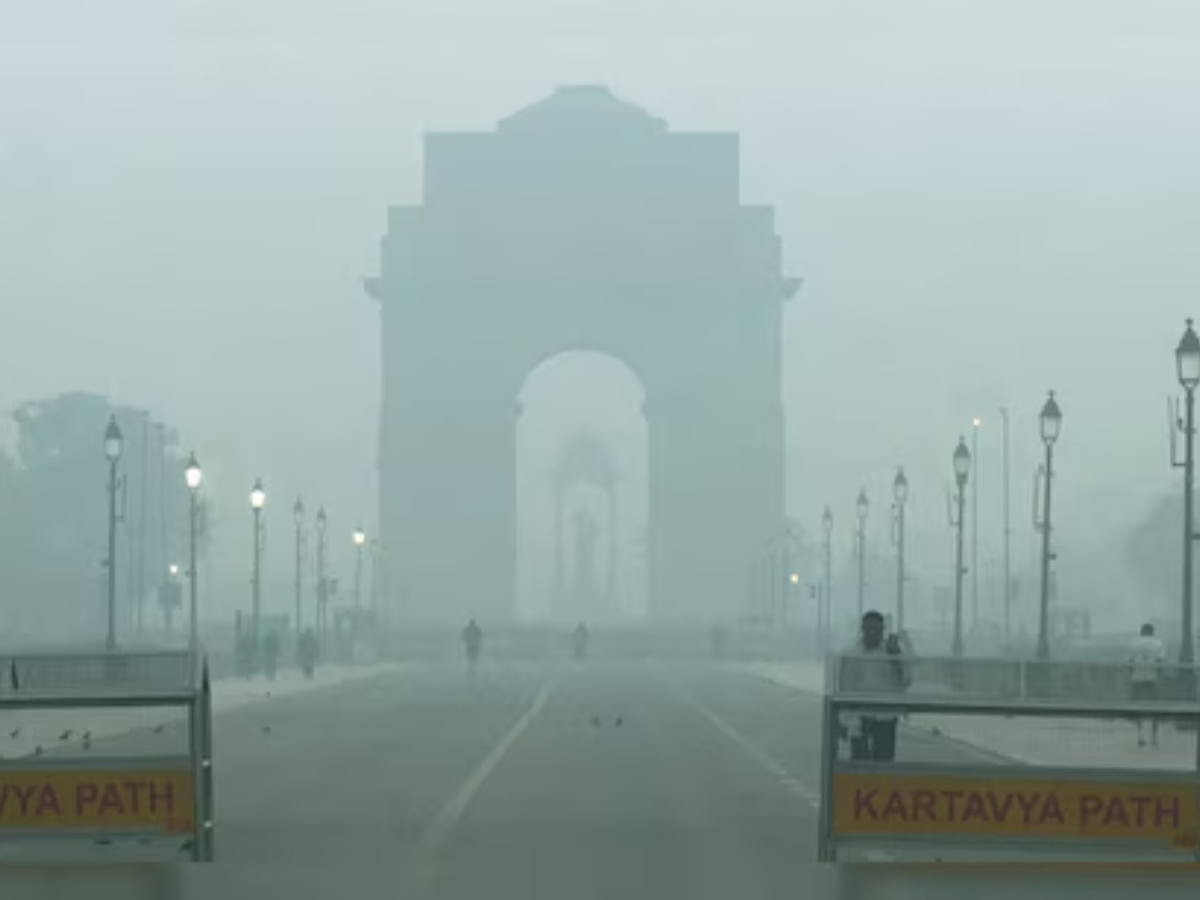
Delhi's Air Quality Sees Minor Uptick, AQI At 370, Still Remains In 'Very Poor' Zone (Pic Credit: ANI)
Delhi’s air quality plunged to ‘Severe’ levels for the first time this season on Monday, prompting authorities to implement Stage 3 of the Graded Response Action Plan (GRAP).
According to the Commission for Air Quality Management (CAQM), the city’s overall Air Quality Index (AQI) reached 425, triggering the enforcement of GRAP-3 measures. The step aims to curb emissions and control pollution as the toxic haze continues to blanket the national capital.
Despite the current spike, long-term data suggests a marginal improvement in Delhi’s air quality compared to last year. Between January 1 and November 9, 2025, the city’s average AQI stood at 175, compared to 189 during the same period in 2024.
As per the Ministry of Environment, Forest and Climate Change, the average PM2.5 concentration level was recorded at 75 µg/m³ and PM10 at 170 µg/m³, lower than last year’s 87 µg/m³ and 191 µg/m³, respectively.
Authorities have also noted a significant reduction in stubble-burning incidents, a major contributor to Delhi-NCR’s air pollution.
From September 15 to November 9, 2025, Punjab reported 4,062 farm fire cases, marking a 35.2% drop from 6,266 cases in the same period last year. Similarly, Haryana registered 333 incidents, a 65.3% decline from 959 in 2024.
The CAQM is working closely with officials from both states and other concerned agencies to ensure strict enforcement of anti-burning measures and pollution-control directives on the ground.
The Graded Response Action Plan (GRAP) is a four-tier emergency framework developed to combat air pollution in the Delhi-NCR region. It prescribes specific actions depending on the level of air quality:
Stage 1 – Poor (AQI 201–300)
Stage 2 – Very Poor (AQI 301–400)
Stage 3 – Severe (AQI 401–450)
Stage 4 – Severe Plus (AQI above 450)
Currently, with the AQI above 400, Stage 3 restrictions have been implemented.
Under Stage 3, a series of stringent measures are in force to control emissions and reduce public exposure to toxic air:
Certain essential public projects are exempted from the ban. Activities related to railways, metro expansion, airports, defence, sanitation, and healthcare facilities are allowed to continue, provided they comply with strict dust and waste management guidelines.
READ MORE: Delhi Blast: Lal Qila Metro Station Shut Amid After Car Explosion In Red Fort Vicinity
West Bengal Yuva Sathi scheme offers ₹1500 monthly aid to unemployed youth. Here’s how to…
Bihar Civil Court Peon Admit Card 2026 Out: Check Exam Details, And Direct Link To Download
The Bihar Civil Court has issued the Peon (Attendant) Admit Card 2026 for candidates who…
In Delhi’s Uttam Nagar, a dispute between two families escalated into a violent clash that…
