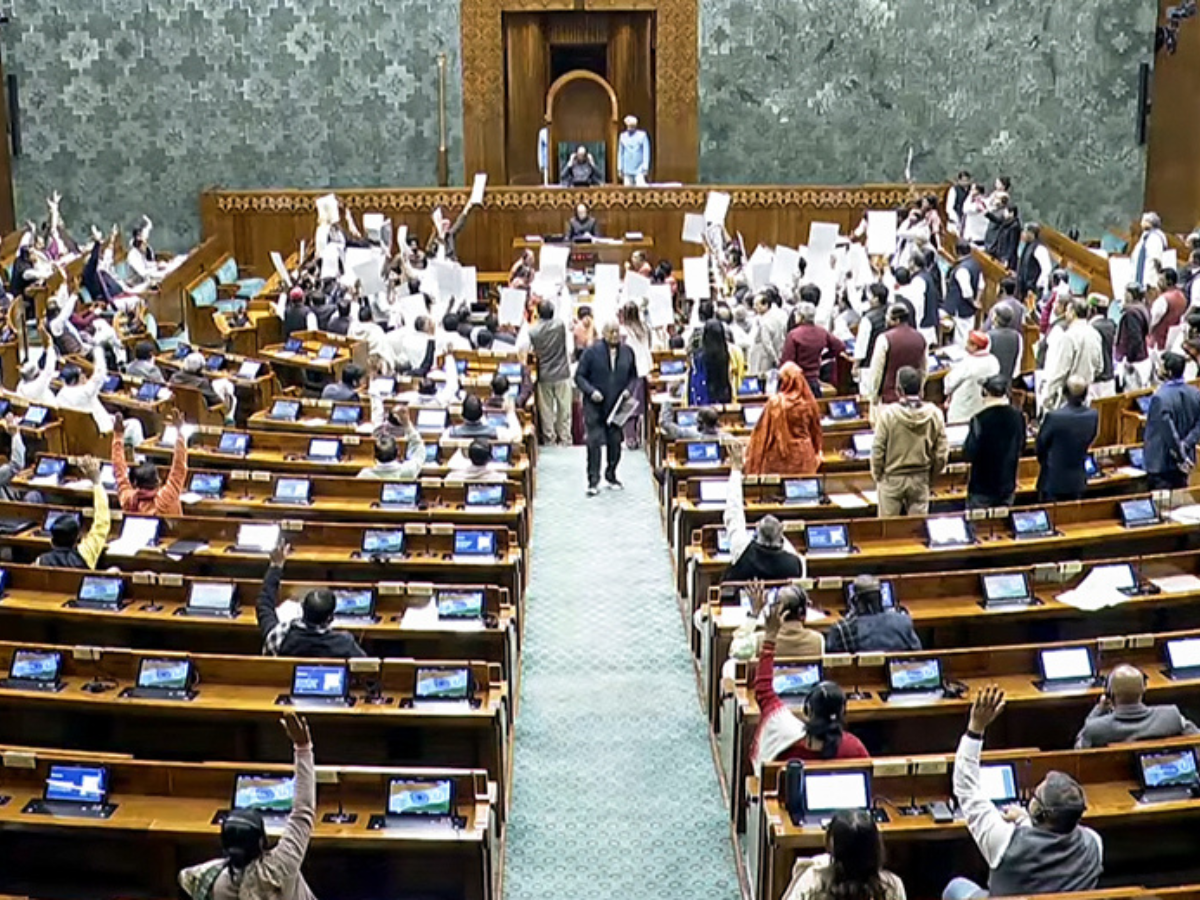
VB-G RAM G Bill Gets President’s Nod, Replaces MGNREGA. (Image: ANI, File Photo)
President Droupadi Murmu on Sunday gave assent to the Viksit Bharat Guarantee for Rozgar and Ajeevika Mission (Gramin) (VB G RAM G) Bill, 2025, marking a significant milestone in the transformation of rural employment policy, as per a release by the President’s Secretariat.
The Act replaces the Mahatma Gandhi National Rural Employment Guarantee Act (MGNREGA), 2005, with a modern statutory framework that enhances livelihood security and is aligned with the national vision of Viksit Bharat @2047.
Anchored in the principles of empowerment, growth, convergence and saturation, the Act seeks to transform rural employment from a standalone welfare intervention into an integrated instrument of development. It strengthens income security for rural households, modernises governance and accountability, and links wage employment with the creation of durable and productive rural assets, thereby laying the foundation for a prosperous and resilient Rural Bharat.
The Act provides a statutory guarantee of at least 125 days of wage employment per rural household in each financial year to households whose adult members volunteer to undertake unskilled manual work.
The Act mandates payment of wages every week or, in any case, within fifteen days of completion of work. In cases of delay beyond the stipulated period, delay compensation shall be payable in accordance with the provisions of Schedule II, thereby reinforcing wage security and protecting workers from delays.
All works are planned through a bottom-up process, and all assets created are aggregated into the Viksit Bharat National Rural Infrastructure Stack, ensuring convergence of public investments, avoidance of fragmentation, and outcome-based planning aimed at saturation of critical rural infrastructure, based on varying local needs.
All works originate from Viksit Gram Panchayat Plans (VGPPs), prepared at the Gram Panchayat level through participatory processes and approved by the Gram Sabha.
These plans are digitally and spatially integrated with national platforms, including PM Gati Shakti, enabling whole-of-government convergence while fully retaining decentralised decision-making.
The Act is implemented as a Centrally Sponsored Scheme, to be notified and operationalised by the State Governments in accordance with the provisions of the Act. The cost-sharing pattern is 60:40 between the Centre and States, 90:10 for North Eastern and Himalayan States, and 100% central funding for Union Territories without legislatures. The administrative expenditure ceiling has been enhanced from 6% to 9%, enabling improved staffing, training, technical capacity and field-level support, and strengthening the ability of institutions to deliver outcomes effectively.
The Viksit Bharat – Guarantee for Rozgar and Ajeevika Mission (Gramin) Act, 2025, represents a decisive step towards renewing and strengthening India’s rural employment framework in line with the vision of Viksit Bharat @2047.
The Act does not dilute the right to demand employment. On the contrary, it places a clear statutory obligation on the government to provide not less than 125 days of guaranteed wage employment to eligible rural households. The expansion of guaranteed days, together with strengthened accountability and grievance redressal mechanisms, reinforces the enforceability of this right.
Technology under the Act is intended as an enabling mechanism, not a barrier. Sections 23 and 24 provide for technology-enabled transparency through biometric authentication, geo-tagging and real-time dashboards, while Section 20 strengthens social audits by Gram Sabhas, ensuring community oversight, transparency and inclusion.
The Act removes earlier disentitlement provisions and restores unemployment allowance as a meaningful statutory safeguard. Where employment is not provided within the stipulated period, the unemployment allowance becomes payable after fifteen days.
The passage of the Viksit Bharat – Guarantee for Rozgar and Ajeevika Mission (Gramin) Act, 2025, represents a significant renewal of India’s rural employment guarantee.
(With Inputs from ANI)
Bangladeshi actress Arohi Mim is trending online after rumours linked her to a viral “3…
Bengaluru to face 24-hour water cut Feb 5–6 and 7-hour power outages Feb 6–7 as…
Smriti Mandhana–Palash Muchhal’s Cancelled Wedding: Actor Nandish Sandhu Spills Beans on The Breakup
According to Nandish Sandhu, the postponement was initially attributed to a medical emergency in Smriti…
