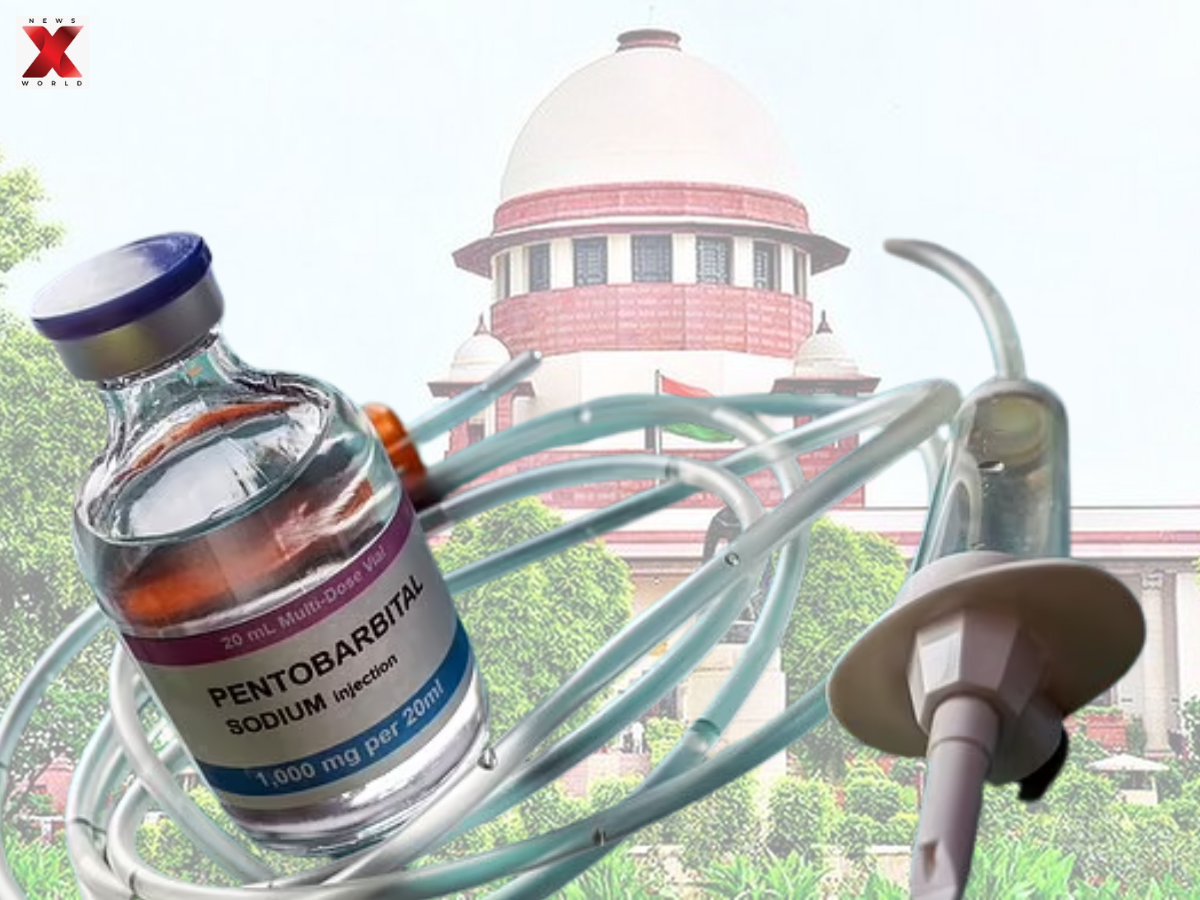
The court observed that his health condition has continued to deteriorate ( PHOTO: REPRESENTATIONAL IMAGE)
On Thursday, the Supreme Court instructed the Noida district hospital to establish a primary medical board to consider the petition of passive euthanasia of a 31-year-old man who is 100 per cent disabled because of quadriplegia and who has been in a vegetative state of existence over ten years.
The court noted that his health status has been steadily getting worse and requires urgent medical examination in the course of the legal procedure.
Passive euthanasia refers to the act of letting a patient die through the withdrawal or failure to initiate treatment or life support machines to keep the patient alive. It is not associated with some lethal injection or drug.
The district hospital in Sector 39, Noida, was directed by a bench comprising Justice JB Pardiwala and Justice KV Viswanathan to provide its report in two weeks.
This was in lieu of an application filed by the father of Harish Rana who asked the court to permit passive euthanasia to his son because of his ever deteriorating condition.
The medical board was also clearly instructed by the Supreme Court and said,
We would like the primary board to make us have a report that the life-sustaining treatment may be withheld. with the primary board leave their report on the first, and when they are presented before us, we will then order further. and cause this exercise to be done in two weeks,
This is a second approach of the same request in two years where the parents have addressed the Supreme Court on the passive euthanasia of the son.
Previously, the Supreme Court had heard a report by the Union Health Ministry, on November 8 last year, which recommended that Harish Rana should still be staying in home care with the support of the Uttar Pradesh government and the frequent visits of a doctor and physiotherapist.
The court also had said that in case he could not be given home care, he would be transferred to Noida district hospital to ensure that proper medical services were provided.
In the hearing, the advocate Rashmi Nandakumar who defended the father told the court that regardless of all the efforts the family puts in and with the support of the state government, the patient is not getting better.
She said, “Nowadays, the thing that is occurring is that he is getting sick very frequently and has been taken to the hospital. What I seek is that his case, according to the judgment of this court in common cause case (2018 decision), should be sent to a primary board. Should the doctors suspect that he might be withheld treatment, then the second step would be the constitution of the secondary board and then the case will be presented before the secondary board, and then he can be deprived of treatment.”
She also explained that the family did not require an active euthanasia and that she added, “The counsel added that she did not demand active euthanasia but passive euthanasia of the son where the judgement of this court says that the life treatment may be withheld to terminate the suffering.”
Justice Pardiwala on reading the reports and medical history expressed a lot of concern and remarked, “Look at what has happened to the boy. It’s pathetic.”
The bench also instructed that a copy of its order be promptly forwarded to the Naidia district hospital and also to the office of Additional Solicitor General Aishwarya Bhati to ensure that it is complied and monitored.
As indicated in the case history, on August 20 last year, the Supreme Court had termed the issue very hard and they had requested the Centre to respond to the petition of parents.
In 2013, Harish Rana, a student of Punjab University sustained severe injuries to his head after falling off the fourth floor of his paying guest house. He has been in a complete state of bed since then and has been in a dependency of artificial medical assistance more than 12 years.
The Supreme Court had already voted in favor of the Delhi High Court that had denied the formation of a medical board to discuss passive euthanasia.
This was stated to be because Rana was neither on a ventilator nor a mechanical life-support and was being fed via a food pipe, which did not consider her to be passive euthanasia as defined by legal standards.
The court however was sympathetic of the parents, by saying that the patient was in a sustained vegetative state more than ten years and that the family went as far as selling their house to cover his medical bills.
Last year in July, the Delhi High Court turned down the parents plea saying that Rana was not under life support machines and she could survive in basic ways without mechanical support.
Euthanasia is a term that has a Greek origin; it is translated as good death or deliberate killing of someone to bring to an end, unbearable suffering, which can be caused by incurable or terminal diseases.
It may be defined as a painless, premeditated practice to abate life with the main purpose of relieving physical, emotional, or spiritual suffering.
Types: In a broad categorization, euthanasia can be divided into the following types according to to consent and method.
Based on consent :
Voluntary Euthanasia: This is done under the informed consent of a mentally competent patient who requests to take his or her own life.
Non-voluntary Euthanasia: It is performed in situations where the patient is incapable of consent (e.g. unconscious or mentally incapacitated), and a surrogate decision-maker permits it.
Involuntary Euthanasia: It is carried out against the will of the patient or without seeking his/her consent, it is illegal and ethically wrong.
Active Euthanasia: Intentionally killing an individual by performing such actions as using deadly drugs was regarded as a crime punishable by the Indian Penal Code (IPC).
The new BNS follows this position and makes active euthanasia a crime to avoid abuse and preserve life.
Bharatiya Nyaya Sanhita, sections 100 and 101 of BNS define culpable homicide and murder that is, any homicide, the euthanasia included, is classified as a crime except when it is a part of some legal exceptions.
Passive Euthanasia: It is legally allowed because the historic Supreme Court ruling on Aruna Shanbaug v. Common Cause v. (2013) and explicated further by Union of India (2011). Passive euthanasia is when life-sustaining care is withheld or taken away and the patient dies naturally (Union of India, 2018).
Ethical/ Moral opposition: euthanasia is taken by many members of the Indian society to be ethically wrong because of the sanctity of life and its inviolable nature.
Religion and cultural orientation are strongly against positive ending of life as it is synonymous to killing.
Risk of Abuse and Coercion: The elderly, the disabled, and financially dependent are vulnerable groups that may be pressured or coerced into the decision of euthanasia.
In India, as socioeconomic differences and unequal access to healthcare and services are present, family members or caregivers might make decisions based on financial, emotional, or practical reasons and undermine the actual autonomy of the patient.
This kind of coercion might result in unethical practices and violation of the idea of voluntary choice.
Problem with Assessing Mental Capacity: It is necessary to carry out psychiatric tests to be sure that patients who demand euthanasia are of sound mind and that they are making rational choices.
Nevertheless, psychiatrists in India claim that they do not feel sufficiently confident with the diagnosis of depression or even with the identification of coercion in subtle forms and terminally-ill patients.
This makes it more probable that unsuitable decisions on euthanasia will be given, and it may lead to ethical and legal issues on the part of medical practitioners.
Laws and the Criminalisation: According to the Indian Penal Code, active euthanasia and assisted suicide is a criminal act.
The Bharatiya Nyaya Sanhita (BNS), 2023 may be used to prosecute acts that constitute active euthanasia or assisted suicide.
The definition in section 100 and 101 of the BNS constitute culpable homicide and murder and therefore any killing, including euthanasia, will become a criminal offence unless it qualifies within the stated exceptions. Also, Section 108 criminalises abetment of suicide, which complicates the legal system of active euthanasia.
There is no representation of a firm legislation to control euthanasia, which creates uncertainties and danger to practitioners.
West Bengal Yuva Sathi scheme offers ₹1500 monthly aid to unemployed youth. Here’s how to…
Bihar Civil Court Peon Admit Card 2026 Out: Check Exam Details, And Direct Link To Download
The Bihar Civil Court has issued the Peon (Attendant) Admit Card 2026 for candidates who…
In Delhi’s Uttam Nagar, a dispute between two families escalated into a violent clash that…
