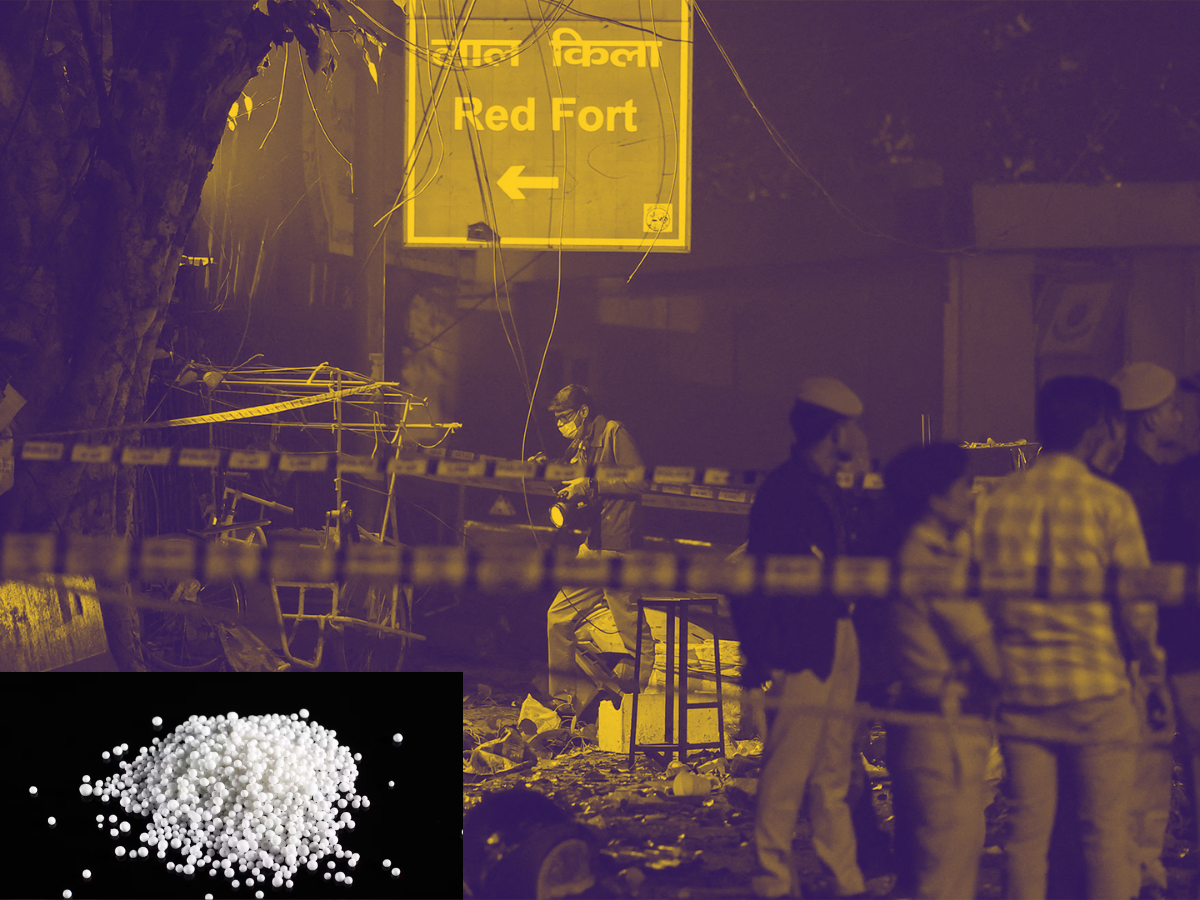
What Is Ammonium-Nitrate Fuel-Oil?
Investigators probing the Red Fort blast in Delhi have confirmed that the explosion involved Ammonium-Nitrate Fuel-Oil (ANFO) and detonators. The high-intensity blast on November 10, 2025, killed nine people and injured more than twenty. Forensic experts found traces of ammonium-nitrate near the site, indicating the use of ANFO, a widely used industrial explosive.
Now the question arises,
The substance is known for its cost-effectiveness and destructive power. Officials said the explosion’s strength suggested a carefully planned act involving improvised explosive devices. Investigations continue to determine how the materials were procured and assembled.
Ammonium-nitrate (NH4NO3) is a white crystalline compound mainly used as a nitrogen-based fertiliser in agriculture. On its own, it is stable and does not explode easily. When mixed with fuel oil, it forms Ammonium-Nitrate Fuel-Oil (ANFO), a bulk industrial explosive.
ANFO usually contains 94% ammonium-nitrate and 6% fuel oil. The fuel oil is absorbed into small, porous ammonium-nitrate particles. The explosive requires a detonator or booster to trigger the reaction. Despite its industrial utility, its accessibility makes it a potential component for creating improvised explosive devices.
The power of an ANFO blast lies in the rapid chemical reaction between ammonium-nitrate and fuel oil. When ignited, the combination releases gases like nitrogen, carbon dioxide, and steam, creating a high-pressure shock wave. ANFO detonates at around 3,200 meters per second, producing a force capable of severe structural damage.
The confined nature of the explosion amplifies its destructive capacity. The process also emits toxic gases such as carbon monoxide and nitrogen oxides. The explosion propagates through a supersonic shock wave, releasing energy in microseconds and creating massive impact zones.
Terror outfits have repeatedly used ANFO due to its low cost, easy availability, and stability during storage. The explosive’s high destructive potential makes it ideal for improvised explosive devices (IEDs). Its use in the Red Fort blast mirrors several past terror incidents involving similar materials.
Authorities confirmed that the Delhi explosion matched the chemical and structural profile of ANFO-based devices. Forensic experts believe detonators triggered the explosion. Investigators are examining possible cross-border connections and supply chains of the materials involved.
Security agencies have tightened monitoring of ammonium-nitrate movement nationwide.
Officials identified the suspected attacker as Dr. Mohammad Umar, who allegedly operated alone in a Hyundai i20 that exploded near the Red Fort. Preliminary findings linked him to a recently busted terror module in Faridabad. Authorities said Umar transported the explosive materials and assembled the device independently. The probe focuses on uncovering his connections and the logistics behind the attack.
Indian laws classify any mixture containing more than 45% ammonium-nitrate as an explosive. The regulation aims to prevent illegal use while maintaining its industrial applications in mining and construction.
The Red Fort explosion underscores the dual-use risk of industrial chemicals like ammonium-nitrate. While it serves vital functions in mining and construction, its misuse poses serious threats. Authorities have called for stronger enforcement of licensing and transport regulations. Security agencies are reviewing supply chains to identify gaps in monitoring. Forensic teams continue to analyse debris samples to confirm the explosive’s composition. Officials emphasised that stringent controls and awareness among handlers are essential to prevent further misuse of such substances in potential terror activities.
Must Read: Predictable Tactic’: MEA India Slams Pakistan For False Claim On Involvement In Islamabad Blast
Swastika Sruti is a Senior Sub Editor at NewsX Digital with 5 years of experience shaping stories that matter. She loves tracking politics- national and global trends, and never misses a chance to dig deeper into policies and developments. Passionate about what’s happening around us, she brings sharp insight and clarity to every piece she works on. When not curating news, she’s busy exploring what’s next in the world of public interest. You can reach her at [swastika.newsx@gmail.com]
Jab Khuli Kitaab X review: Fans praise touching narrative and stellar performances by Pankaj Kapur…
Many militias in Iraq that are closely linked to Iran are currently hesitant to join…
MP Apex Bank Recruitment 2026: Last Chance to Apply for 2,076 Vacancies
The Madhya Pradesh Rajya Sahakari Bank Limited (MP Apex Bank) will close the registration window…
