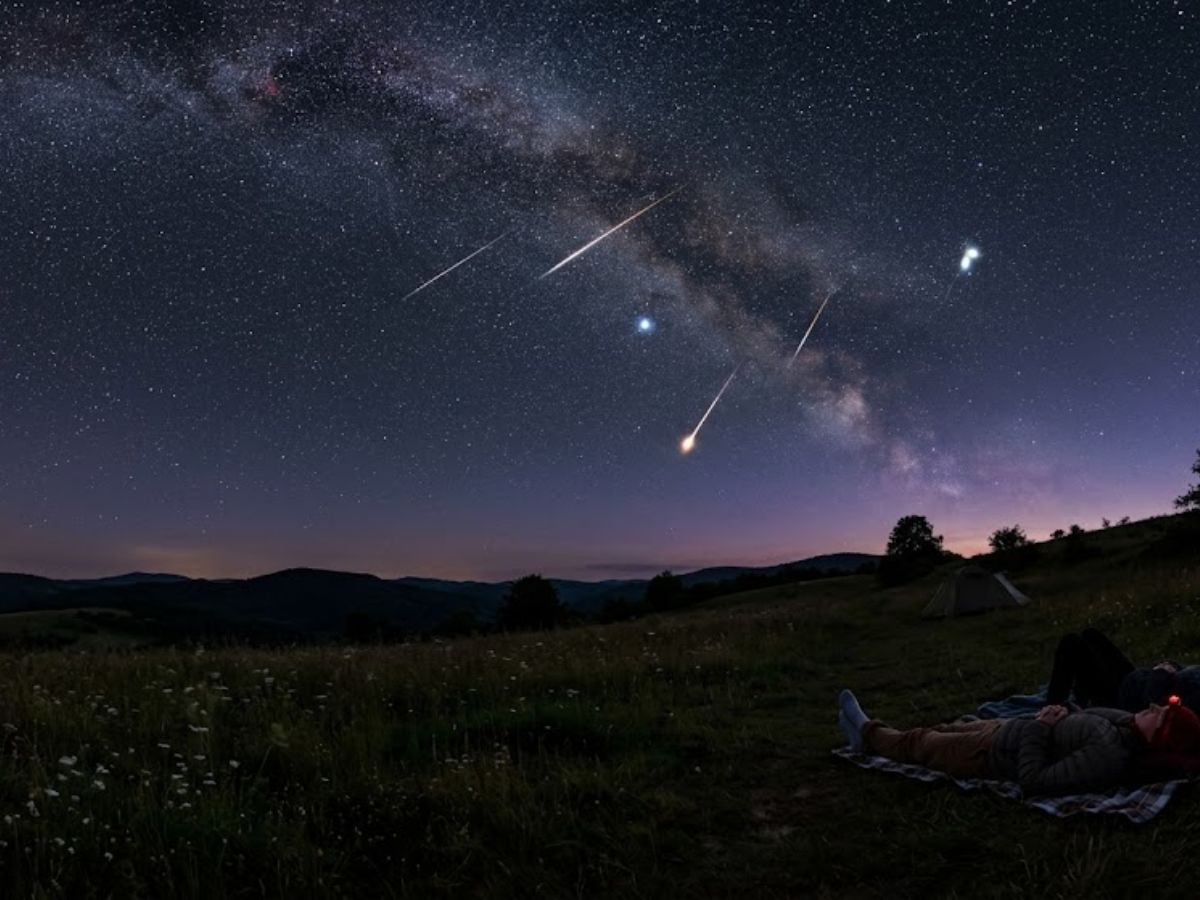
Lyrid meteor shower peaks April 21-22. Check best time in India, visibility, tips, and how to watch shooting stars. Photo: Gemini.
Lyrid Meteor Showers: A NASA astronaut has offered a rare glimpse of what a meteor shower looks like from orbit, sharing striking images that reveal “shooting stars” from a perspective few will ever witness. Jessica Meir, who was aboard the International Space Station, documented the ongoing Lyrid meteor shower from space. Posting about her experience, she said she successfully photographed meteors during the annual celestial event. She explained that the images were captured from the station’s cupola. Skywatchers have a chance to witness one of the oldest known meteor showers as the Lyrid meteor shower continues through the end of April, with peak activity expected midweek. According to the NASA, the annual celestial event will remain active until April 30, with the peak occurring on Wednesday night. During this time, observers may spot up to 20 meteors per hour under favourable conditions.
The Lyrids are typically visible between April 16 and April 25 each year. In 2026, peak activity is expected on the night of April 21 into the early hours of April 22, when the chances of spotting meteors are highest.
The meteor shower will be visible across much of the Northern Hemisphere, including the UK, Europe, North America, and large parts of Asia.
In India and South Asia, the best viewing window is just before dawn, while in the UK, observers are advised to look east after midnight.
Experts recommend heading away from city lights for the best experience, as light pollution can significantly reduce visibility. Locations such as the countryside or designated dark-sky areas offer clearer views.
NASA advises that the best time to watch the Lyrids is after 10 p.m., with optimal visibility improving after midnight and continuing into the early morning hours. Peak visibility is typically around 2 a.m., when the meteor shower’s radiant point is higher in the sky.
For the best viewing experience:
Lie flat on your back with your feet facing east
Allow 20 to 30 minutes for your eyes to adjust to the darkness
Avoid looking at phones or artificial light sources
Choose a dark location far from urban lighting
Weather conditions are expected to be favourable, with relatively clear skies and temperatures gradually dropping into the 50s by early Thursday morning.
The Lyrid meteor shower is among the oldest recorded in human history. NASA notes that the first documented sighting dates back to 687 B.C., meaning the event has been observed for over 2,700 years.
The meteors occur when Earth passes through debris left behind by Comet C/1861 G1 (Thatcher), a long-period comet that orbits the Sun approximately every 415 years. As these particles enter Earth’s atmosphere at high speeds, they burn up, creating bright streaks of light commonly referred to as “shooting stars.”
Unlike some other meteor showers, the Lyrids typically do not leave behind long glowing dust trails. However, they can occasionally produce bright flashes known as fireballs.
The Lyrid Meteor Showers get its name from the constellation Lyra, as the meteors appear to originate from this reg ion. However, they can streak across any part of the sky, so locating Lyra is not essential for viewing.
For better chances of spotting longer and more dramatic meteor trails, observers are advised to look about 40 degrees away from the radiant point, near the bright star Vega.
Key FAQs
What is the best time to watch?
After midnight until dawn, when the sky is darkest and the radiant is highest.
How many meteors are visible per hour?
Typically 10–20 meteors, with rare bursts reaching higher numbers.
Do I need a telescope or binoculars?
No. The Lyrids are best viewed with the naked eye.
Where should I look?
Near the constellation Lyra, particularly around the star Vega, but slightly away from it for better visibility.
Zubair Amin is a Senior Journalist at NewsX with over seven years of experience in reporting and editorial work. He has written for leading national and international publications, including Foreign Policy Magazine, Al Jazeera, The Economic Times, The Indian Express, The Wire, Article 14, Mongabay, News9, among others. His primary focus is on international affairs, with a strong interest in US politics and policy. He also writes on West Asia, Indian polity, and constitutional issues. Zubair tweets at zubaiyr.amin
Multiple People Shot Near Ohio’s Old West End Festival, Several Victims Hospitalized | Watch
Multiple people were shot near the Old West End Festival in Toledo, Ohio, prompting a…
Afghanistan Earthquake: 4.0 Magnitude Quake Strikes Hindu Kush Region
A 4.0 magnitude earthquake struck Afghanistan in the early hours of Sunday, according to the…
Nearly 50 Nigerien Migrants Die Of Thirst After Truck Breaks Down In Sahara Desert | Watch
Nearly 50 Nigerien migrants died of thirst after their truck broke down in a remote…
