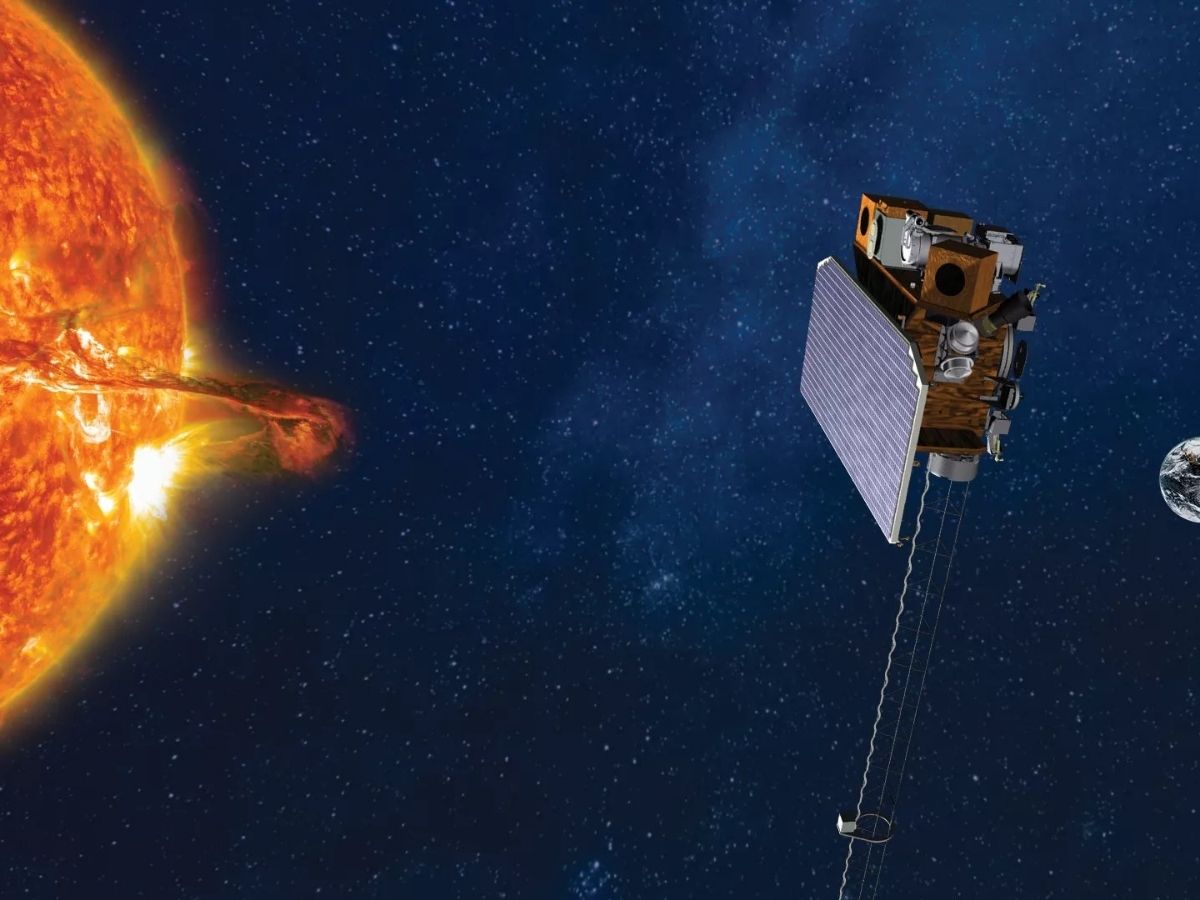
NOAA SOLAR-1
For decades, the world has relied on old, part-time instruments to track what the sun throws at us. That is changing now. NOAA’s SOLAR-1 satellite has entered full operational service, parked about one million miles from Earth, watching the sun around the clock.
This is not a research experiment. It is a working watchdog.
SOLAR-1, which launched in September 2025 aboard a SpaceX Falcon 9 rocket from Kennedy Space Center, reached its final position at the Lagrange Point 1 in January 2026. This spot between the Earth and the sun gives it a clear, unobstructed view of incoming solar activity before it hits us.
The satellite carries a set of instruments that measure solar wind, track eruptions from the sun’s surface called Coronal Mass Ejections (CMEs), and send that data back to Earth without pause. No gaps. No delays caused by old equipment.
Old data sources could take up to eight hours to deliver solar imagery to forecasters. SOLAR-1 gets coronagraph images to them within 30 minutes. Other instrument data arrives within five minutes.
That speed matters. A solar storm that goes undetected can knock out power grids, mess up GPS, disrupt airline routes, and damage satellites. The bigger the warning window, the more operators can do to protect systems before the storm hits.
Clinton Wallace, director of NOAA’s Space Weather Prediction Center, put it plainly: “It means more time to act. It gives time for power grid operators to prepare, more time for satellite operators to protect assets, more time for aviation and national security partners to understand risk, and more time for human spaceflight teams to protect astronauts and missions.”
The sun is currently near the peak of its 11-year activity cycle. Solar storms are more frequent. The risk to satellites, GPS networks, power infrastructure, and even astronauts in space is at its highest point in over a decade.
SOLAR-1 covers a wide range of systems that are at risk from space weather: the electric grid, communications, aviation navigation, national security operations, and crewed missions like NASA’s Artemis program.
Before this satellite, there was no dedicated, always-on American system for this job. The US was essentially relying on instruments not built for the purpose, or sharing data from other missions that had their own primary goals.
SOLAR-1 is now feeding live data to NOAA’s Space Weather Prediction Center, which issues watches, warnings, and alerts to industries and governments across the country.
NOAA says more missions at the L1 point are planned for the future, building on what SOLAR-1 starts. For now, it is the only satellite the US has built from scratch, specifically to do this one job, all the time.
Syed Ziyauddin is a media and international relations enthusiast with a strong academic and professional foundation. He holds a Bachelor’s degree in Mass Media from Jamia Millia Islamia and a Master’s in International Relations (West Asia) from the same institution.
He has work with organizations like ANN Media, TV9 Bharatvarsh, NDTV and Centre for Discourse, Fusion, and Analysis (CDFA) his core interest includes Tech, Auto and global affairs.
Tweets @ZiyaIbnHameed
From Delhi to Los Angeles: The Indian Entrepreneur Reshaping Health Tech Investments in America
Kinshuk Kocher, Co-Founder – Caredose New Delhi [India], June 10: There is a photograph Kinshuk…
The National Testing Agency (NTA) has announced several changes for the upcoming NEET UG re-examination…
Action King Arjun Sarja’s martial arts family drama continues its fairytale run as the undisputed…
