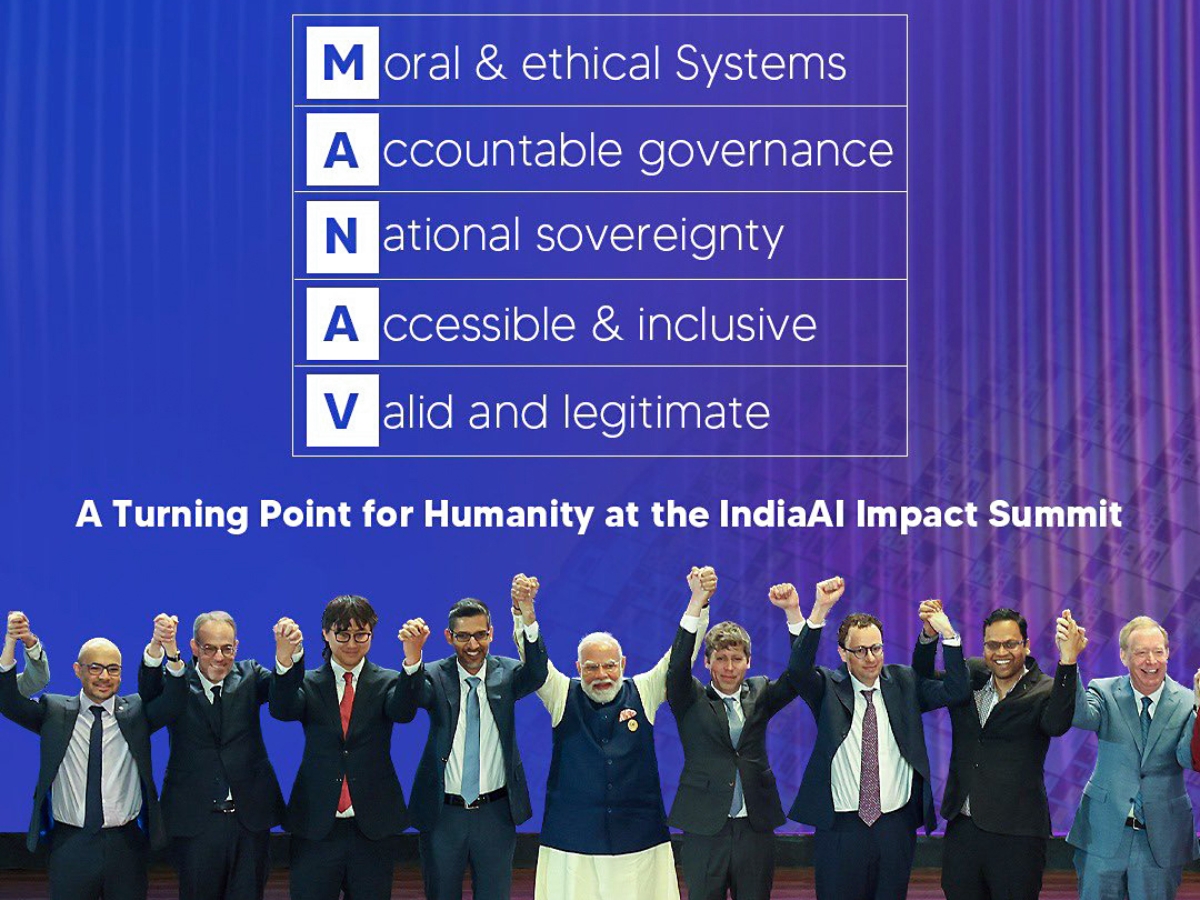
AI Impact Summit 2026 ends with New Delhi Declaration backed by 88 nations. Photo: ANI.
The AI Impact Summit 2026 concluded on Friday with the adoption of the New Delhi Declaration on AI Impact, a framework endorsed by 88 countries and international organisations. According to an official government statement released on Saturday, the declaration places strong emphasis on national sovereignty, expanding access to artificial intelligence, and strengthening international cooperation to ensure the equitable distribution of AI’s benefits worldwide.
Held in New Delhi between February 18 and 20, the summit attracted participation from more than five lakh visitors. The event brought together global policymakers, industry leaders, and technology experts, positioning India as an emerging force in shaping international AI governance and infrastructure development.
Countries and international organisations that endorsed the declaration include the United States, United Kingdom, China, France, Israel, Canada, Russia, Saudi Arabia, Singapore, and the European Union, among others.
The declaration is anchored in the philosophy of “Sarvajan Hitaya, Sarvajan Sukhaya” (Welfare for all, Happiness for all), underscoring the principle that artificial intelligence must serve humanity collectively.
“Guided by the principle of ‘Sarvajan Hitaya, Sarvajan Sukhaya’ (Welfare for all, Happiness for all), the Declaration underscores that the benefits of AI must be equitably shared across humanity,” the statement said.
The New Delhi Declaration calls for coordinated global action across seven priority areas. These include:
Democratising AI resources
Promoting economic growth and social good
Ensuring secure and trusted AI systems
Expanding access for social empowerment
Strengthening collaboration among nations to replicate AI use cases globally
While multiple themes were highlighted, the central focus remained on democratising AI access and encouraging cross-border partnerships to scale AI applications worldwide.
Government Response and Investment Commitments
Union IT Minister Ashwini Vaishnaw described the summit as a “grand success,” stating that India secured infrastructure investment commitments exceeding USD 250 billion during the event.
Inspired by the principle of “सर्वजन हिताय, सर्वजन सुखाय” (Welfare for all, Happiness of all), we believe that AI’s promise is best realized only when its benefits are shared by humanity.
We, the participants from countries and international organizations, gathered in New Delhi on 19 February 2026 to hold the AI Impact Summit. The advent of AI marks an inflection point in the trajectory of technological evolution. The choices that we make today will shape the AI-enabled world that future generations will inherit.
This calls for further international cooperation and multistakeholder engagement across our countries along the seven Chakras (pillars) of the AI Impact Summit centered around the principles of development of human capital; broadening access for social empowerment; trustworthiness of AI systems; energy efficiency of AI systems; use of AI in science; democratizing AI resources; and use of AI for economic growth and social good. In complimentarity with existing international and other initiatives, we will work to fostering shared understanding, while respecting national sovereignty, on how AI could be made to serve humanity, noting the initiatives across the seven Chakras (pillars) of the Summit.
Robust digital infrastructure and meaningful and affordable connectivity are prerequisites for deploying AI and unlocking its full potential. Inspired by the principle of “Vasudhaiva Kutumbakam” (the world is one family), we recognize the importance of enhancing the affordability of and access to AI resources that would be critical to enabling all countries to develop, adopt and deploy AI for the benefit of their citizens.
To this effect, we take note of the Charter for the Democratic Diffusion of AI as a voluntary and non-binding framework to promote access to foundational AI resources, support locally relevant innovation, and strengthen resilient AI ecosystems while respecting national laws.
Wide-scale adoption of AI and AI-based applications hold unprecedented potential to drive economic and social development. Open-source AI applications and other accessible AI approaches, where appropriate, and wide-scale diffusion of AI use cases can contribute to scalability, replicability, and adaptability of AI systems across sectors.
We take note of the Global AI Impact Commons as a voluntary initiative that provides a practical platform to encourage and enable the adoption, replication, and scale-up of successful AI use cases across regions.
Advancing secure, trustworthy and robust AI is foundational to building trust and maximizing societal and economic benefits. Noting that deepening our understanding of the potential security aspects remains important, we recognize the importance of security in AI systems, industry-led voluntary measures, and the adoption of technical solutions, and appropriate policy frameworks that enable innovation while promoting the public interest throughout the AI’s lifecycle.
We recognize the development of the voluntary and non-binding Trusted AI Commons, a collaborative platform consolidating technical resources, tools, benchmarks and best practices that all can access and adapt to their contexts; as well as its voluntary guidance note.
We recognize that removing structural barriers to and increasing availability of AI research infrastructure can promote the use of AI in scientific research and development across countries. International scientific collaborations can unlock the potential of AI in research and development by bringing unique expertise, perspectives, and resources.
We take note of the voluntary and collaborative International Network of AI for Science Institutions as a platform to connect scientific communities and pool AI research capabilities across regions among participating institutions, in order to accelerate the impactful adoption of AI.
AI holds the potential to uplift all sections of society by enabling individuals to access knowledge, cross-border AI solutions, information, services, opportunities and enhancing participation in social and economic activities. We recognize the importance of collaborations that would facilitate AI adoption for social empowerment.
We take note of the development of a voluntary and collaborative platform to facilitate exchange of learning, knowledge, and scalable practices to advance AI adoption for social empowerment.
Realizing the full promise of AI requires equipping individuals with relevant skills by expanding AI human resource development, specific initiatives on education, AI workforce development, training of public officials, enhancing public awareness of AI capabilities, increasing AI literacy as well as upgrading vocational and training ecosystems.
While encouraging international collaboration on meaningful skilling and reskilling AI initiatives, we take note of the voluntary guiding principles for reskilling in the age of AI and the playbook on AI workforce development, which would support participants in preparation for a future AI driven economy.
Recognizing the growing demands of AI on energy, infrastructure, and natural resources, we underscore the importance of developing energy efficient AI systems. Affordable AI systems may expand access to AI and accelerate local innovation that would advance shared developmental aspirations.
We recognize that the Voluntary Guiding Principles on Resilient, Innovative, and Efficient Artificial Intelligence would guide us towards development of resilient and efficient AI systems. We also take note of the Playbook on Advancing Resilient AI Infrastructure as a knowledge output, which is a reference resource to support resilient AI development.
We acknowledge that the AI Impact Summit will contribute to strengthening international cooperation and multistakeholder approach to advance shared priorities as well as voluntary and non-binding guidelines and principles, which can promote AI for ensuring a prosperous future for humanity.
We remain committed to advancing our shared aspirations for realizing the benefits of AI and look forward to continued cooperation for translating these aspirations into concrete actions for the three Sutras of the India AI Impact Summit 2026.
Zubair Amin is a Senior Journalist at NewsX with over seven years of experience in reporting and editorial work. He has written for leading national and international publications, including Foreign Policy Magazine, Al Jazeera, The Economic Times, The Indian Express, The Wire, Article 14, Mongabay, News9, among others. His primary focus is on international affairs, with a strong interest in US politics and policy. He also writes on West Asia, Indian polity, and constitutional issues. Zubair tweets at zubaiyr.amin
IND vs SA Super 8, T20 World Cup 2026: Head-to-Head Record, Stats, And Key Numbers
IND vs SA Super 8 clash at T20 World Cup 2026: Check head-to-head record, overall…
Vijay Raghavendra shines in Second Case of Seetharam X, a dark, twisty crime thriller with…
Tanya Mittal has set social media buzzing after sharing photos in bridal-style lehengas with captions…
