Inventions that were discovered by accident (PHOTO: X)
Some of the world’s most important inventions didn’t come from years of planning or careful research. Honestly, a lot of them happened by accident.
People stumbled onto these breakthroughs while chasing something completely different, and those lucky moments changed entire industries and everyday life, too.
Think about it: medicines that save lives, snacks everyone loves, even technologies that shape how we live all started with someone’s curiosity and a bit of quick thinking when things didn’t go as planned. Mistakes turned into major milestones. Here are a few of the best accidental inventions in history
The first antibiotic, something that’s saved millions of lives, came from a mess in a lab.
In 1928, Alexander Fleming, a bacteriologist in London, got back from vacation and found mold growing on one of his petri dishes. Not exactly what he’d planned, but when he looked closer, he saw the area around the mold had no bacteria. That mold was Penicillium notatum, and Fleming called its bacteria-killing juice “penicillin.” He published a paper about it in 1929, but honestly, he didn’t know if it would be useful. Penicillin was tough to purify and keep stable, so it just sat there as a scientific curiosity.
Fast forward about ten years. Chemists at Oxford University read Fleming’s work and decided to take a crack at turning penicillin into real medicine. The first patient got it in 1940, and by 1942, penicillin was in wide use. Now, it’s the world’s most common antibiotic.
Smoke detectors are so common now, most people don’t even notice them. But these little gadgets save lives. Just having one in your home cuts your risk of dying in a fire by more than half. And you have a Swiss physicist named Walter Jaeger to thank for that.
Back in the 1930s, Jaeger was trying to invent a sensor to detect poison gas. Not exactly a smoke detector. But when he lit a cigarette near the device, the smoke set it off. That’s when he realized he was onto something else—a way to detect smoke. That discovery led to the modern smoke detector.
In the 1950s, smoke detectors started showing up in factories and big buildings, but they were expensive—way out of reach for most homes. Then, in the 1970s, prices dropped fast thanks to new tech, and suddenly, smoke detectors were everywhere. By 1977, people had bought over 12 million of them. Now, almost every home has one.
George De Mestral, a Swiss engineer, didn’t set out to invent the fastener that astronauts use in space. In 1941, he just went for a walk with his dog and came home to find both of them covered in burrs from the cocklebur plant. Annoying, right? But instead of grumbling, De Mestral took a closer look and noticed the burrs had tiny hooks that stuck to loops in his clothes and his dog’s fur.
That got him thinking. He spent more than a decade trying to make a fabric that worked the same way. In 1955, he patented Velcro, a mashup of the French words for “velvet” and “hook.” Funny enough, it’s actually made out of nylon, not velvet. The fashion world didn’t jump on board right away, but NASA loved it. They used Velcro on spacesuits and inside shuttles, and people started thinking NASA invented it.
Now, you’ll find Velcro everywhere: clothes, cars, hospitals, airplanes. And after years of research, scientists finally figured out how to make Velcro quieter in 2021. Not bad for an idea that started with a walk in the woods.
Some inventors feel nothing but pride over their discoveries. Others, not so much. Take dynamite. Its creation haunted one of the men responsible, and he never meant for its explosive ingredient to see the light of day.
Back in 1847, Ascanio Sobrero, an Italian chemist, mixed glycerol with nitric and sulfuric acids. What he got was nitroglycerin way more powerful than gunpowder, and a lot less predictable. Sobrero actually hated the thought of people using it. But his lab partner, Alfred Nobel, recognized a money-maker when he saw one. Nobel worked out a way to tame nitroglycerin by mixing it with silica powder, and in 1867, he introduced dynamite. He didn’t get there unscathed, either his factories exploded twice along the way.
Today, people remember Nobel for the prize that carries his name, honoring those who help humanity. The irony? That prize was funded by the fortune Nobel built from his patented explosives, the very thing Sobrero wished he’d never created.
Sobrero’s invention led straight to Nobel’s, and he never got over it. “When I think of all the victims killed during nitroglycerine explosions, and the terrible havoc that has been wreaked, which in all probability will continue to occur in the future, I am almost ashamed to admit to be its discoverer,” Sobrero once confessed.
Nobel’s breakthrough came when he mixed nitroglycerin with kieselguhr, creating a paste he could mold into rods. He patented this new material as dynamite in 1867. Now, you’ll find dynamite rods from Nobel’s original batch displayed in the Nobel Prize Museum in Stockholm.
Pharmaceutical breakthroughs are full of happy accidents; think Viagra (meant for high blood pressure) or Valium (originally a failed dye). Warfarin’s story, though, starts in a much messier place: a muddy field, not a lab.
In the 1920s, healthy cows and sheep started dying from unstoppable internal bleeding. Farmers were baffled. It took a Canadian vet named Frank Schofield to figure it out. The animals had been eating moldy sweet clover hay, which turned out to have an anticoagulant that stopped their blood from clotting.
Fast forward to 1940. At the University of Wisconsin, biochemist Karl Link and his team finally isolated the compound from the hay. They came up with a powerful version and named it warfarin, after the Wisconsin Alumni Research Foundation, which backed the project.
But before warfarin became a go-to drug for heart attacks, strokes, and blood clots, it found a different use: killing rats. In 1948, it was approved as a rodenticide. Only years later, in the mid-1950s, did doctors start giving it to people. One of the first human patients? President Dwight D. Eisenhower, after his 1955 heart attack.
Charles Darwin once said fire was humanity’s greatest achievement after language, and honestly, he’s got a point. People have been obsessed with making fire easier for ages. Before matches, you had to mess around with flint and steel or awkward fire drills.
Early matches were kind of wild. The “Prometheus match,” for example, invented in 1829, had a tiny glass vial of sulfuric acid wrapped in paper. You lit it by crushing the glass and Darwin, of all people, used to show off by biting these matches to light them. Not the safest party trick, as you can imagine.
Meanwhile, in England, a pharmacist named John Walker was tinkering with chemicals and accidentally scraped a coated stick against his hearth. The stick caught fire, and just like that, Walker had an idea. In 1827, he started selling “Congreves” cardboard sticks with a mix of potassium chlorate and antimony sulfide. Strike one against sandpaper, and you had fire.
People loved Walker’s invention, but he never patented it. That meant anyone could copy it, and they did. For years, his name got lost in the shuffle. It took decades after his death in 1859 for people to finally recognize him as the father of the friction match.
Others jumped on the bandwagon. “Lucifer matches” were a straight rip-off of Walker’s original design. The next big step came in 1832 with the “Congreve” match, this time using yellow phosphorus. Some of these early matches are now part of the Bryant and May collection at the Science Museum in London.
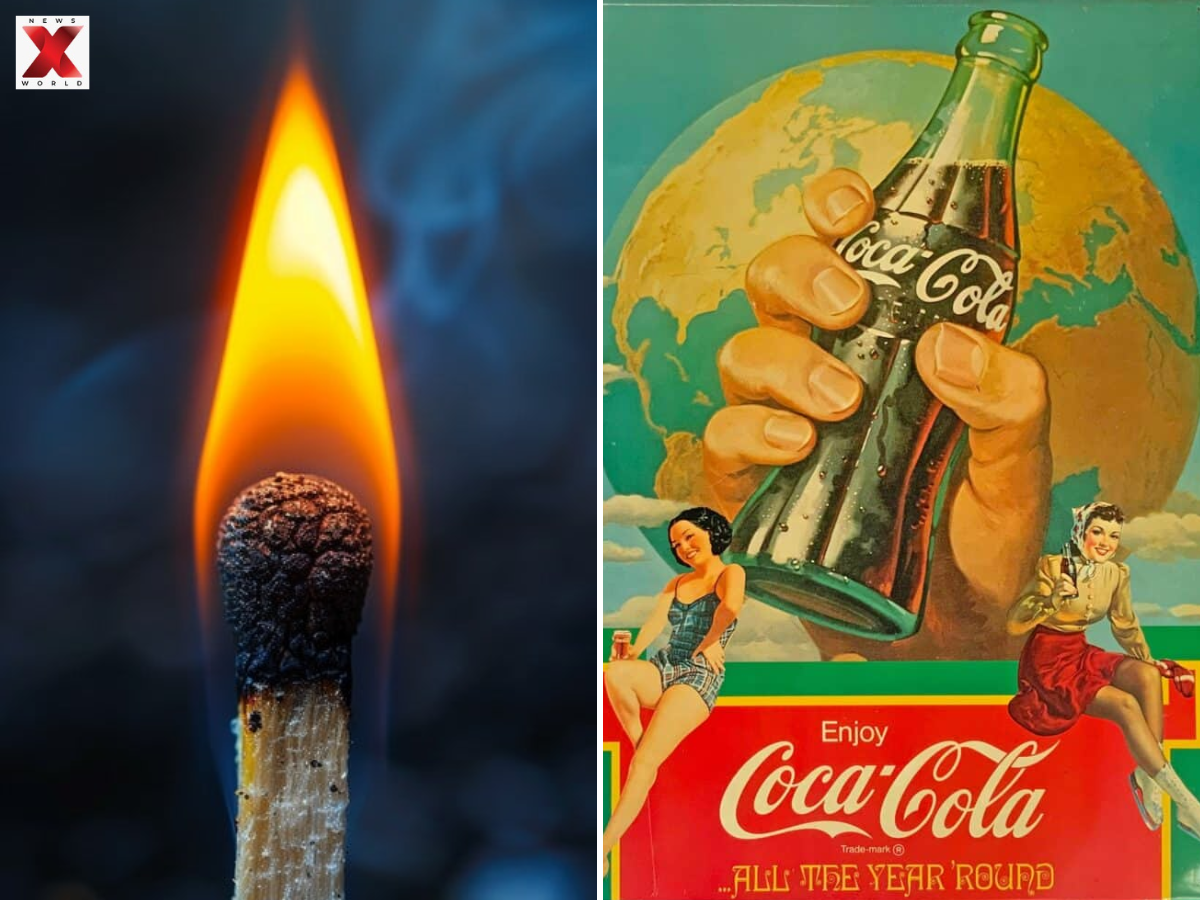
It is one of the most popular soft drinks in the world, but the history of its appearance is also rather strange. An American pharmacist, John Pemberton, was attempting to develop a painkiller in the year 1866. Pemberton was seriously wounded during the Civil War, and had an opiate habit of morphine, which he proposed to restrain by creating a substitute, without opium, of equivalent strength.
His initial product that he named Pemberton French Wine Coca had a few ingredients that one does not find in the current recipe. Coca wine that mixed alcohol and leaves of the coca plant that contains cocaine and kola nuts which contains stimulating caffeine.
His French Wine was a success but when the temperance movement gained momentum in his home state of Georgia in 1886, he was forced to come up with an alcohol free version.
He used sugar syrup in place of wine and when he was experimenting with the formula he went and poured his drink into carbonated water. Having tried it, he chose to sell the drink as a fountain beverage rather than a medicine under the label of Coca-Cola, which refers to its original components.
Regrettably, Pemberton became unhealthy, and his morphine addiction deteriorated, and he died in poverty only two years after inventing it. He also sold his interests to his business associate Asa Griggs Candler who made Coca-Cola one of the best companies in the nation by that time.
Iran’s Foreign Minister Abbas Araghchi said Tehran is prepared for a possible US ground invasion…
Stock Market Today: Indian markets brace for volatility as Sensex and Nifty 50 open lower…
The UAE has issued a safety advisory warning residents to remain indoors during missile alerts…
