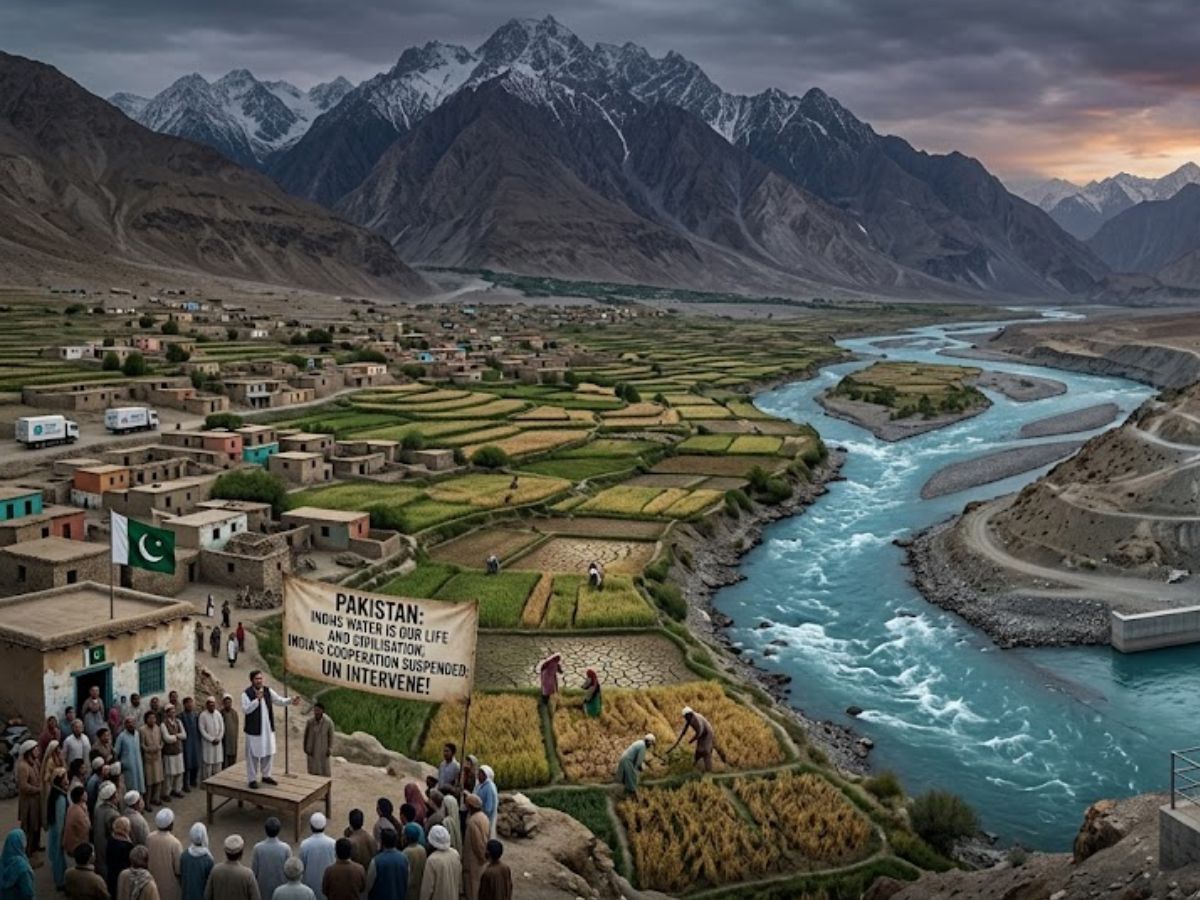
Pakistan moves UNSC over Indus Waters Treaty suspension, urges India to resume pact. Photo: Gemini.
Pakistan has approached the United Nations Security Council (UNSC), seeking intervention over India’s decision to suspend the decades-old Indus Waters Treaty (IWT). India suspended the decades old agreement in April last year, after a brief war between the two countries. As the treaty continues to remain in abeyance, Islamabad has intensified efforts to internationalise the issue, with its Permanent Representative to the UN, Asim Iftikhar Ahmad, meeting UNSC President Jamal Fares Alrowaie. During the meeting, he delivered a formal letter from Pakistan’s Deputy Prime Minister and Foreign Minister Ishaq Dar.
In an official statement, Pakistan’s UN mission said, “the Security Council has been urged to take note of this concerning situation and call upon India to fully implement the Indus Waters Treaty, resume all cooperation and data sharing required under the treaty without delay, refrain from any coercive measures regarding water, and fulfill its international obligations in good faith.”
According to reports, Pakistani media, along with certain Western platforms and think tanks, have mounted a coordinated campaign to portray Islamabad as a victim and pressure India to resume water-sharing under the Indus River System.
This effort comes even as Pakistan attempts to project itself as a peacemaker on the global stage, including by positioning itself as a mediator in the Iran-US conflict.
India announced the suspension of the treaty on April 23, 2025, just a day after a deadly terror attack in Pahalgam that killed 26 people, most of them tourists.
The attack was claimed by The Resistance Front, a group linked to Pakistan-based terror networks.
New Delhi justified its decision on national security grounds, asserting that cooperation under such circumstances was untenable. It also invoked the principle that “blood and water cannot flow together.”
The Indus Waters Treaty is built on a clear and permanent division of river waters between the two countries.
Under Article II, India has exclusive rights over the eastern rivers—Ravi, Beas, and Sutlej.
Under Article III, Pakistan is granted exclusive use of the western rivers—Indus, Jhelum, and Chenab.
India’s access to the western rivers remains tightly restricted. Under Article III(2), read with Annexures D and E, India is permitted only limited, non-consumptive uses such as run-of-the-river hydroelectric projects.
Pakistan has repeatedly warned that politicising water resources could have severe humanitarian and economic consequences.
At a UN World Water Day event in March, Federal Minister for Climate Change and Environmental Coordination Musadik Malik criticised India’s move, calling it a violation of international law and a setback to decades of cooperation.
“For us, water is nature. Water is humanity. Water is our civilisation. For us, water is agriculture,” Malik said.
Also Read: Iran Slams Talks On Pakistan Soil, Calls It ‘Strategic Blunder’ – Will Asim Munir Pay The Price?
Zubair Amin is a Senior Journalist at NewsX with over seven years of experience in reporting and editorial work. He has written for leading national and international publications, including Foreign Policy Magazine, Al Jazeera, The Economic Times, The Indian Express, The Wire, Article 14, Mongabay, News9, among others. His primary focus is on international affairs, with a strong interest in US politics and policy. He also writes on West Asia, Indian polity, and constitutional issues. Zubair tweets at zubaiyr.amin
New Delhi [India], June 9: In a move that signals a profound shift in the…
Indian legend Suresh Raina rolls back the years in the Sanatan Premier League. Discover what…
Bangalore Weather Today (9 June 2026): Heavy Rain, Thunderstorms to Hit in Several Districts
Bengaluru is expected to witness heavy rain, cloudy skies and scattered thunderstorms today as monsoon…
