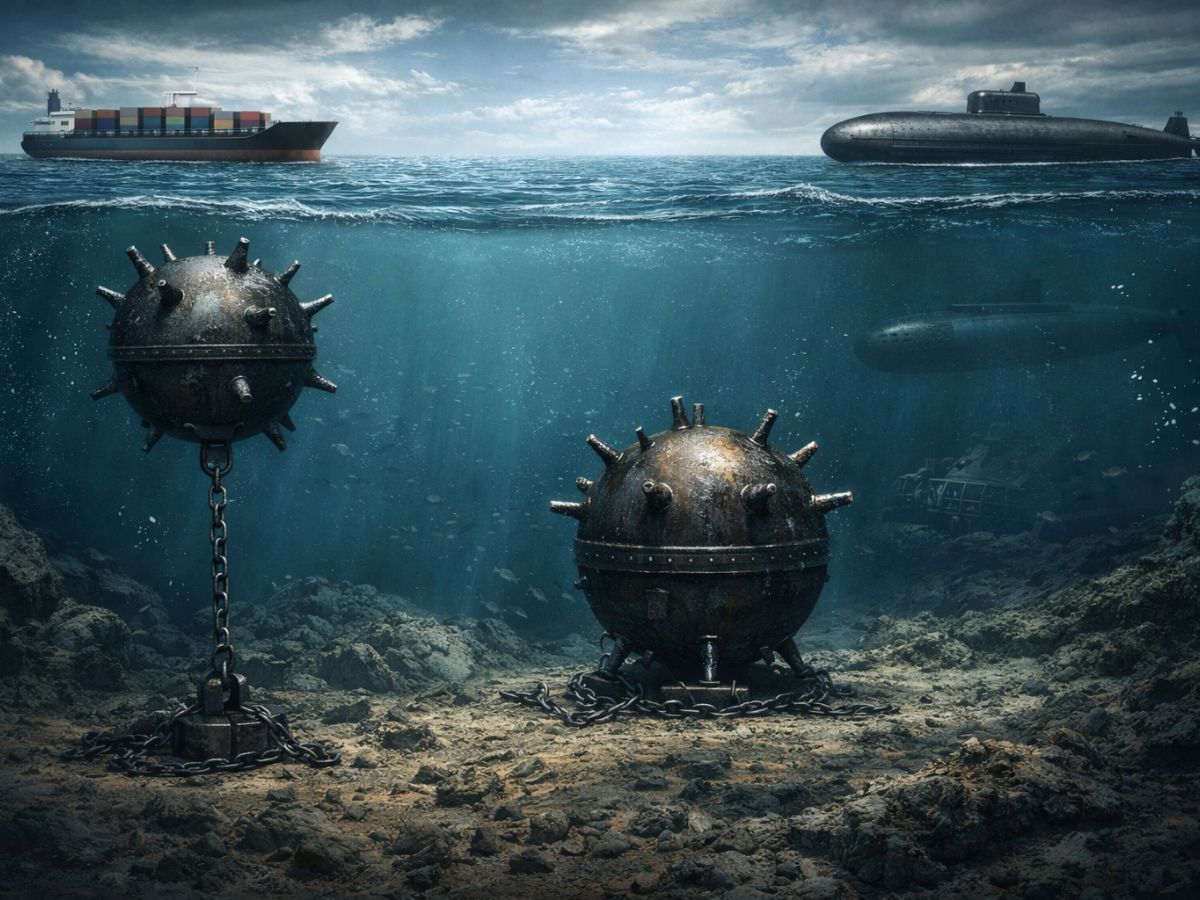
A Silent Threat Beneath the Water (Image: AI generated)
Once again, the Strait of Hormuz is one of the most dangerous places on Earth. Despite a tenuous ceasefire between the U.S. and Iran, recent information indicates that naval mines will remain an ongoing threat to any vessels that transit the strait since they were placed in the water during conflict between the two nations and remain there unaccounted for.
Iranian Revolutionary Guard Corps (IRGC) has warned vessels about these maritime hazards and advised that if a vessel travels a new route, then it will be safe from hitting a mine. This statement clearly demonstrates that there continues to be a high probability of an underwater attack on medium and large vessels transiting through the Strait of Hormuz, even though active fighting has been put to halt due to a ceasefire in place.
Sea mines are defined as explosive devices that are placed in maritime environments in an attempt to damage or destroy a ship. Depending upon the type of sea mine, the mine can either float just under the surface of the water or be located on the seafloor. The different types of mines include some that detonate when another vessel comes in contact with them; advanced types that detect a vessel’s sound, underwater pressure, or the vessel’s magnetic fields before detonating; and unguided missiles that can pierce through a vessel or detonate underneath a vessel, creating an underwater wave.
Iran possesses a multitude of different types of sea mines such as magnetic mines, contact mines and remote control mines which can be deployed by small boats, submarines or fake civilian vessels, therefore they can easily be used to block or divert the flow of shipping through a narrow route like the Strait of Hormuz coming in or out of Iran and thus creating a high risk of having no escape routes available for any vessels travelling through.
The Strait of Hormuz is one of the world’s most significant maritime transit ways for oil since almost 20% of the world’s daily oil supply passes through here; therefore, any minor disruptions to the flow of oil passing through the strait could affect world markets and drive up fuel costs around the globe due to price fluctuations in oil.
After the recent outbreak of hostilities with Iran, they are reported to have planted several mines in the Strait of Hormuz to use as part of their overall strategy to retaliate against their enemies and gain an upper hand in this situation. It was reported that these mines were deployed “within the last several days,” indicating that events escalated quickly within the course of the conflict.
An even greater fear is that a ship will not see the threat until it’s too late. Mines are often not visible and they can remain live for a very long time. Even mines that are old or simple can create a tremendous amount of destruction. In fact, there have been incidents where just one mine almost sunk an American warship which indicates how effective these types of weapons can be.
Even after a ceasefire, ships continue to receive directions to change their routes. The Iranians have begun publishing a map outlining “danger areas”, and providing directions for vessels now to use those routes, which will mostly take vessels closer to the Iranian coast. However, this will also require ships to coordinate directly with Iranian forces, creating an additional source of tension and control.
As a result, the Strait of Hormuz has gone from being an open international waterway to a tightly controlled and very dangerous waterway. Ships are being advised to follow a specific set of instructions, and, according to some accounts, the amount of vessel traffic permitted through the Strait is severely limited each day.
The IRGC has clearly stated that all vessels must cooperate for safe passage. Its warning highlights both the danger and the control Iran now holds over this critical chokepoint. As long as these underwater mines remain, the threat is not just military it affects global trade, oil prices, and the stability of the entire region.
Also Read: Khawaja Asif Urges Muslim Community To Recognize Its ‘True Enemy’ Is India And Israel, Sparks Row
Khalid Qasid is a media enthusiast with a strong interest in documentary filmmaking. He holds a Master’s degree in Convergent Journalism from AJK MCRC. He has also written extensively on esports at Sportsdunia. Currently, he covers world and general news at NewsX Digital.
Chinese academic Jiang Xueqin has sparked debate with bold predictions on a possible US-Iran war,…
Wipro may announce its first April buyback in 3 years alongside Q4 results, aiming to…
Iran warned that any ceasefire violation by US-Israel forces will face a “decisive, immediate” response,…
