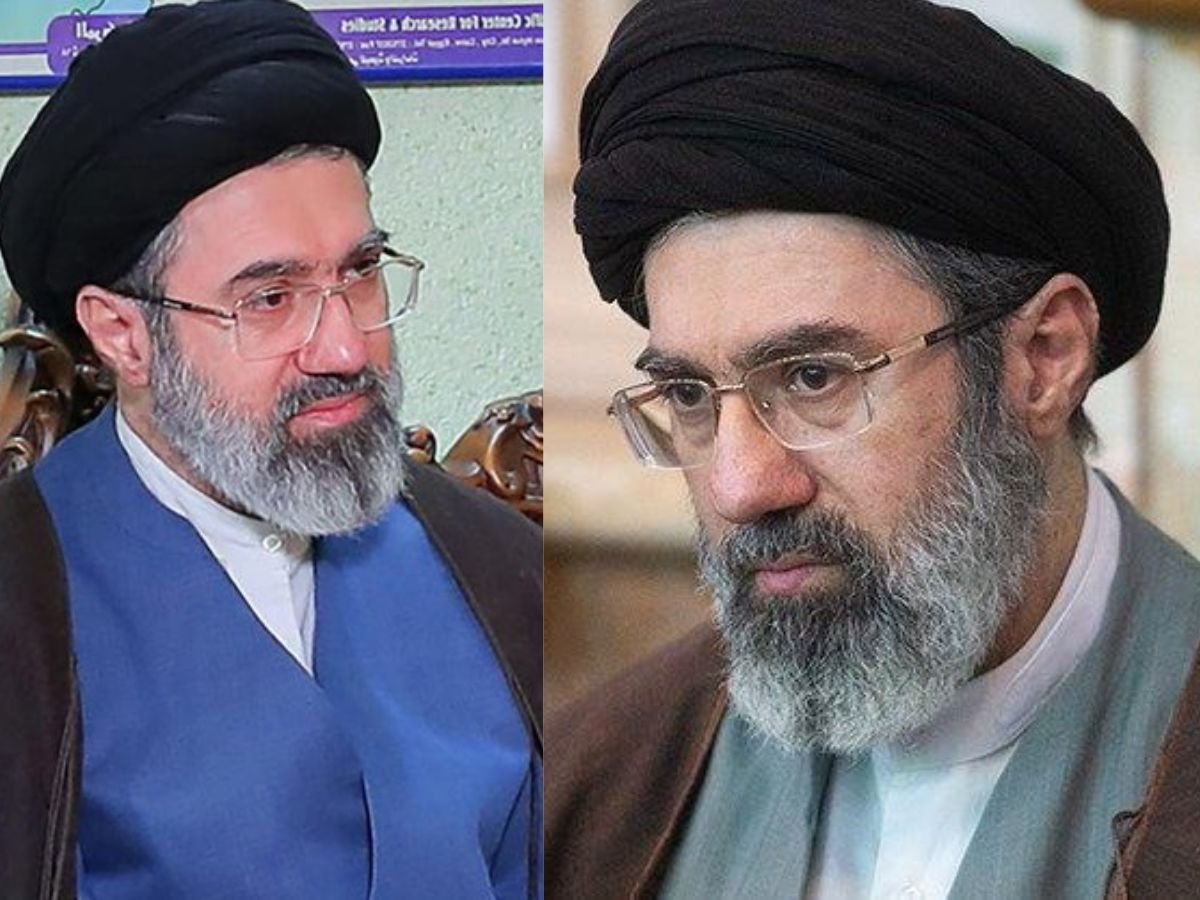
Mojtaba Khamenei injured in Israeli strikes, avoids public view as IRGC takes control. Photos: X.
New details are emerging about the status of Iran’s Supreme Leader Mojtaba Khamenei. The 56-year old cleric cum political leader has been in absence since the death of his father. He has not issued any audio or video message since assuming power, reportedly due to severe injuries sustained during Israeli airstrikes on February 28, according to a report by The New York Times. Mojtaba, 56, is said to have suffered extensive physical injuries, including severe burns to his face and lips, making it difficult for him to speak. “His face and lips have been burned severely, making it difficult for him to speak [and] he will need plastic surgery,” the report stated. Citing four Iranian officials, the report added that one of his legs has undergone three operations, and he is awaiting a prosthetic. He has also had surgery on one of his hands. Despite his condition, officials said Khamenei “does not want to appear vulnerable or sound weak,” which has influenced his decision to avoid public appearances.
An Iranian official described the Supreme Leader as “gravely” injured but “mentally sharp and engaged.”
Since taking over following the death of his father, Syed Ali Khamenei, in a joint US-Israel strike on February 28, Mojtaba Khamenei has largely disappeared from the public sphere. No audio or video messages have been released, with his statements instead appearing on social media or being read on state television.
Communication with the Supreme Leader has also become highly restricted. According to the report, messages to him are handwritten, sealed in envelopes, and passed along a human chain of trusted couriers.
“Messages to him are handwritten, sealed in envelopes and relayed via a human chain from one trusted courier to the next, who travel on highways and back roads, in cars and on motorcycles until they reach his hide-out. His guidance on issues snakes back the same way,” the report noted.
Senior Iranian officials, including top government figures and commanders of the Islamic Revolutionary Guard Corps (IRGC), are reportedly avoiding direct contact with Khamenei. The reason, officials say, is fear that Israel could track their movements and locate him.
“Senior government officials do not visit him, fearing that Israel may trace them to him and kill him,” the report said.
Despite this, Iran’s President Masoud Pezeshkian and Health Minister Mohammad-Reza Zafarghandi are said to have been involved in his medical care. The Supreme Leader is currently surrounded primarily by doctors and healthcare professionals.
With Khamenei difficult to access, much of Iran’s decision-making authority has reportedly shifted to military leadership, particularly the Islamic Revolutionary Guard Corps.
The report noted that the Guards have taken the lead in shaping Iran’s recent military and diplomatic strategies. “It was the Guards who came up with the strategy for Iran’s attacks on Israel and the Persian Gulf states, along with the closing of the strait to maritime traffic,” it said.
“They were the ones who agreed to a temporary cease-fire with the United States and approved back-channel diplomacy and direct negotiations with the United States,” the report added.
The IRGC also selected parliament speaker Mohammad Bagher Ghalibaf, one of their own, to lead talks with US Vice President JD Vance in Islamabad.
The reported lack of clear and accessible leadership in Tehran has emerged as a concern for Washington. US President Donald Trump has indicated that ongoing peace negotiations are being hindered by communication delays and uncertainty over who holds decision-making authority in Iran.
The US has extended a two-week ceasefire indefinitely as it awaits a response to its latest proposal, which prioritizes ending nuclear enrichment and the surrender of approximately 1,000 pounds of highly enriched uranium.
“There’s obviously a lot of internal division,” White House Press Secretary Karoline Leavitt told reporters. “This is a battle between the pragmatists and the hardliners in Iran right now, and the president wants a unified response. And so, as we await that response, there’s a cease-fire.”
Also Read: ‘United And Revolutionary’: Iran Parliament Speaker Dismisses Trump’s Infighting Claims
Zubair Amin is a Senior Journalist at NewsX with over seven years of experience in reporting and editorial work. He has written for leading national and international publications, including Foreign Policy Magazine, Al Jazeera, The Economic Times, The Indian Express, The Wire, Article 14, Mongabay, News9, among others. His primary focus is on international affairs, with a strong interest in US politics and policy. He also writes on West Asia, Indian polity, and constitutional issues. Zubair tweets at zubaiyr.amin
Who Is Omar Artan? Somalia Referee Denied Entry To USA By CBP For FIFA World Cup 2026
Somalia referee Omar Abdulkadir Artan has been denied entry to the US for the FIFA…
PM Modi Breaks Nehru's Record, World Reacts: Global Leaders Shower Praise
Prime Minister Narendra Modi has scripted history by becoming India's longest continuously serving elected Prime…
Legendary Tamil Filmmaker Bharathiraja and Actor Behind 16 Vayathinile Dies at 84
Veteran Tamil filmmaker and actor Bharathiraja, best known for directing the iconic 1977 film 16…
