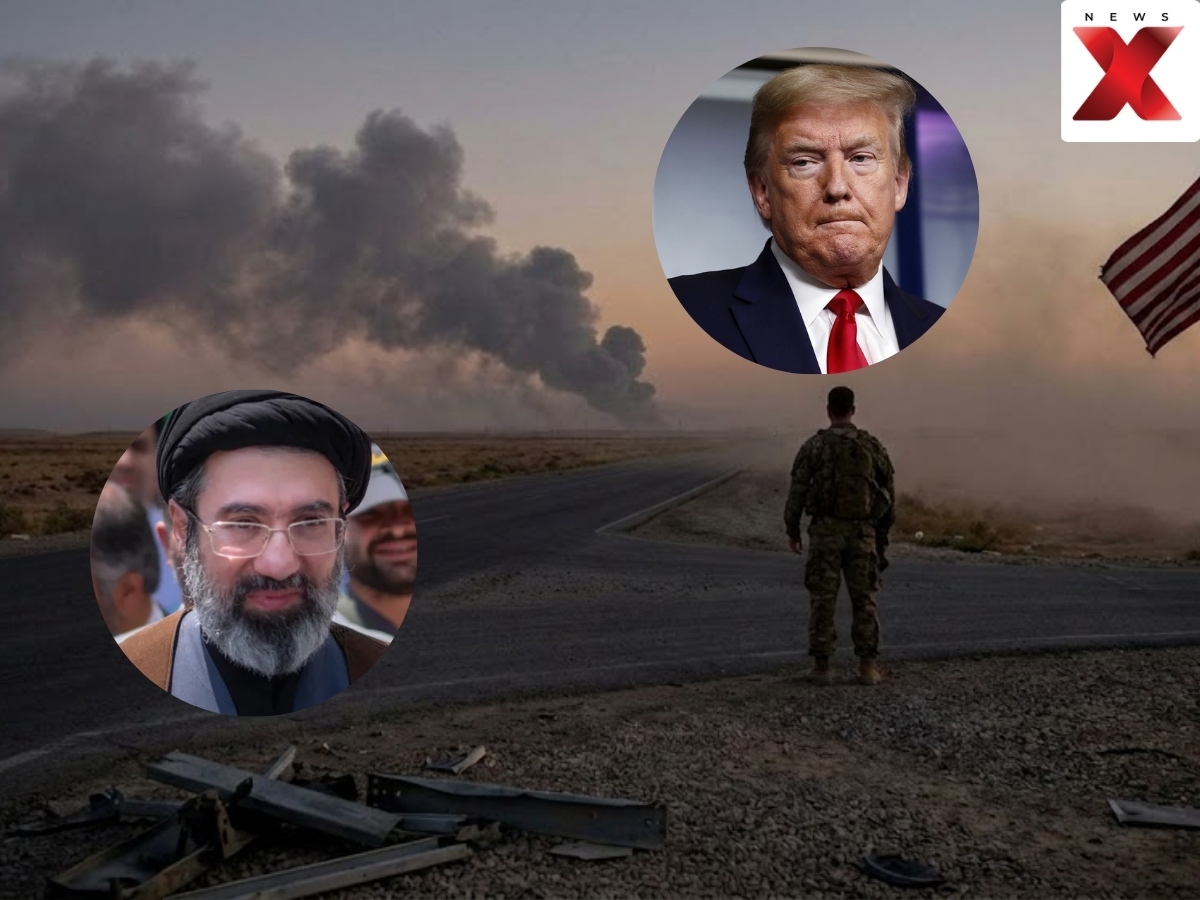
Trump signals Iran war may end soon but warns of escalation over Strait of Hormuz as questions grow over US exit plan. Photos: X.
US President Donald Trump on Monday gave conflicting reports about the timeline of the Iran war. He suggested that the ongoing war against Iran could be relatively short-lived, while warning that the United States would escalate military action if Tehran disrupts global oil supplies. Speaking at a press conference in Florida, Trump indicated that the conflict might conclude soon but left open the possibility of further escalation under certain conditions.
“It’s going to be ended soon, and if it starts up again they’ll be hit even harder,” Trump said.
When asked whether “soon” meant the war could end within a week, the president replied:
“No, but I think soon.”
The comments came after Trump told lawmakers that the military campaign against Iran would be a “short-term excursion,” noting that it came at a time when US economic indicators had been gradually improving.
Hours after the press conference, Trump issued a strong warning to Iran in a social media post, specifically referencing the critical Strait of Hormuz, one of the world’s most important oil shipping routes.
“If Iran does anything that stops the flow of Oil within the Strait of Hormuz, they will be hit by the United States of America TWENTY TIMES HARDER than they have been hit thus far,” Trump wrote.
During the press conference, Trump also revealed that the United States had deliberately held back some major targets in Iran, including facilities linked to electricity production.
According to the president, those sites could be attacked if Tehran attempts to interfere with global oil supplies.
“We’ve left some of the most important targets for later, in case we need to do it,” Trump said.
“If we hit [those targets], it’s going to take many years for them to be rebuilt. [The targets have] to do with electricity production and many other things. We’re not looking to do that if we don’t have to.”
Trump emphasized that such strikes would be considered only if Iran escalates the situation by targeting global energy flows.
“I will not allow a terrorist regime to hold the world hostage and attempt to stop the globe’s oil supply. If Iran does anything to do that, they’ll get hit at a much harder level. I will take out those targets… that I mentioned just before.”
Iran quickly responded to Trump’s remarks. A spokesperson for the Islamic Revolutionary Guard Corps (IRGC) said Tehran, not Washington, would ultimately decide the outcome of the war.
“Iran will determine when the war ends.”
The IRGC spokesperson also issued a stark warning, stating that if US and Israeli attacks continue, Iran could halt oil exports from the region entirely.
Tehran would not allow “one liter of oil” to be exported if the strikes persist, the spokesperson warned.
Meanwhile, Trump is reportedly facing increasing pressure from some advisers to outline a clearer strategy for ending the conflict. Concerns within the administration have grown over the economic and political consequences of a prolonged war.
According to reporting by The Wall Street Journal, the president has publicly suggested that the military campaign may conclude soon, arguing that many of its objectives have already been achieved. Speaking to reporters in Florida, Trump said the mission was progressing faster than expected and hinted that hostilities could wind down in the near future.
Behind the scenes, however, several officials have urged the president to present a more detailed exit strategy, particularly as global energy prices climb and American voters face rising fuel costs.
The conflict has already triggered significant volatility in energy markets. Crude oil prices briefly climbed above $100 per barrel before easing.
The spike has raised alarms among some of Trump’s political allies, who worry that higher fuel costs could strain household finances and potentially damage the administration politically.
At the same time, some officials caution that stepping away from the conflict may not be simple.
As long as Iranian forces continue attacks across the region and Israel maintains military operations against Iranian targets, the United States could face sustained pressure to remain engaged in the fighting.
Trump’s public comments on the conflict have also appeared at times to send mixed signals. In recent days, he has called for Iran’s unconditional surrender while also suggesting that the war might end quickly.
The president has declined to rule out stronger military action but has said he is not close to authorising the deployment of US ground troops.
The widening conflict in the Middle East has also drawn scrutiny from US lawmakers, who are demanding greater transparency from the administration.
Members of Congress have sought answers on the overall strategy, the potential exit plan, and the financial and human costs the war could impose on Americans as the confrontation with Iran continues to unfold.
Zubair Amin is a Senior Journalist at NewsX with over seven years of experience in reporting and editorial work. He has written for leading national and international publications, including Foreign Policy Magazine, Al Jazeera, The Economic Times, The Indian Express, The Wire, Article 14, Mongabay, News9, among others. His primary focus is on international affairs, with a strong interest in US politics and policy. He also writes on West Asia, Indian polity, and constitutional issues. Zubair tweets at zubaiyr.amin
The AED to INR exchange rate has crossed the 25 mark for the first time…
Pakistan has unveiled emergency fuel-saving measures as fears grow over possible oil supply disruptions amid…
NIOS Practical Exam Hall Ticket 2026 Out for Class 10, 12 At sdmis.nios.ac.in
The National Institute of Open Schooling (NIOS) has released the hall tickets for the April…
