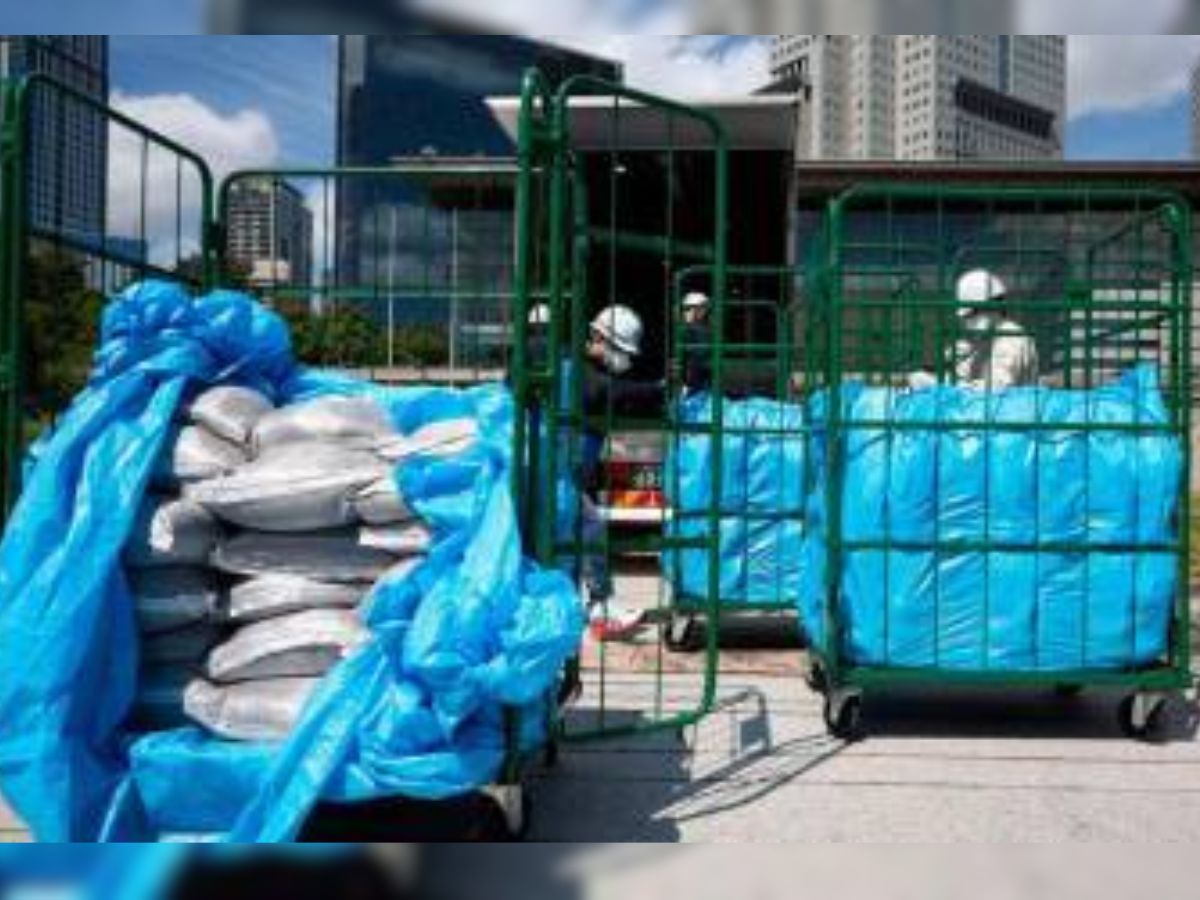
Japan moves Fukushima soil to PM's office to show it's safe for reuse after 2011 disaster; plan faces public resistance. Photo/X.
Japan is taking an innivative path to allay the fears of public concerns over radioactive waste as authorties on Saturday transported dozens of bags of mildly radioactive soil from near the crippled Fukushima nuclear plant to the Japanese Prime Minister’s office.
Japan has earlier launched an extensive decontamination exercise following the March 2011 earthquake and tsunami that triggered a major nuclear disaste.
Japan has been ever since removng a layer of contaminated soil from large areas of Fukushima Prefecture to lower radiation levels. Around 14 million cubic metres of soil have been transported and stored at temporary facilities near the Fukushima Daiichi plant.
The Japanese government has set a deadline of 2045 to transfer the stored soil to other locations across the country. However, the plan has met resistance, as few communities are willing to accept the radioactive earth.
According to the environment ministry, most of the stored soil contains low levels of radiation, equivalent to or even less than the exposure from a single X-ray per year for someone standing directly on or working with the soil.
In an effort to demonstrate that the soil poses no significant danger, the government has decided to reuse some of it.
On Saturday, workers unloaded bags of the Fukushima soil from a truck and placed them in the front yard of the Prime Minister’s office in central Tokyo. According to earlier reports, the soil will be used in flower beds.
The environment ministry said the contaminated earth will be covered with a layer of ordinary soil about 20 centimetres, or eight inches, deep.
In March 11, 2011, when a 9.0-magnitude earthquake struck off Japan’s eastern coast leadinng to Fakushima nuclear disaster. The quake still is one of the strongest disasters that hit the country.
According to the reports, the 2011 quake was so strong that it shifted the Earth off its axis. The disater set off tsunami that inturn swept over Japan’s main island of Honshu. Over 18,000 people were killed in one of the world’s biggest natural disaster while the entire coastal town was destroyed.
The Fukushima Daiichi nuclear power plant beared the major brunt of the tsunami flooding the reactors leading to one of the worst nuclear disasters in history. In the aftermath, Japan set an exclusion zone that expanded as radiation leaked from the plant. Ove 150,000 people were evacuated from around the nuclear town.
Zubair Amin is a Senior Journalist at NewsX with over seven years of experience in reporting and editorial work. He has written for leading national and international publications, including Foreign Policy Magazine, Al Jazeera, The Economic Times, The Indian Express, The Wire, Article 14, Mongabay, News9, among others. His primary focus is on international affairs, with a strong interest in US politics and policy. He also writes on West Asia, Indian polity, and constitutional issues. Zubair tweets at zubaiyr.amin
A Los Angeles jury held Meta and Google responsible for harmful social media design, awarding…
Iran warned it could open a new conflict zone at the strategic Bab al-Mandab Strait…
Iran’s IRGC said it had “successfully targeted” a US F-18 and released a video to…
