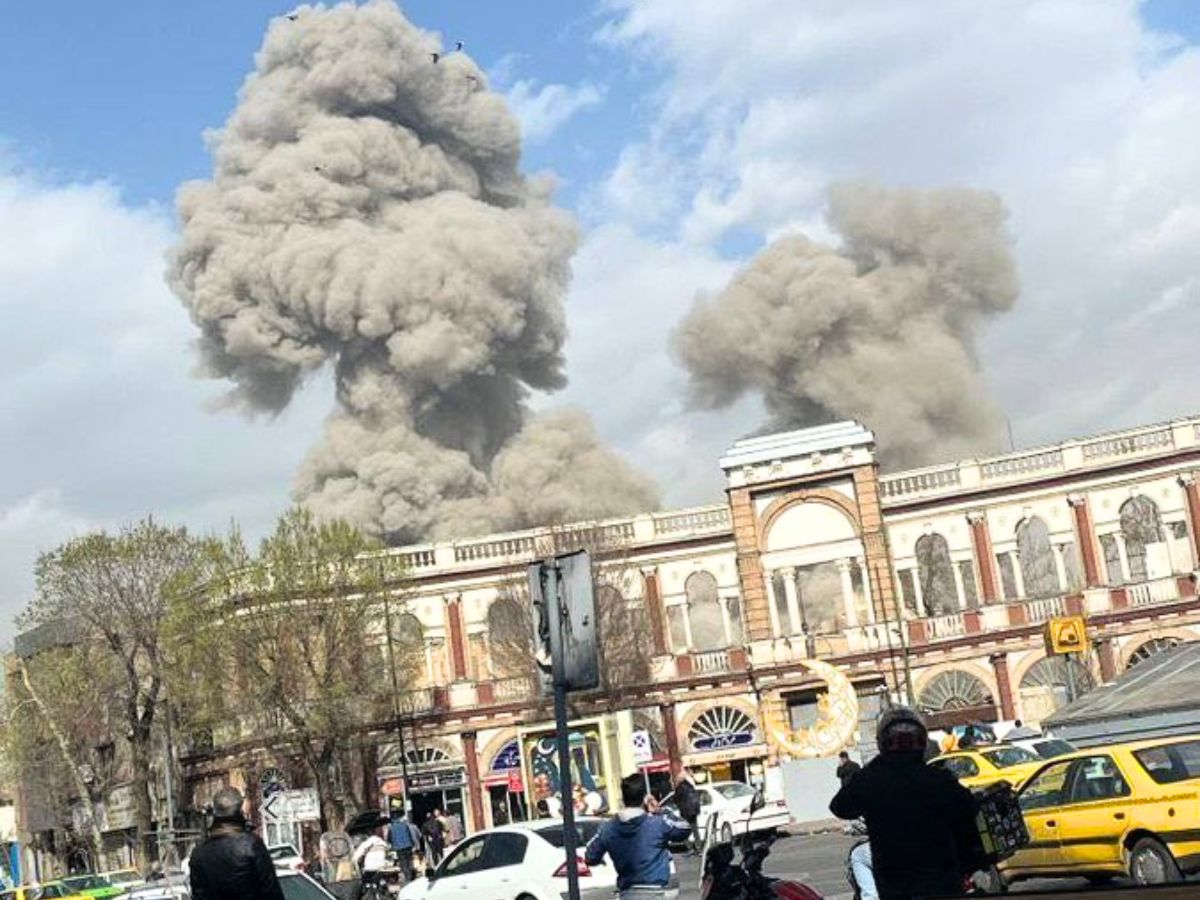
Middle East on edge as US-Iran war erupts. (Photo: X/@bulkybxt)
Tensions in the Middle East have surged dramatically after US President Donald Trump confirmed on Saturday that the United States has begun “major combat operations in Iran,” marking a dangerous new phase in the long-simmering standoff between Washington and Tehran.
Israel earlier announced it had launched a “preemptive strike” against Iran, with explosions reported in Tehran. The operation, reportedly named “Roar of the Lion,” targeted strategic Iranian sites. Within hours, Iran retaliated with a wave of missiles aimed at Israel, triggering air raid sirens and emergency alerts across the country.
The rapid escalation has raised fears that the US-Iran conflict could spiral into a broader regional confrontation involving Gulf nations and Iran-backed groups.
Following coordinated US-Israel strikes on Iranian targets, Iran launched a large-scale missile barrage at Israel. Israeli air defence systems were activated nationwide, intercepting several incoming projectiles, while authorities declared a state of emergency.
President Trump defended the strikes as necessary to prevent Iran from acquiring nuclear weapons, stating that Tehran “can never have a nuclear weapon.” He also acknowledged that US casualties remain a possibility if the conflict intensifies.
Airspace closures in Iran and Israel, disruptions to commercial aviation, and heightened security alerts at American embassies across the Gulf underscore the seriousness of the unfolding crisis.
If Iran widens its retaliation, analysts believe American military bases across the Gulf could become primary targets. The United States maintains tens of thousands of troops in the region under the US Central Command (CENTCOM), with installations strategically positioned in key Gulf countries.
Here’s a closer look at major American military bases across the Middle East:
In Bahrain, the Naval Support Activity Bahrain hosts the US Navy’s Fifth Fleet and US Naval Forces Central Command. The deep-water port accommodates aircraft carriers and other large vessels, making it a critical hub for maritime security operations in the Persian Gulf.
The base has been operational since 1948 and remains central to US naval strategy in the region.
Al Udeid Air Base in Qatar is the largest US military installation in the Middle East. Established in 1996, it houses more than 11,000 coalition and American personnel and can accommodate around 100 aircraft and drones.
Al Udeid serves as a forward headquarters for CENTCOM’s air forces and special operations units. It has previously been targeted by Iranian missiles during earlier escalations.
In Kuwait, the US operates Camp Arifjan, the forward headquarters for the US Army component of CENTCOM.
Ali al-Salem Air Base hosts the 386th Air Expeditionary Wing and functions as a primary airlift hub for regional operations. The US also deploys MQ-9 Reaper drones from Kuwaiti facilities.
The United States maintains troops in Iraq, particularly in the autonomous Kurdish region, as part of the coalition against the Islamic State group. While Washington has reduced its footprint under agreements with Baghdad, American forces remain exposed to potential retaliation from Iran-backed militias operating in Iraq.
US forces also remain deployed in Syria to counter the remnants of the Islamic State group. American personnel in Syria have faced repeated attacks in recent years, highlighting the risks of operating in a volatile theatre influenced by Iranian-backed actors.
In the United Arab Emirates, Al Dhafra Air Base hosts the US 380th Air Expeditionary Wing. The facility supports combat aircraft rotations and advanced air warfare training, along with drone operations.
Its proximity to Iran makes it strategically significant in any potential escalation.
Beyond direct military exchanges, Iran-backed groups such as the Houthis in Yemen have signalled possible missile and drone attacks on shipping routes and Israeli targets. Such moves could widen the conflict to critical maritime corridors in the Red Sea and the Strait of Hormuz, threatening global energy supplies.
With nuclear talks between Washington and Tehran stalled, diplomatic channels appear strained. International leaders have called for restraint, but military posturing on all sides suggests the crisis may deepen before de-escalation efforts gain traction.
As Iran and the United States openly exchange strikes, the Middle East stands at a precarious crossroads. American military bases across the Gulf are now on heightened alert, and the possibility of a sustained, multi-front confrontation cannot be ruled out.
Whether the conflict remains contained or expands into a prolonged regional war may depend on diplomatic backchannels and the calculations made in Washington, Tehran, and allied capitals in the coming days.
Sofia Babu Chacko is a journalist with over five years of experience covering Indian politics, crime, human rights, gender issues, and stories about marginalized communities. She believes that every voice matters, and journalism has a vital role to play in amplifying those voices. Sofia is committed to creating impact and shedding light on stories that truly matter. Beyond her work in the newsroom, she is also a music enthusiast who enjoys singing.
IDF releases first aerial footage of massive airstrikes under Operation Lion’s Roar targeting missile sites.
EXPLOSIONS in Riyadh, Saudi Arabia! Will Cristiano Ronaldo Play For Al Nassr Against Al Fayha?
Amidst the ongoing conflict between Israel and Iran, loud explosions were reportedly heard in Riyadh,…
This week carries a Number 6 tone, which brings focus to relationships, responsibility, home, reputation,…
