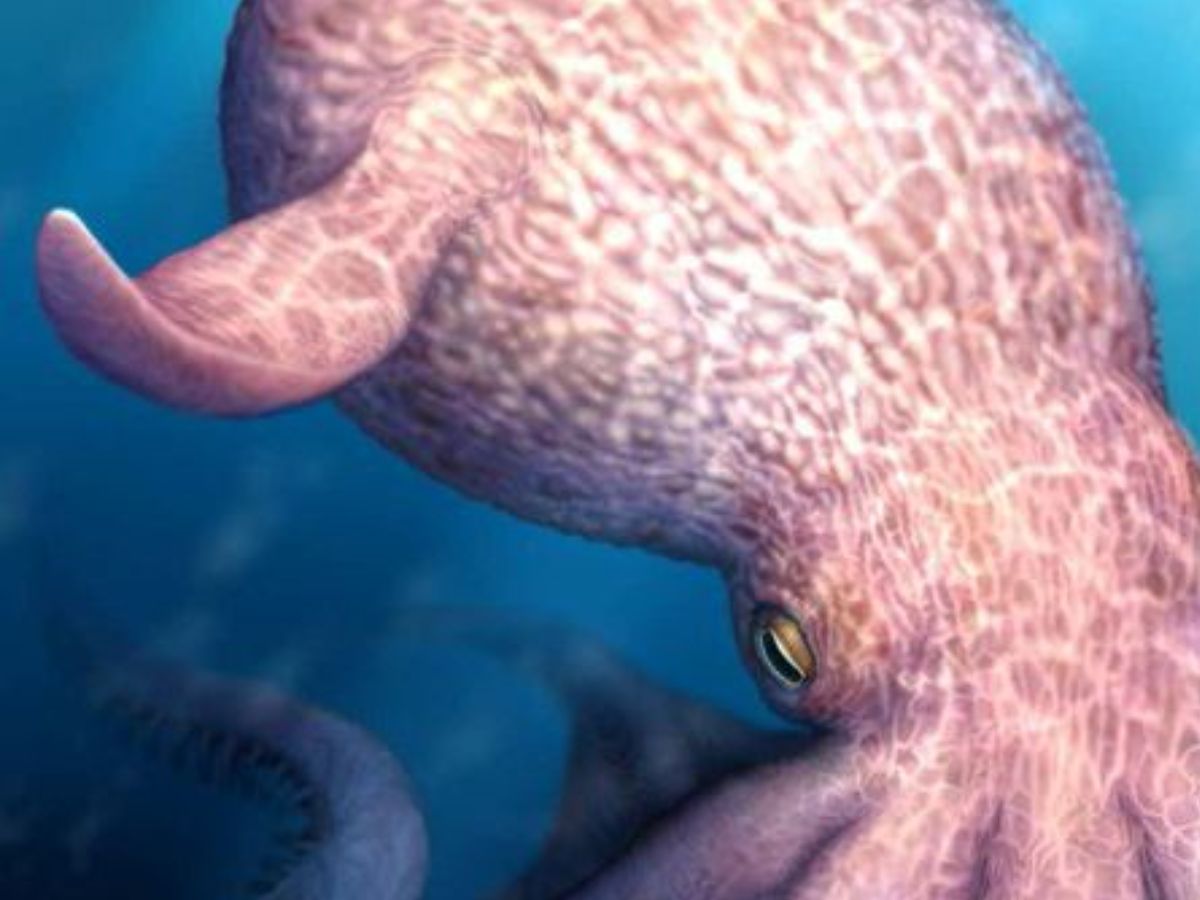
(Image Credit: Yohei Utsuki, Department of Earth and Planetary Sciences, Hokkaido University)
Nanaimoteuthis: According to Norse mythology, the Kraken is a massive tentacled sea monster that pulls sailors and ships into the deep. According to recent research, a giant octopus that prowled the waters as an apex predator lived during the dinosaur era, and it was as near to a real-life Kraken as it gets.
Nanaimoteuthis: According to scientists, fossils of beaks, the hard jaw structure of soft-bodied invertebrates, show that Nanaimoteuthis haggarti, an octopus species that existed between 86 and 72 million years ago during the Cretaceous Period, reached in length from 22 to 61 feet (6.6 to 18.6 meters). “These creatures were extraordinary. According to palaeontologist Yasuhiro Iba of Hokkaido University in Japan, the primary author of the study that was published on Thursday in the journal Science, “they represent what could be described as a real ‘Cretaceous Kraken,’ with their large bodies, long arms, powerful jaws, and advanced behaviour.” “For roughly the past 370 million years, marine ecosystems have been thought to be dominated by large vertebrate predators – first fishes and sharks, then marine reptiles and later whales. Our study shows that giant invertebrates, namely octopuses, also functioned as apex predators in the Cretaceous sea,” Iba said. Iba said Nanaimoteuthis haggarti is one of the largest invertebrates on record.
Nanaimoteuthis: “Until now, the largest-known invertebrate has been the modern giant squid, which can reach about 12 meters (39 feet) in total length,” Iba stated. According to the researchers, the severe wear shown on the beaks is compatible with the frequent crushing of hard objects like bones and shells, which is suggestive of a predator that pursued clams, giant fish, shelled tentacled animals, and other substantial prey. The largest specimens seem to have lost almost 10% of their entire jaw length as a result of wear. Iba stated that this is more severe than what is usually observed in contemporary cuttlefishes and octopuses that consume hard prey. The beaks were shaped like those of certain deep-sea octopuses alive today that swim with the help of fins, leading the researchers to conclude that these Cretaceous octopuses also bore fins.
Nanaimoteuthis: The numerous beak fossils studied in the research came from Japan and Canada’s Vancouver Island. The researchers reexamined previously known specimens and discovered new fossils as well. The researchers also studied the beaks of a close relative called Nanaimoteuthis jeletzkyi that lived about 100 to 72 million years ago. It was not quite as big, ranging from 9 to 25 feet (2.8 to 7.7 meters) long, but also was an active predator. Because octopuses are soft-bodied animals, they seldom fossilize well. The beak, the only rigid part of the octopus body, is made of a hard and durable material called chitin, also found in the exoskeletons of crabs, lobsters and insects. Guided by modern-day octopus anatomy, the researchers were able to estimate the size of the Cretaceous octopuses based on the dimensions of the beaks.
Nanaimoteuthis: “Octopuses are not simply biting predators. They use long, flexible arms to capture prey and powerful jaws to process it. As body size increases, their ability to control large prey with their arms and to process it with their jaws also increases,” Iba said. “In addition, octopuses are among the most intelligent invertebrates. In our fossils, the jaws show asymmetric wear, suggesting lateralized behavior – favoring one side over the other, something like handedness. This indicates not only strength, but also advanced and flexible behavior,” Iba said.
Nanaimoteuthis: These octopuses coexisted alongside other huge predators in the Cretaceous seas, such as sharks that were comparable in size to modern great white sharks and marine reptiles known as plesiosaurs and mosasaurus, which could grow up to 50 feet (15 meters) in length. “These giant octopuses likely occupied the same ecological tier and may have competed with marine reptiles and sharks within the same ecosystem,” Iba stated. Our perception of ancient oceans is altered by their presence. Giant invertebrates like octopuses now occupy the top of the food web in ecosystems that were formerly dominated only by vertebrate predators.
(With Inputs From Reuters)
Canada Introduces Bill To Ban Social Media For Children Under 16 And Regulate AI Chatbots
Canada has introduced a new digital safety bill that would ban social media for children…
Why Epstein Allegedly Tried To Blackmail Bill Gates Over Extramarital Affairs
Bill Gates told Congress he did not fully understand Jeffrey Epstein's crimes and denied witnessing…
US Launches New Strikes On Iran After Trump Threatens ‘Very Hard’ Response
The United States has launched a fresh wave of airstrikes against Iran, targeting multiple military…
