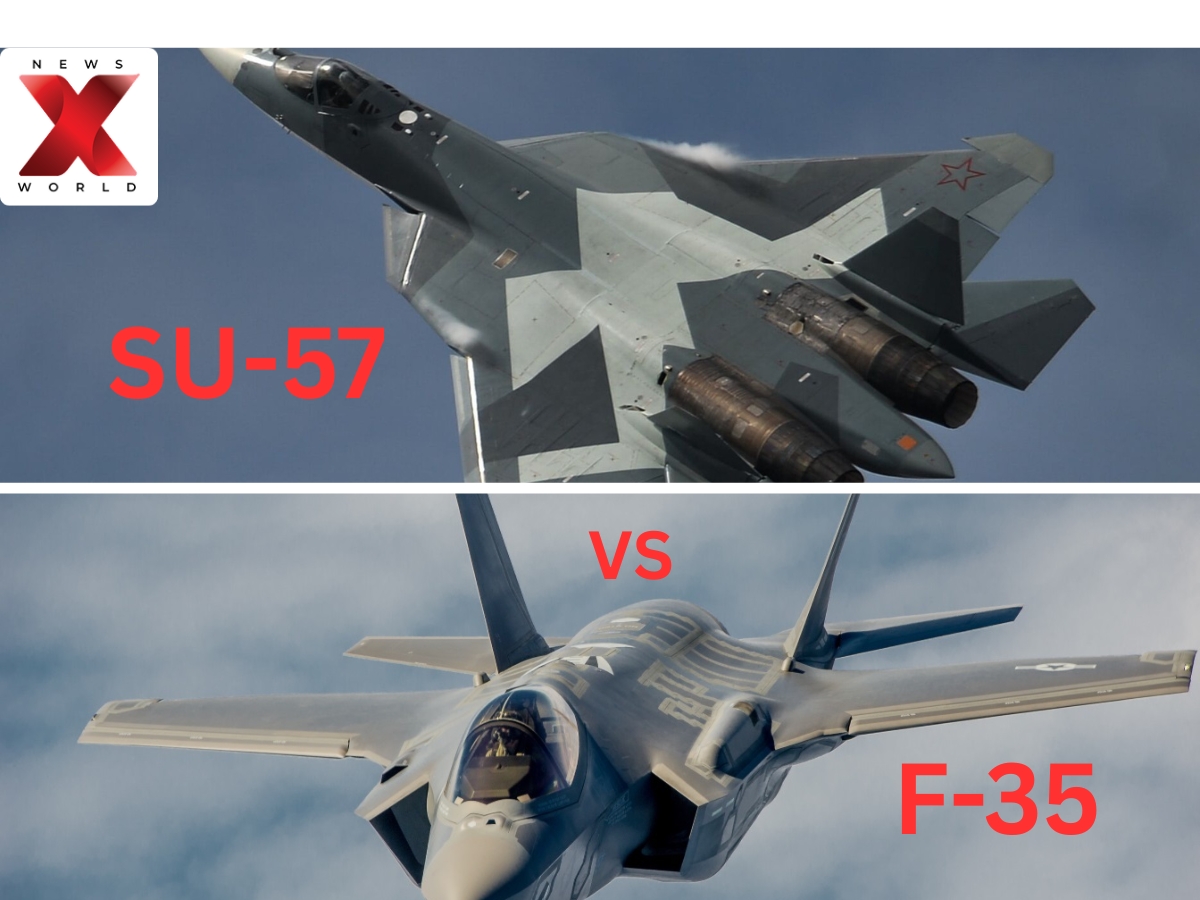
India weighs F-35 vs Su-57 fighter jets as AMCA faces delays; comparing cost, specs, capabilities and strategic impact. Photos: X.
Su-57 Vs F-35 Fighter Jet: Russian President Vladimir Putin is in India on a two-day visit for the India-Russia Summit. Putin is holding talks with Indian Prime Minister Narendra Modi on a whole range of issues. However, the most headline-grabbing issue that is being discussed by the two leaders is the defence cooperation. The two countries are discussing whether India will acquire Russia’s SU-57 fighter jet and whether there would be technological transfer with the coveted purchase.
India is in a tight situation when it comes to the acquisition of the fifth-generation fighter jet. On one side, US President Donald Trump has offered India the opportunity to purchase the advanced F-35 Lightning II stealth fighter during his meeting with Prime Minister Narendra Modi at the White House. On the other side, Russia’s Rosoboronexport has also announced that it is ready to sell the Su-57E to India, with now talks in an advanced stage as heads of the countries discuss the potential deal.
India is facing this catch-22 situation as its indigenous AMCA is still years away from entering production, according to reports.
So, with limited choices of acquiring a fifth-generation fighter-jet, the question arises which one is better for India – F-35 or Su-57.
Here is a complete breakdown of the two competing offers, comparing the F-35 and Su-57E, their costs, global adoption, and what each option means for India’s strategic interests.
The F-35 is built by defense and aerospace manufacturer Lockheed Martin. It is a single-engine, single-seat, fifth-generation multirole stealth fighter. It is designed for a wide spectrum of operations including air-to-air combat and precision strikes to reconnaissance.
F-35 Fighter Jet comes in three variants which include F-35A, F-35B,and F-35C.
Top speed: Mach 1.6 (approx. 1,931 km/h)
Combat range: Around 1,500 km
Strengths: Highly advanced stealth, sophisticated avionics and sensor systems and strong situational awareness and network-centric warfare capability.
The F-35 program is backed by one of the largest global defence ecosystems, offering interoperability with NATO forces and extensive logistical support.
Russia’s Sukhoi-designed Su-57 is a twin-engine, fifth-generation multirole fighter built for air superiority and strike capabilities. It emphasises manoeuvrability, speed and weapons-carrying versatility. At Aero India 2025, where both the F-35 and Su-57 were showcased, a Russian representative reiterated that Moscow is ready to supply the Su-57 to India.
Top speed: Mach 2 (approx. 2,136 km/h)
Combat range: About 1,900 km
Features: Capable of carrying weapons internally and externally, advanced manoeuvrability and is fesigned for both air-to-air and air-to-ground combat.
Unit cost: $80–110 million (variant-dependent)
Lifetime program cost: Expected to exceed $1.5 trillion, including maintenance, spares and upgrades
Unit cost: Roughly $35–$40 million, less than half the price of an F-35
Trade-off: Lower costs but without the F-35’s extensive support ecosystem
India has a deep military partnership with Russia. The IAF already operates several Russian-origin platforms, including the Su-30MKI. Introducing the Su-57 would align naturally with India’s existing ecosystem.
However, the US offer gives India a chance to diversify defence acquisitions and access cutting-edge Western technologies. The F-35’s stealth and battlefield networking systems are regarded as among the most advanced globally. But there are constraints
US equipment often comes with strict conditions, which can create hesitation. Integrating a completely new platform will require major changes in training and infrastructure. Also, buying foreign stealth fighters may affect funding and timelines for India’s indigenous AMCA program.
According to reports, India is developing its own fifth-generation fighter, named the Advanced Medium Combat Aircraft (AMCA. It is being developed by HAL and DRDO’s Aeronautical Development Agency. AMCA is not expected to enter service before 2036 (The War Zone). According to reports, HAL first aimed for a prototype by 2025, but the project has been under development since 2010.
The delays have raised concerns about India falling behind China and Pakistan. China has already developed the J-35A, visually similar to the F-35. It has also inducted over 200 J-20 stealth fighters into the PLA Air Force.
India’s choice, whether to purchase the F-35, the Su-57E, or rely solely on its indigenous AMCA, will depend on cost, strategic autonomy, long-term defence planning, and the geopolitical implications of choosing either Washington or Moscow.
Zubair Amin is a Senior Journalist at NewsX with over seven years of experience in reporting and editorial work. He has written for leading national and international publications, including Foreign Policy Magazine, Al Jazeera, The Economic Times, The Indian Express, The Wire, Article 14, Mongabay, News9, among others. His primary focus is on international affairs, with a strong interest in US politics and policy. He also writes on West Asia, Indian polity, and constitutional issues. Zubair tweets at zubaiyr.amin
Pakistan rarely stays out of the headlines, and this time it is for a viral…
Chennai (Tamil Nadu) [India], March 05: As Tamil Nadu accelerates toward its ambition of becoming…
In a disturbing incident, two sisters were found dead inside their residence in South Delhi’s…
