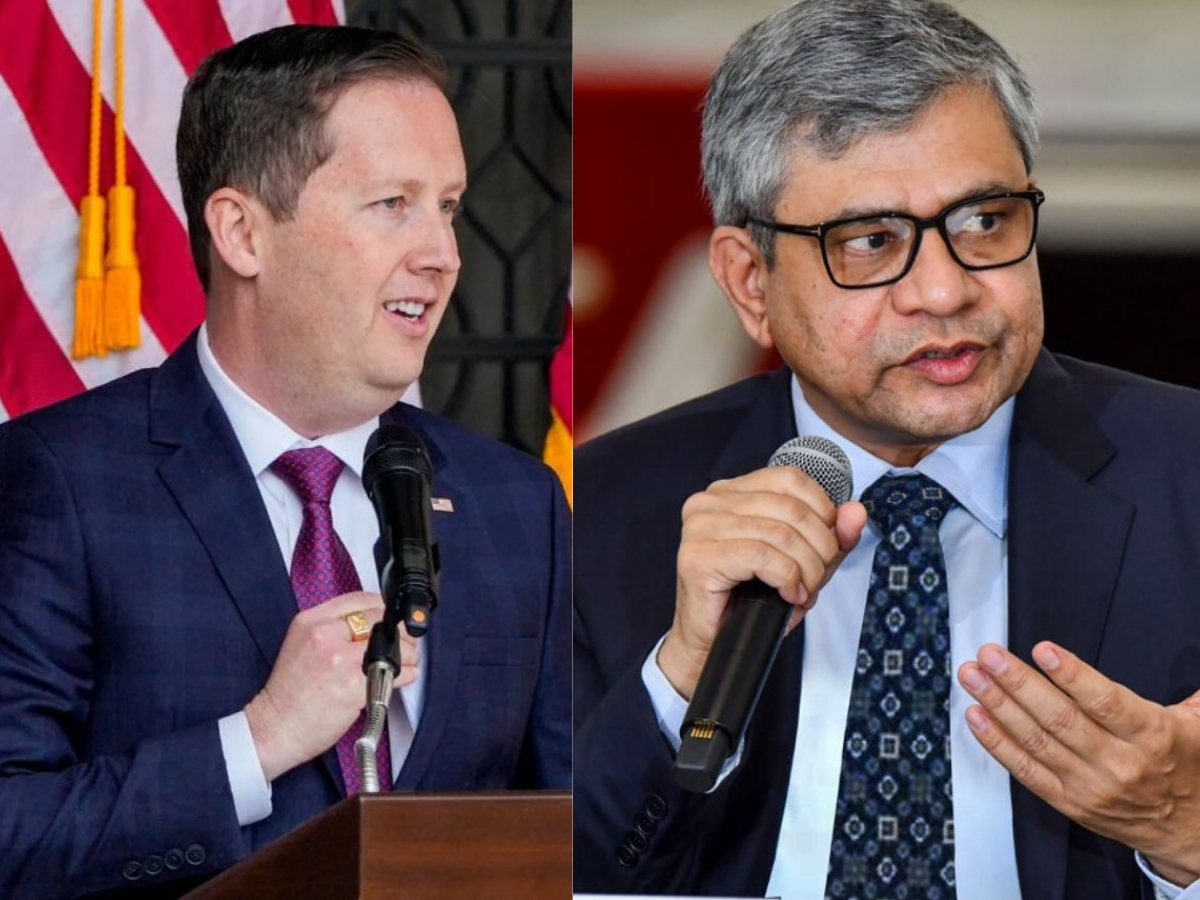
Trump plans to bring India into Pax Silica as Ashwini Vaishnaw joins US rare earths talks. Photos: X.
Pax Silica: The newly appointed US Ambassador to India, Sergio Gor, on Monday announced that the “next call” on trade between the two countries is scheduled for January 13. The ambassador also confirmed India’s inclusion in the Pax Silica initiative. The announcement has signaled a softening in tensions after New Delhi was initially left out of the US-led tech alliance.
Pax Silica is a US-led program designed to secure global AI and technology supply chains. According to the US State Department, the initiative aims to unite “friendly and trusted” countries to ensure that key technologies remain safe, reliable, and free from control by hostile actors.
Launched on December 12, the initiative is viewed as a strategic counter to China’s dominance in global manufacturing. It focuses on building a “secure, prosperous, and innovation-driven silicon supply chain,” covering areas such as critical minerals, energy inputs, advanced manufacturing, semiconductors, AI infrastructure, and logistics.
Initially, India was excluded from the list of participating countries, which included Japan, South Korea, Singapore, the Netherlands, the UK, Israel, the UAE, and Australia, raising concerns about potential friction over trade uncertainties. Around the same time, India invited China to participate in its AI Impact Summit scheduled for February, further highlighting its independent approach to global tech collaborations.
At a press interaction at the US Embassy in New Delhi, Ambassador Gor addressed ongoing trade negotiations:
“Many of you have asked me for an update on the ongoing trade deal negotiations. Both sides continue to actively engage. In fact, the next call on trade will occur tomorrow [January 13]. Remember, India is the world’s largest nation, so it’s not an easy task to get this across the finish line, but we are determined to get there.”
He emphasized that while trade remains a key pillar, the US-India relationship extends to multiple strategic areas:
“And while trade is very important for our relationship, we will continue to work closely together on other very important areas… such as security, counterterrorism, energy, technology, education and health. …. Today, I’m pleased to announce that India will be invited to join this group of nations as a full member next month.”
In parallel, Minister for Electronics and Information Technology Ashwini Vaishnaw participated in a Critical Minerals Ministerial Meeting hosted by US Treasury Secretary Scott Bessent in Washington, D.C. The meeting, part of a G7 engagement, also invited countries like India and Australia.
The discussions focused on “derisking” and “decoupling” critical mineral supply chains—a crucial step for reducing dependence on potentially hostile powers.
“Participated in the Critical Minerals Ministerial Meeting hosted by Treasury Secretary Scott Bessent. Strengthening critical mineral supply chains is vital to enhancing the resilience of India’s manufacturing capabilities and rapidly growing electronics sector,” Vaishnaw said in a social media post.
For the Trump administration, securing leadership in critical minerals and rare earths is a top priority. Officials have warned that the US’s national and economic security is threatened by reliance on foreign mineral production from hostile powers.
According to the International Energy Agency, China is the leading refiner of several key minerals, including copper, lithium, nickel, cobalt, graphite, and rare earth elements, controlling approximately 70% of the global market.
The West’s growing concern over China’s manufacturing dominance has prompted multinational companies to adopt a China-plus-one strategy post-COVID-19. The US has pursued decoupling strategies and a trade war with China, creating an opportunity for India to capture a share of the shifting global manufacturing supply chain.
Experts note that countries participating in Pax Silica are leaders in the AI and semiconductor sectors, and India’s inclusion could provide access to joint ventures and strategic co-investments.
India currently lacks a global-scale AI infrastructure. Experts say that membership in Pax Silica could boost New Delhi’s growth in technology-heavy sectors, reduce import dependency, and strengthen its role in global tech supply chains.
Zubair Amin is a Senior Journalist at NewsX with over seven years of experience in reporting and editorial work. He has written for leading national and international publications, including Foreign Policy Magazine, Al Jazeera, The Economic Times, The Indian Express, The Wire, Article 14, Mongabay, News9, among others. His primary focus is on international affairs, with a strong interest in US politics and policy. He also writes on West Asia, Indian polity, and constitutional issues. Zubair tweets at zubaiyr.amin
Fresh explosions rocked Tehran after Israel launched what it called a “pre-emptive attack” on Iran,…
Ravi Shastri Gets Big Honour: MCA to Name Wankhede Stadium Stand After India Legend
Under the Mumbai Cricket Association’s special tribute initiative, former India captain and head coach Ravi…
Iran-US-Israel War: Does Iran Already Have A Nuclear Bomb – And If Yes, Will It Nuke Israel?
Israel’s pre-emptive strike on Iran has reignited global fears over Tehran’s nuclear ambitions and the…
