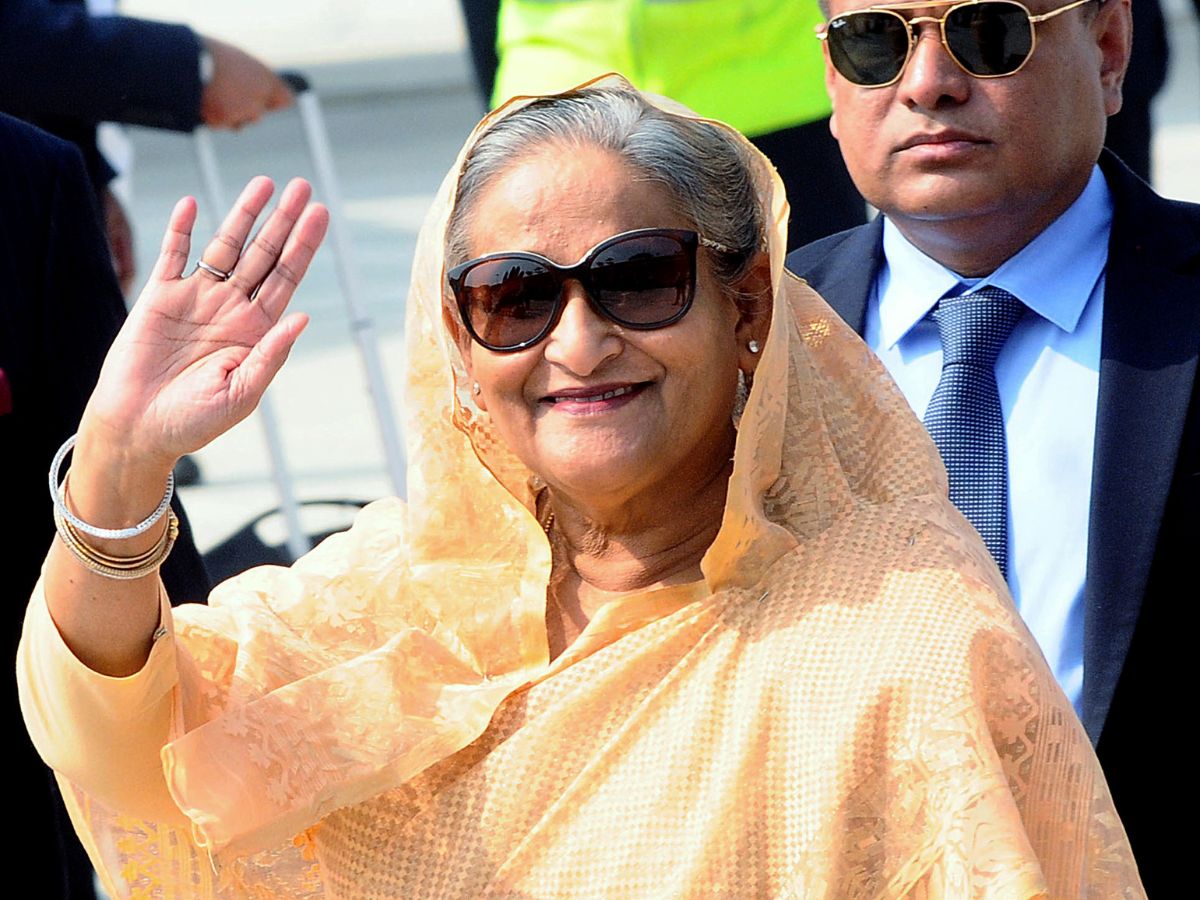
Report Says US Funding Pattern In Bangladesh Aligns With Hasina Govt’s Fall (Photo: ANI, file photo)
A latest report of the Bangladesh Human Rights Watch levels damning allegations of US funding regime change in India’s neighbouring country in the years before the fall of the Sheikh Hasina government.
The report states that US foreign assistance to Bangladesh remained flat through the 2000s, accelerated from 2018 onwards, reached an all-time peak of USD 572,530,819 in precisely the year of the coup, and declined sharply into 2025 and 2026.
The report accessed by The Daily Guardian exclusively states that the trajectory is not consistent with normal development assistance patterns, which tend to grow or remain stable.
“It is consistent with the lifecycle of a targeted political operation: investment phase, activation phase, transition phase, withdrawal phase,” it states.
Titled “Foreign Engineering of Regime Change 2018-2016,” the report states that “US foreign assistance to Bangladesh remained relatively flat through the 2000s, accelerated from approximately 2018 onward (the year NED and USAID governance programming intensified), reached an all-time peak of USD 572,530,819 in fiscal year 2024 – precisely the year of the coup (when Sheikh Hasina government was toppled and she had to escape out of Bangladesh)- and declined sharply into 2025 and 2026,” the report states.
“Bangladesh occupies a geopolitically critical position at the northern apex of the Bay of Bengal. The Bay of Bengal is the primary maritime corridor connecting the Indian Ocean to the South China Sea, and its control is a central theatre of US-China strategic competition under the Indo-Pacific Command (INDOPACOM) framework. Bangladesh’s coastline, river delta geography, and proximity to both Myanmar and the Chittagong Hill Tracts make it a high-value location for any regional military posture. Under Sheikh Hasina’s government, Bangladesh pursued a multi-vector foreign policy that included substantial Chinese infrastructure investment, most notably within the framework of the Belt and Road Initiative (BRI).
China financed and built the Padma Bridge’s railway link, the Karnaphuli Tunnel, and multiple power generation projects. Bangladesh did not join QUAD and maintained studied neutrality between Washington and Beijing. This posture was strategically inconvenient for the United States. A government unwilling to host US military infrastructure or pivot away from Chinese investment represented an obstacle to INDOPACOM’s containment architecture in South Asia,” the report states.
The report states that the single largest traceable governance grant in Bangladesh was awarded to Democracy International (DI) for the Strengthening Political Landscape (SPL) programme.
“Running from March 2017 to October 2025, the programme received USD 29,900,000 from USAID-OM…,” it says.
“Sub-awardees under DI’s SPL programme included The Global Hunger Project (USD 951,747 in two tranches), M/S Beatnik (USD 102,199), and (name)…. newspaper (USD 29,438 in two tranches). The presence of a major Bangladeshi daily newspaper as a sub-awardee of a US-funded political landscape programme raises direct questions about editorial capture and media manipulation,” the report adds.
Further, the report states that DI also received a USD 1,100,000 grant in October 2024 – after the coup – for the USAID Responsive Local Governance Activity running to September 2029.
“This confirms that the US operational presence in Bangladesh’s governance architecture continued and was renewed following the transition,” it states.
Consortium for Elections and Political Process Strengthening (CEPPS) – a joint vehicle comprising the International Republican Institute (IRI), the National Democratic Institute (NDI), and the International Foundation for Electoral Systems (IFES) – received USD 21,000,000 for the ‘Amar Vote Amar (AVA)’ activity, running August 2022 to July 2025, the report states.
“A prior CEPPS programme, the Bangladesh Elections Support Activity (BESA), received USD 7,600,000 from January 2013 to January 2016. The AVA programme was the primary US vehicle for shaping Bangladesh’s 2024 electoral environment. Its sub-award architecture is notably layered, consistent with the source document’s observation that ‘much of these grants were broken down and awarded to sub-grantees to hide transaction traces,” it further states.
The report further says that “Counterpart International (CI) received USD 10,500,000 from USAID for the Promoting Advocacy and Rights programme, running April 2018 to October 2024. CI was a downstream implementing partner of both USAID’s SPL programme and the UK DFID’s SPP2 programme, making it one of the key nodes connecting the US and UK intervention architectures.”
“The Cooperative for Assistance and Relief Everywhere (CARE) received USD 9,655,000 from USAID-OM for the Bangladesh Integrated Youth Activity, running June 2023 to June 2028. Stated purpose: to ‘increase the meaningful participation of Bangladeshi youth within their communities and in the economy,’ the report states.
“Sub-awardees included Jaago Foundation (USD 932,669) and Bangladesh Youth Leadership Center (USD 1,067,715) – organisations with documented histories of receiving US public diplomacy funding,” it said.
Citing the testimony of NED President Damon Wilson before the US Congress (in February 2025), the report notes that NED-supported partners helped advance electoral reforms, monitor the integrity of the process, and promote voter education in the lead-up to Bangladesh’s most recent elections.”
The report further states that BRAC, Bangladesh’s largest and most institutionally embedded domestic NGO, received USD 14,700,000 from USAID under the BAMA programme, running from June 2023 on an ongoing basis.
“Stated objectives included: strengthening democracy for an inclusive society, fostering sustainable economic growth, advancing human capital development, and strengthening resilience to shocks. BRAC’s institutional reach across Bangladesh’s rural and urban civil society made it an exceptionally high-leverage conduit for political messaging and mobilisation,” the report states.
It adds that the most significant dollar volumes in the US assistance portfolio are concentrated not in governance grants but in education programmes.
“This is structurally significant: large education contracts provide financial cover, maintain institutional presence, and build youth networks that can be activated for political purposes,” the report said.
“The most operationally striking component of the US intervention architecture is the involvement of the US Department of the Navy through the Naval Supply Systems Command (NAVSUP), Singapore office. Over a decade, NAVSUP channelled contracts into Bangladesh for programmes that have no plausible relationship to naval supply logistics,” the report states.
Citing former US state department official Mike Benz who had publicly stated that he had proof that the US had actively interfered in the domestic politics of multiple nations, including India and Bangladesh, the report said that Benz had “identified US-funded Bangladeshi rap groups producing protest songs as a documented tactic.”
“The Association of American Voices grant (USD 66,600 from DOS Bureau of South and Central Asian Affairs) for ‘Youth Excellence on Stage (YES) Academy – engage and train Bangladeshi youth in American hip-hop music’ directly corroborates this claim. The USD 923,400 contract awarded to undisclosed domestic awardees by USAID for ‘Social Movements and Collective Action Expertise’ running from August 2023 to December 2024 is particularly significant. The description explicitly names the programme purpose as providing expertise in social movements. This is a contract for protest organising infrastructure, disbursed less than one year before the August 2024 uprising,” it said.
It further states that the Global Youth Leadership Center grant dated 30 September 2024 – weeks after the coup – stated its purpose as “amplifying youth voices ‘ultimately influencing the interim government’s reform agenda and future political priorities.’ This demonstrates that the same funding pipeline that built the mobilisation capacity was immediately redirected to consolidating the post-Hasina order,” the report said.
Khalid Qasid is a media enthusiast with a strong interest in documentary filmmaking. He holds a Master’s degree in Convergent Journalism from AJK MCRC. He has also written extensively on esports at Sportsdunia. Currently, he covers world and general news at NewsX Digital.
Delhi Metro Expansion Plan 2026: 36 KM Corridor With 37 Stations Approved
Delhi Metro Phase IV expansion includes a 36-km corridor with 37 stations. Here's everything you…
Google Layoff Workers In Cloud Division Amid AI Push
Google has reportedly laid off employees in its Cloud division, including teams from Mandiant and…
Stock Market Today | Closing Bell |Benchmark indices Nifty and Sensex ended marginally lower on…
