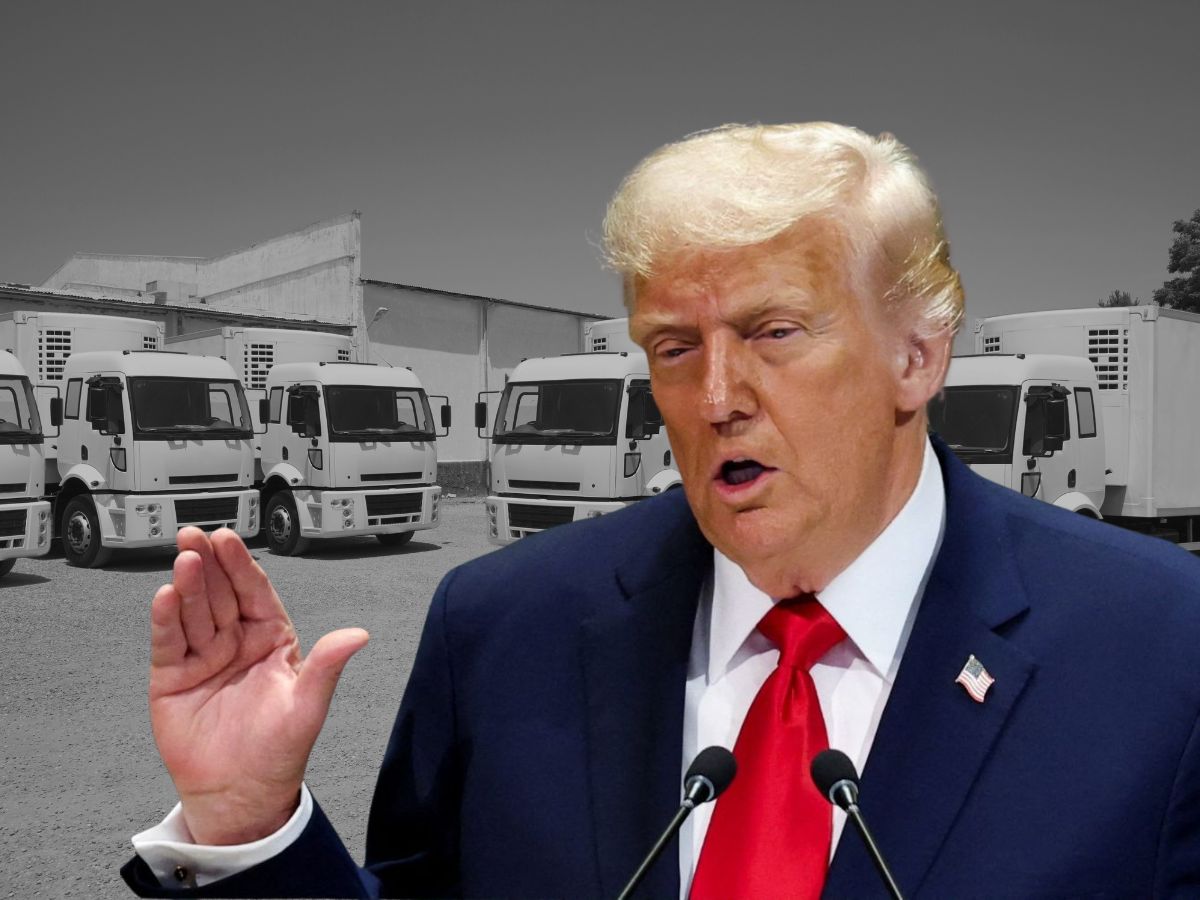
US crackdown forces more than 7,000 truck drivers off the road for failing English tests. (Photo: ANI, Canva)
The United States has removed more than 7,000 commercial truck drivers from service this year for failing mandatory English proficiency tests a sudden crackdown that has disproportionately affected Indian-origin drivers, particularly Sikhs from Punjab and Haryana.
According to US Transportation Secretary Sean Duffy, 7,248 drivers have been taken off the roads as of October 2025 based on real-time roadside English Language Proficiency (ELP) checks recorded by the Federal Motor Carrier Safety Administration (FMCSA). The number marks a sharp rise from 1,500 disqualifications reported in July, indicating intensified enforcement over the past few months.
The North American Punjabi Truckers Association estimates that between 130,000 and 150,000 Indian-origin truck drivers work in the US trucking industry, most of them Punjabi Sikhs. Nearly 90 percent of Sikhs employed in the trucking sector work as drivers, making them particularly vulnerable to the crackdown.
The new enforcement follows President Donald Trump’s 2025 executive order declaring English the official national language of the United States. The order reinstated a rule that requires all commercial truck drivers to speak and understand English well enough to read road signs, communicate with police and authorities, and maintain transport documentation. The rule, cited as 49 CFR 391.11(b)(2), directs law enforcement officials to immediately take drivers off duty if they fail to demonstrate English proficiency during inspections.
Transportation Secretary Sean Duffy defended the policy, stating that America’s roads will be “safer alongside truckers who can understand and interpret our traffic signs.” He emphasized that failure to meet the English requirement would no longer result in a mere warning but lead to immediate disqualification.
The renewed enforcement gained urgency after a series of high-profile accidents allegedly involving Indian truck drivers, including a deadly pileup in California in which an Indian-origin driver was accused of killing three people, and a Florida crash that left three dead after a tractor-trailer driven by a man from India who had repeatedly failed commercial driving tests attempted a dangerous U-turn.
FreightWaves, a price reporting agency that tracks FMCSA data, reported that at least 5,006 English-related violations have already been recorded this year, and the number continues to rise as more states begin on-spot enforcement.
However, trucking industry groups argue that the rule is discriminatory and unnecessarily punitive. Businesses near the southern border, where many bilingual or Spanish-speaking drivers operate, say experienced drivers are being disqualified not for lack of knowledge, but due to communication barriers during roadside checks. “This is not a safety issue it’s a communication style issue,” said Adalberto Campero, CEO of Texas-based carrier Unimex, adding that many drivers have transported goods safely for years.
Sikh advocacy groups have also raised concerns that an interim rule introduced by the Trump administration could lead to thousands more immigrant drivers losing their commercial licences. For many Punjabi truckers, trucking has been a reliable pathway to financial stability in the US. The sudden enforcement has triggered fear within the community, with drivers worried that minor language challenges could cost them their livelihood.
The United States depends heavily on immigrant drivers especially in states like Texas and California, where India is among the top source countries for commercial driving licenses. Any disruption in this labor pool could pose challenges for an already strained supply chain.
As enforcement of English proficiency tests expands nationwide, thousands of Indian-origin truckers now face uncertainty over their jobs and future in the American trucking industry.
Sofia Babu Chacko is a journalist with over five years of experience reporting on Indian politics, crime, human rights, gender issues, and stories about marginalized communities. She believes journalism plays a crucial role in amplifying unheard voices and bringing attention to issues that truly matter. Sofia has contributed articles to The New Indian Express, Youth Ki Awaaz, and Maktoob Media. She is also a recipient of the 2025 Laadli Media Awards for gender sensitivity. Beyond the newsroom, she is a music enthusiast who enjoys singing. Connect with Sofia on X: https://x.com/SBCism
Mumbai to Host III Russia–India Forum Connecting Russian Capital with Indian Businesses
Mumbai (Maharashtra) [India], March 16: National Stock Exchange (NSE) On March 19, 2026, the III…
Veteran actress Navnindra Behl passed away at the age of 76. On March 16, her…
The Bharatiya Janata Party has released its first list of 47 candidates for the Kerala…
