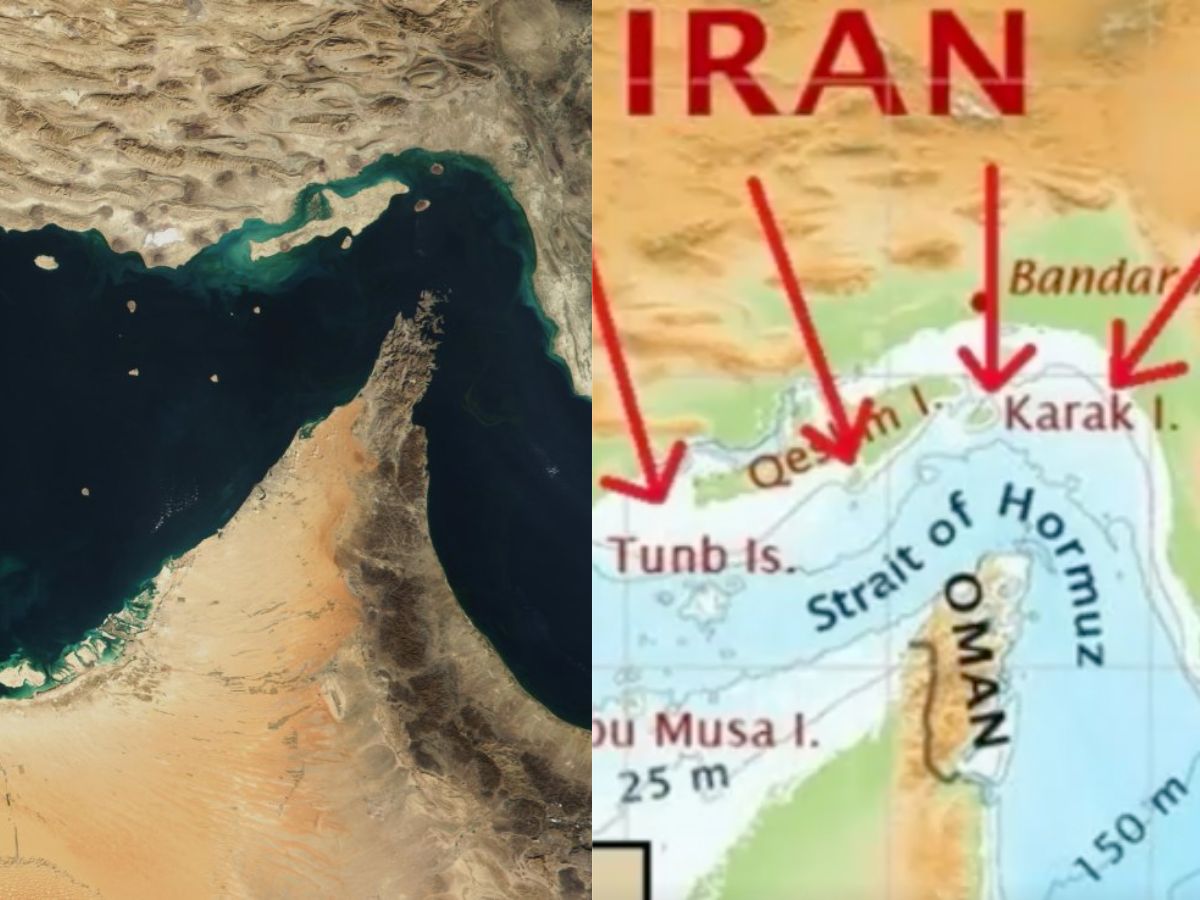
US strikes on Iran spark fresh fears over Strait of Hormuz disruption. (Photo: X)
Tensions in West Asia escalated sharply after the United States and Israel launched coordinated strikes on Iran, raising fears of wider conflict in the Gulf region.
At the heart of global concern lies the Strait of Hormuz, the world’s most critical oil transit chokepoint and a lifeline for India’s crude oil imports.
With nearly half of India’s monthly crude supplies passing through this narrow maritime corridor, any disruption could send shockwaves through energy markets and the Indian economy.
The Strait of Hormuz connects the Persian Gulf to the Gulf of Oman and the Arabian Sea. Roughly 20% of the world’s petroleum liquids consumption, about 21 million barrels per day, flows through this narrow channel. For Asian economies such as India, China, Japan, and South Korea, the strait is even more vital.
According to data from Kpler, nearly 50% of India’s monthly oil imports in January–February transited through the Strait of Hormuz, up from around 40% in late 2025. India currently imports approximately 2.6 million barrels per day (bpd) of crude through this route, primarily from Iraq, Saudi Arabia, the UAE, and Kuwait.
Given that India imports nearly 85-90% of its crude oil requirements, the country remains highly vulnerable to supply disruptions in the Gulf.
While the United States and Israel have stated that their military objective is to neutralise strategic targets in Iran, markets fear retaliation that could threaten shipping lanes.
Iran has, in the past, warned that it could block or disrupt traffic through the Strait of Hormuz in response to military aggression. Even without a full blockade, risks such as tanker seizures, missile threats, or mining of sea lanes could:
Spike global oil prices
Increase freight and insurance costs
Delay cargo deliveries
Trigger currency and fiscal pressures in oil-importing nations
Analysts caution that even the perception of risk in Hormuz can drive a geopolitical premium in Brent crude prices before any actual supply shortage materialises.
There are limited alternatives to bypass Hormuz. Saudi Arabia operates the East-West pipeline to the Red Sea, while the UAE has the Abu Dhabi Crude Oil Pipeline to Fujairah. However, these routes have finite capacity and are prioritised for producers’ export strategies.
In the event of a prolonged disruption, India may need to:
Increase sourcing from Russia
Turn to the United States, West Africa, or Latin America
Draw from strategic petroleum reserves
Deepen long-term term contracts
However, longer shipping routes from alternative suppliers would increase landed crude costs due to higher freight charges.
A disruption in the Strait of Hormuz would likely have immediate consequences:
1. Crude Oil Price Surge: Brent prices could rise sharply amid supply fears.
2. Higher Import Bill: India’s oil import costs would escalate.
3. Rupee Pressure: A widening current account deficit could weaken the currency.
4. Domestic Inflation: Rising fuel prices could push up transportation and food costs.
The Gulf escalation comes at a time when India had recently adjusted its crude sourcing mix, reducing dependence on Russian supplies and increasing imports from traditional Middle Eastern partners many of whom rely on the Hormuz route.
The Strait of Hormuz is not just important, it is irreplaceable in the short term. Between 2020 and 2022, oil flows through the strait rose significantly as global demand recovered post-pandemic. More than one-quarter of globally traded seaborne oil passes through it. Around one-fifth of global LNG trade also transits this narrow channel.
With escalating military tensions, the strategic waterway is once again in the geopolitical spotlight. Even a temporary disruption could have cascading effects across global energy markets.
The US strikes on Iran have reignited fears of instability in one of the world’s most sensitive energy corridors. For India heavily dependent on imported crude and deeply linked to Gulf suppliers the Strait of Hormuz represents both an economic lifeline and a strategic vulnerability.
Whether the conflict escalates further or stabilises diplomatically will determine if the world’s most vital oil transit chokepoint remains open or becomes the epicentre of a new global energy crisis.
Sofia Babu Chacko is a journalist with over five years of experience covering Indian politics, crime, human rights, gender issues, and stories about marginalized communities. She believes that every voice matters, and journalism has a vital role to play in amplifying those voices. Sofia is committed to creating impact and shedding light on stories that truly matter. Beyond her work in the newsroom, she is also a music enthusiast who enjoys singing.
IDF releases first aerial footage of massive airstrikes under Operation Lion’s Roar targeting missile sites.
EXPLOSIONS in Riyadh, Saudi Arabia! Will Cristiano Ronaldo Play For Al Nassr Against Al Fayha?
Amidst the ongoing conflict between Israel and Iran, loud explosions were reportedly heard in Riyadh,…
This week carries a Number 6 tone, which brings focus to relationships, responsibility, home, reputation,…
