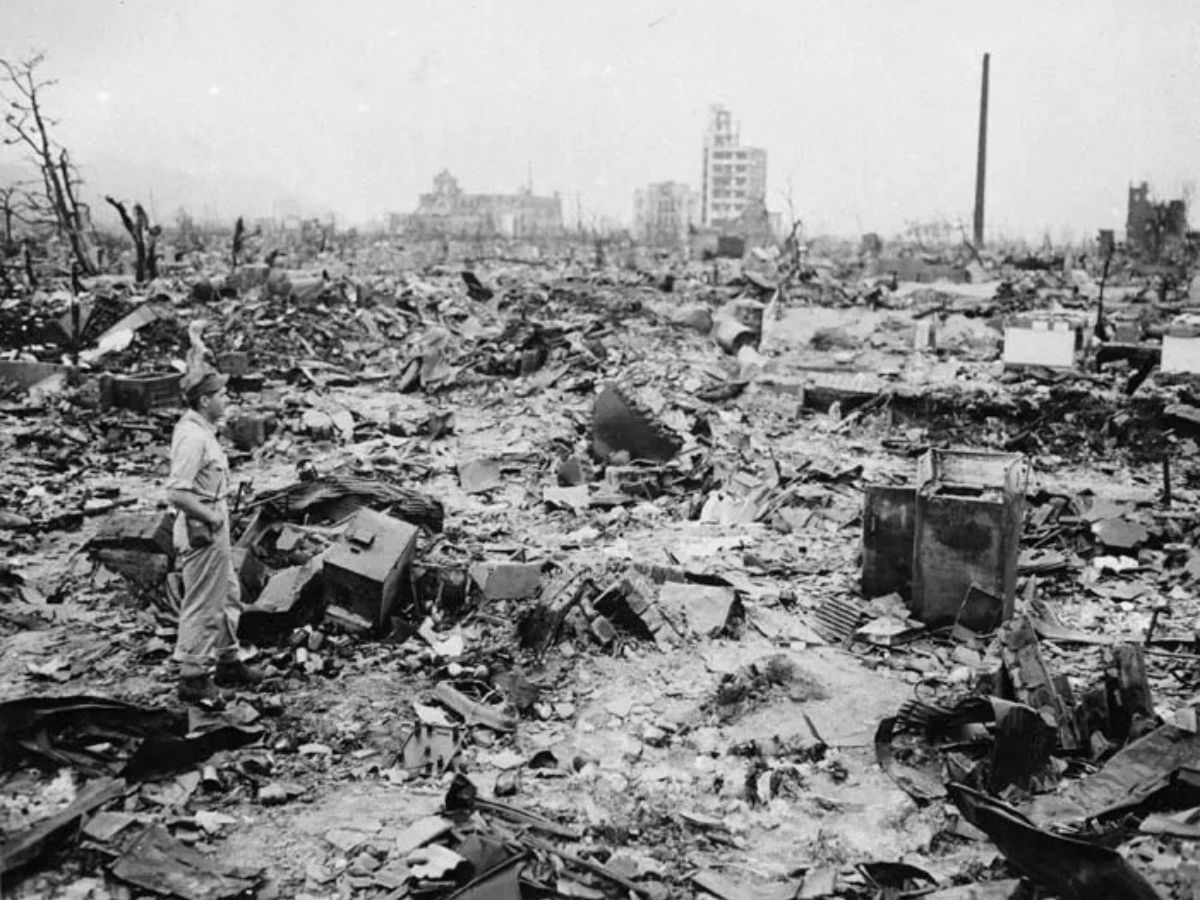
Japan marks 80 years since Hiroshima and Nagasaki bombings that killed over 200,000 and exposed millions to radiation. Photo/X.
Hiroshima And Nagasaki: Japan is commemorating 80 years since the atomic bombings of Hiroshima and Nagasaki by the United States during World War II. The devastating attacks claimed the lives of around 140,000 people in Hiroshima and another 74,000 in Nagasaki.
The first bomb was dropped on August 6, 1945, and the second followed three days later on August 9. The impacts were immediate and catastrophic, with long-term consequences for generations affected by radiation exposure and the fallout known as “black rain.”
Following the bombings, Hiroshima was enveloped in what the US War Department described as an “impenetrable cloud of dust and smoke.” In addition to the initial devastation, survivors were subjected to radiation sickness and environmental hazards. Many suffered from the after-effects of the so-called “black rain” that fell post-explosion.
Also Read: Hiroshima Day: Why the World Remembers August 6
A district court in Hiroshima in 2020, recognized that victims of this “black rain” suffered from illnesses directly caused by the fallout. The court ruled they were entitled to the same benefits as recognized atomic bomb survivors, or Hibakushas, including free medical care.
The atomic bombings were carried out during the final stages of World War II. US – Japan relations had sharply deteriorated, especially after Japanese forces moved toward Indochina in an attempt to seize oil-rich areas of the East Indies. In response, then US President Harry S. Truman authorized the use of nuclear weapons to force Japan into surrender.
“We are now prepared to obliterate more rapidly and completely every productive enterprise the Japanese have above ground in any city,” Truman warned at the time. “It was to spare the Japanese public from utter destruction that the ultimatum of July 26 was issued at Potsdam. If they do not now acknowledge our terms, they may expect a rain of ruin from the air.”
At 8:15 a.m. local time on August 6, 1945, the B-29 bomber Enola Gay dropped an atomic bomb named “Little Boy” on Hiroshima. The device had a blast equivalent to over 20,000 tonnes of TNT. According to the 1946 US Strategic Bombing Survey, the explosion occurred slightly northwest of the city center, killing over 80,000 people and injuring just as many. At the time, most industrial workers had already reported to work, many were commuting, and children were in school.
Three days later, at around 11:00 a.m. on August 9, a second atomic bomb, “Fat Man,” was dropped over Nagasaki. This attack killed more than 40,000 people. The same 1946 survey noted that Nagasaki’s mountainous terrain helped confine the damage to the valley directly below the blast, limiting the total area of destruction to about 1.8 square miles.
President Truman concluded that bombing a city would create a significant psychological and strategic impact. Cities were selected based on military value and lack of cultural significance to minimize the destruction of Japan’s heritage. Kyoto, for example, was spared due to its cultural importance.
Hiroshima was chosen as it was primarily a military hub, housing approximately 318,000 residents. It was the seventh-largest city in Japan and served as headquarters for the Second Army and the Chugoku Regional Army. The city also hosted one of the country’s largest military supply depots and was a key shipping point for troops and equipment.
The atomic bomb was the result of a joint US – British scientific endeavor under the codename Manhattan Project. The project included separate facilities for construction and research within the United States.
Before Truman’s presidency, Franklin D. Roosevelt had started the nuclear program after receiving a warning letter in 1939 from physicist Albert Einstein. Einstein alerted Roosevelt to the possibility that Nazi Germany was developing nuclear weapons, pushing the US to act quickly in the field of atomic research.
Q1: Who was the President of the US when it bombed Hiroshima and Nagasaki?
Harry S. Truman
Q2: What is the Manhattan Project?
Manhattan Project is a codename given to the joint scientific endeavor of the US and UK to build an atomic bomb.
Zubair Amin is a Senior Journalist at NewsX with over seven years of experience in reporting and editorial work. He has written for leading national and international publications, including Foreign Policy Magazine, Al Jazeera, The Economic Times, The Indian Express, The Wire, Article 14, Mongabay, News9, among others. His primary focus is on international affairs, with a strong interest in US politics and policy. He also writes on West Asia, Indian polity, and constitutional issues. Zubair tweets at zubaiyr.amin
Nirmala Sitharaman Announces Content Creator Labs in Schools and Colleges to Boost ‘Orange Economy’
Finance Minister Nirmala Sitharaman announced a strong government backing for India’s creative industries, known as…
Did Govinda Date His Former Co-Star Neelam Kothari In The 90s’? Actress Reveals, ‘Yeh Sach…’
Neelam Kothari breaks her three-decade silence, denying longstanding rumours of a romantic affair with Govinda…
Stock Market Today: Indian stock markets plunged after the Union Budget 2026 as a sharp…
