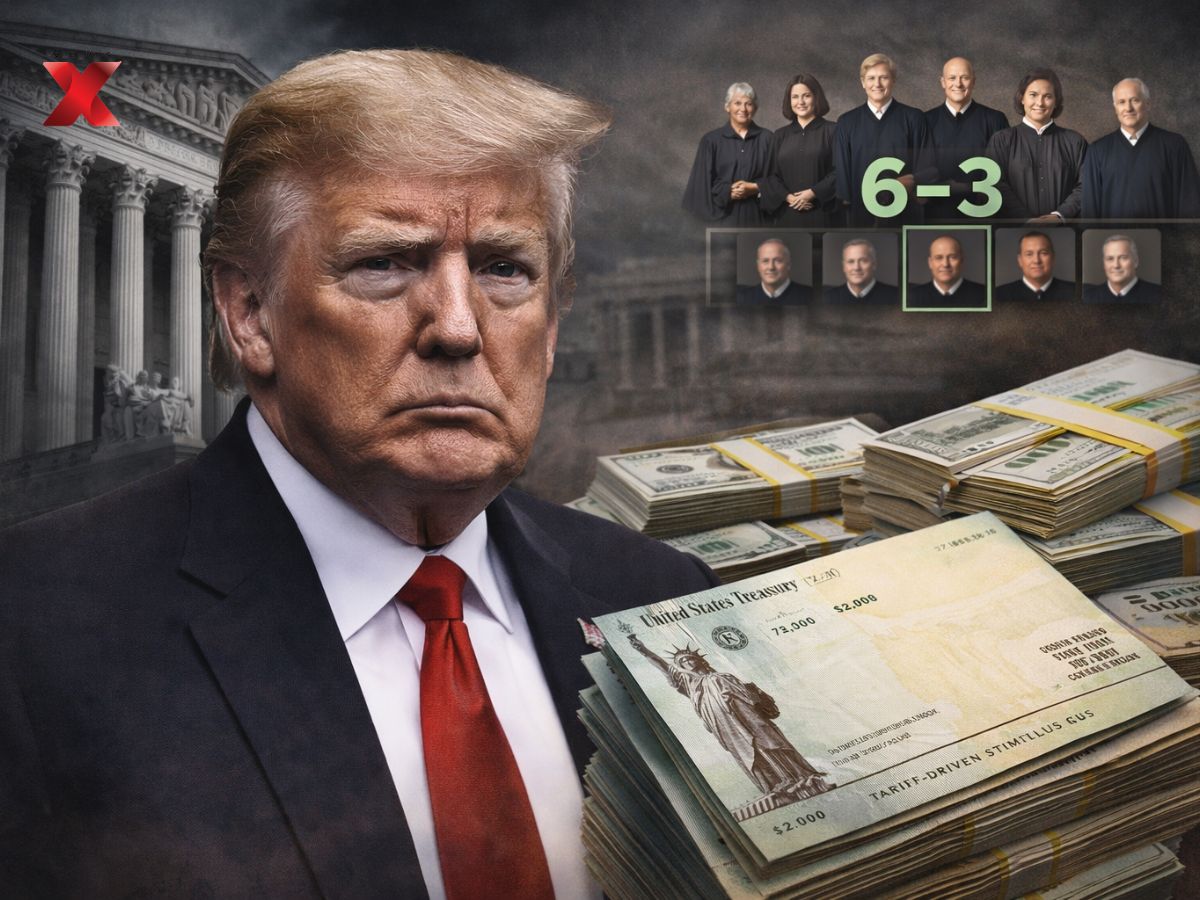
Will Americans Still Get $2,000 Tariff Checks After Supreme Court’s 6–3 Blow to Trump’s Trade Policy? Photo: AI Generated
Donald Trump’s proposals to distribute $2,000 payments to Americans using tariff revenue were already facing uncertainty even before the Supreme Court of the United States struck down key parts of his trade policy.
On February 20, the court ruled that Trump had overstepped his authority by imposing broad tariffs without explicit approval from Congress. As a result, a portion of the tariff revenue collected last year will ned to be returned to businesses. Trump had earlier cautioned that “WE’RE SCREWED” if the court declared the tariffs unlawful.
In a landmark judgment that reverberated across global markets, the United States Supreme Court on Friday invalidated most of President Donald Trump’s expansive tariff measures, marking one of the sharpest judicial setbacks of his second term.
In a 6-3 ruling, the court held that the 1977 International Emergency Economic Powers Act (IEEPA) does not grant the President the authority to impose tariffs- a decision with far-reaching consequences for US trading partners, including India.
The majority concluded that the President lacked the authority under the emergency powers statute to impose a sweeping range of import duties on products from almost all US trading partners.
Chief Justice John Roberts wrote the opinion, which was joined by the court’s three liberal justices as well as fellow conservatives Neil Gorsuch and Amy Coney Barrett. Justices Samuel Alito, Clarence Thomas, and Brett Kavanaugh dissented.
In a January interview with The New York Times, Donald Trump suggested that the funds could be used to issue $2,000 payments to Americans, saying the tariff income was substantial enough to allow such payouts, possibly toward the end of the year.
However, even before the Supreme Court of the United States ruling, there was no detailed legislative framework or clear timeline to authorise the proposed payments, which Trump had indicated might come in 2026. After the decision, the White House avoided directly addressing the future of the plan, stating only that it was acting in the best interests of the American people.
In 2025, the federal government collected roughly $200 billion in additional tariff revenue due to expanded duties. When asked whether this income would be sufficient to fund the rebates — particularly as he had also pledged to allocate tariff funds toward reducing the deficit and strengthening defence — Trump cited strong economic growth and described the tariff revenue as “tremendous.”
A November analysis by the Committee for a Responsible Federal Budget estimated that a $2,000 payment, similar to pandemic-era stimulus checks, would cost about $600 billion. Prior to the court’s ruling, annual tariff collections were projected at around $300 billion — only about half of what would be needed for yearly $2,000 payments.
While Trump has at times questioned whether congressional approval would be required, the US Constitution grants Congress authority over federal spending. White House economic adviser Kevin Hassett told CBS News’ “Face the Nation with Margaret Brennan” on December 21 that the administration would present a proposal to Congress in 2026, noting that any such payments would require an official appropriation.
So far, Congress has not advanced similar legislation. In July, Senator Josh Hawley introduced the American Worker Rebate Act, proposing payments of at least $600 to eligible individuals funded by tariff revenue.
President Donald Trump announced on Saturday that he plans to increase the temporary global tariff on imported goods to 15 percent, according to Reuters. The move comes after the Supreme Court of the United States ruled against tariffs that had been imposed under an economic emergency law.
In a post on Truth Social, the MAGA supremo wrote, “I, as President of the United States of America, will be, effective immediately, raising the 10% Worldwide Tariff on Countries, many of which have been ‘ripping’ the US off for decades, without retribution (until I came along!), to the fully allowed, and legally tested, 15% level.”The move came after the US Supreme Court declared Trump’s tariff actions illegal and questioned his authority to impose sweeping import duties without congressional approval.
The decision followed a ruling by the US Supreme Court, which struck down Trump’s tariff measures as unlawful and challenged his power to levy broad import duties without the consent of Congress.
Manisha Chauhan is a passionate journalist with 3 years of experience in the media industry, covering everything from trending entertainment buzz and celebrity spotlights to thought-provoking book reviews and practical health tips. Known for blending fresh perspectives with reader-friendly writing, she creates content that informs, entertains, and inspires. When she’s not chasing the next viral story, you’ll find her diving into a good book or exploring new wellness trends.
Pakistan launched airstrikes inside Afghanistan in the early hours of Sunday, targeting several locations along…
The British government is weighing new legislation that could strip Andrew Mountbatten-Windsor of his place…
70th Filmfare Awards South Winner List: The 70th Filmfare Awards South celebrated the finest performances…
