Gold Stored In India, Can It Be Reused?
India: The Golden Bird That Still Shines Bright- India has long been called the “Sone Ki Chidiya”, the Golden Bird, and that old nickname still echoes in how the world views it today, glittery eyes of fascination looking back. Gold here isn’t only a metal or an investment class, it’s emotion, identity, and even a quiet scoreboard of status, the kind nobody fully says out loud. From weddings that sparkle like little treasure vaults, to festivals where buying gold feels almost ritualistic, Indians have never really separated wealth from that yellow metal. Even domestic investors show a steady appetite for gold and related metals, treating them as both safety nets and pride assets. In a lot of homes, gold quietly acts as prestige, like the unspoken belief that “more gold means more prosperity.” It’s less about pure shine, and more about how you stand in society.
So, while the world is watching India’s rising economic strength, it also keeps admiring that age-old golden obsession that never quite fades out.
India is often described as sitting on a quiet gold mountain and, honestly, that feels close to the reality of things. According to media reports Industry numbers say that Indian households and temple trusts together hold roughly 30,000–32,000 tonnes of gold, which comes to almost $3.8 trillion, and quite a few forecasts even push it up to around 35,000 tonnes. Even after that, a large share of that wealth stays asleep, is kept for rust, and becomes stale, locked away in lockers, cupboards, and temple vaults. It has a lot of feeling and history behind it, but from an economic point of view, it’s mostly idle. It is same as the money you keep in savings account, and do not use it as an investment, and keep it locked, and that does not multiplies itself! STALE MONEY!
Now think about it from economical point of view, if even a small fraction of that dormant gold actually enters the formal financial system, you could see real movement in trade patterns, liquidity, and import dependence, not just a small effect on paper. This is basically the driving notion behind the government’s push for gold recycling.
Prime Minister Narendra Modi has been urging people to use the existing domestic gold reserves more effectively, instead of leaning more on imports. So here the argument is pretty simple, better to make full use of what’s already here before sourcing again from abroad. And the backdrop matters. India reportedly spent about $72.4 billion in 2025–26 just to satisfy gold demand. So in that light, even long-forgotten jewellery resting at home could quietly, and in a small way, contribute to a wider economic shift.
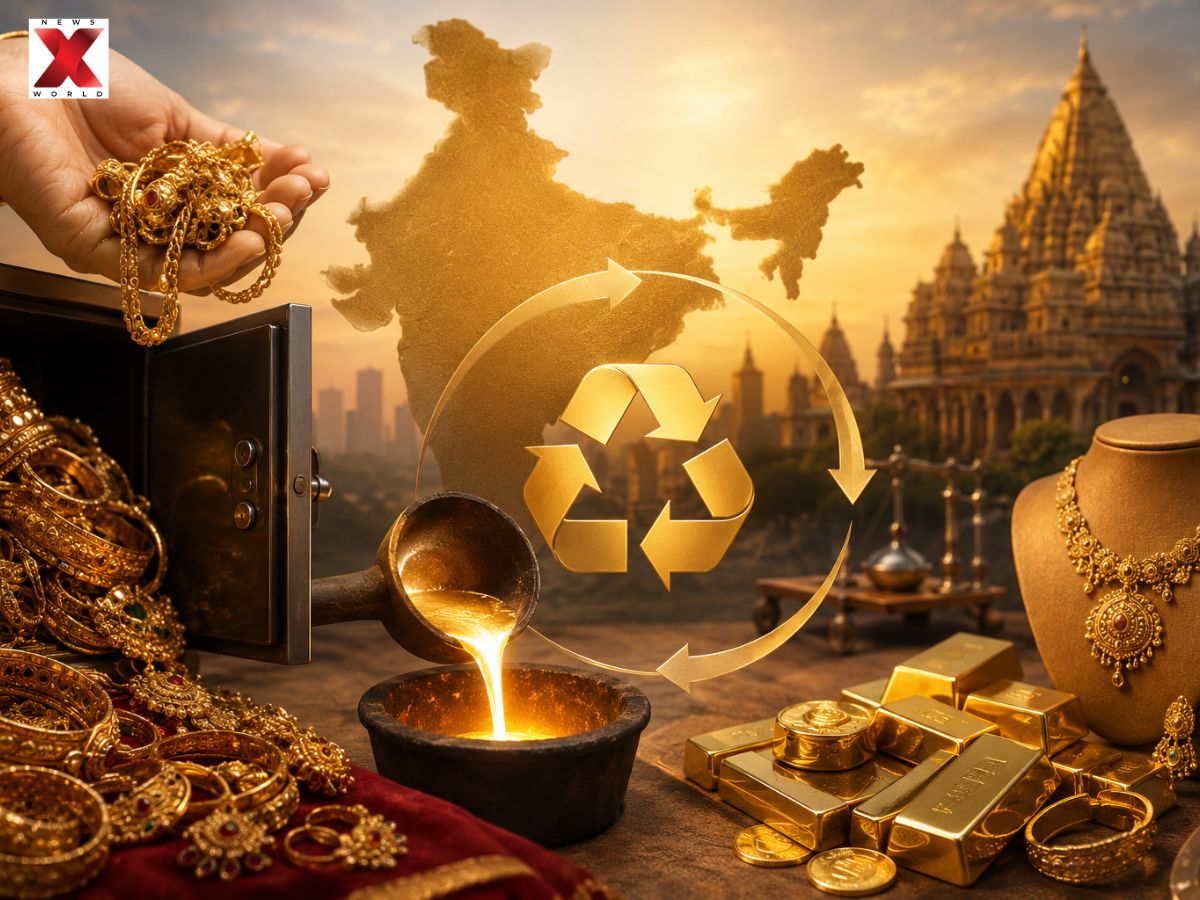
For all the curious minds, who do not know about it, here it is! Gold recycling like taking the old or unused gold, and giving it a new life, as if it were pure, refined gold again. Basically, instead of digging new gold out of the earth, we just reuse what’s already sitting there quietly in lockers, and jewellery boxes. It usually comes from old jewellery, damaged ornaments, coins and bars, industrial waste, and even gold that got pulled out of electronics. So yeah, that “old broken chain” or “outdated ring” isn’t actually useless at all, it’s just waiting for a comeback, maybe later. The whole thing starts with checking the purity first, then melting and refining happens, and during that stage the unwanted stuff is removed. Then the material is purified up to 99.9% (24K gold), ready to slide back into the system.
After that, the very same gold gets reshaped into new jewellery, coins, or bullion, depending on what people need. And honestly here is the interesting bit, it’s not only about money. Compared to mining, recycling uses less energy, it lowers environmental damage, and it reduces the need for fresh extraction too. It’s sort of like recycling plastic, but with more sparkle, and a lot more value attached to it.
Experts estimate that even 1% recycling of household gold annually could lead to:
| Why So Much Gold Remains Idle | Details |
|---|---|
| Store of wealth | Gold is traditionally seen as a safe place to preserve value over time |
| Hedge against inflation | People prefer gold as prices rise and currency value fluctuates |
| Financial security | It acts as a backup during emergencies and financial uncertainty |
| Most Gold Comes From | Details |
|---|---|
| Weddings | Major source of gold purchases in Indian households |
| Gifts | Commonly received during festivals and special occasions |
| Inheritance | Passed down across generations within families |
| Long-term savings | Bought and stored as a form of future financial security |
| Result | Impact |
|---|---|
| Long holding periods | Gold often remains unused for years or even decades |
| Low circulation | A large portion stays locked in lockers and households rather than entering the economy |
Gold recycling basically gives old, unused jewellery a fresh purpose, instead of letting it just sit there quietly in lockers. Instead of consumers having to buy new gold, people can trade in their dated pieces for cash, upgrade the metal into sleek, newer designs, or even process it into refined gold that comes back into circulation. In this way, the worth of the gold stays pretty intact, while the material keeps moving through the economy. So what was once only “stored wealth” becomes part of the financial system again, backing demand, improving liquidity, and helping supply. Put simply, it converts inactive home gold into a working asset, and it still keeps both the emotional meaning and the financial value.
(Disclaimer: The information presented above is based on publicly available data, industry estimates, and media reports. Figures such as household gold holdings, valuation, and economic impact are approximate and may vary across different sources. This content is intended for general informational and editorial purposes only and should not be considered financial or investment advice.)
Aishwarya is a journalism graduate with over 4.5 years of experience thriving in the buzzing corporate media world. She’s got a knack for decoding business news, tracking the twists and turns of the stock market, covering the masala of the entertainment world, and sometimes her stories come with just the right sprinkle of political commentary. She has worked with several organizations, interned at ZEE and gained professional skills at TV9 and News24, And now is learning and writing at NewsX, she’s no stranger to the newsroom hustle. Her storytelling style is fast-paced, creative, and perfectly tailored to connect with both the platform and its audience. Moto: Approaching every story from the reader’s point of view, backing up her insights with solid facts.
Always bold with her opinions, she also never misses the chance to weave in expert voices, keeping things balanced and insightful. In short, Aishwarya brings a fresh, sharp, and fact-driven voice to every story she touches.
Verified Twice, Lost Rs 5.95 Crore: How Trading Scams Trap Investors
A Bengaluru man lost Rs 5.95 crore to a fake trading platform despite verifying it…
JIPMAT 2026 Admit Card Released at exams.nta.nic.in; Know Steps to Download Hall Ticket Here
The National Testing Agency (NTA) has released admit cards for the Joint Integrated Programme in…
From Siri To Apple Intelligence: How iOS 27 Will Change Your iPhone
Apple is expected to unveil iOS 27 at WWDC 2026 with a major AI-focused upgrade,…
