India's First Nobel Prize Winner
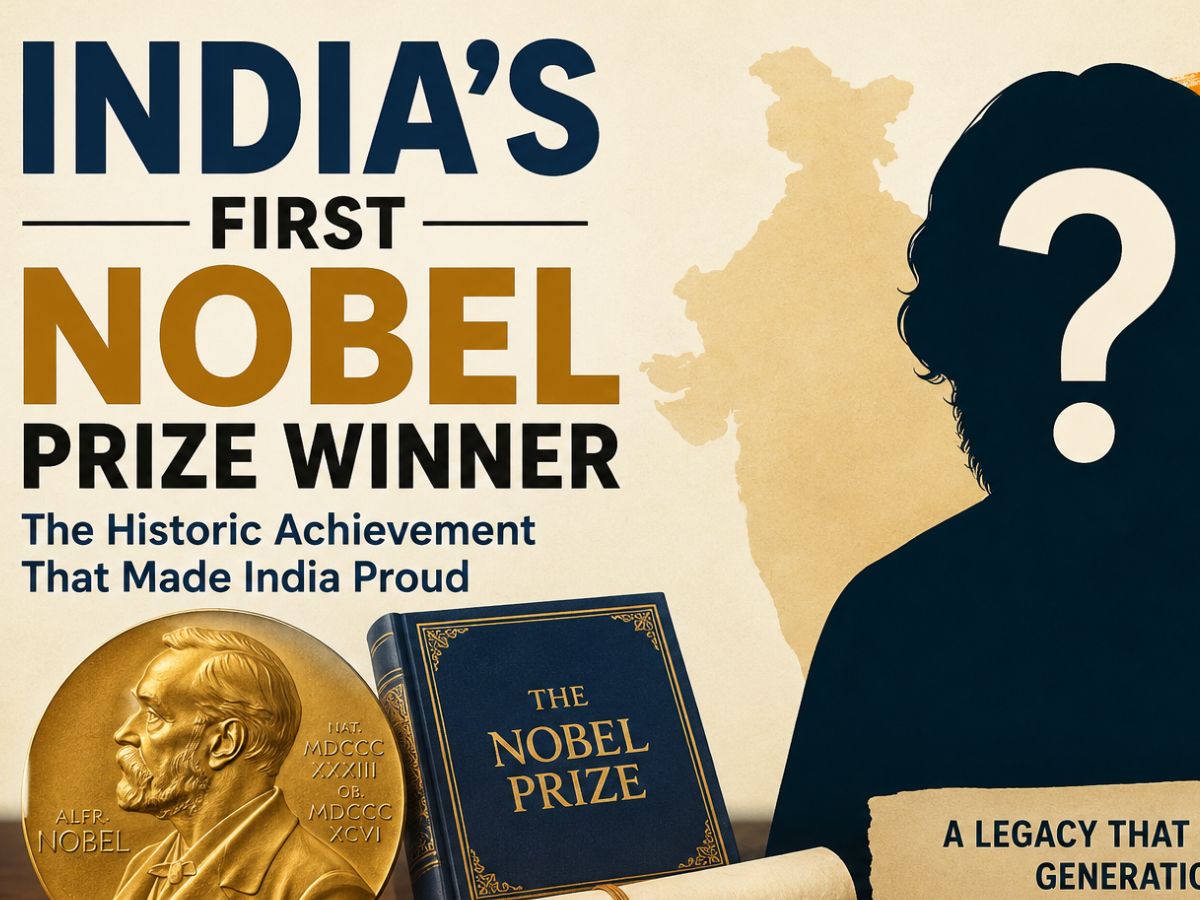
Many Indians have made their mark on the world for their achievements in literature, science, peace and economics. The one who achieved the distinction of being the first Indian to win a Nobel Prize was the language who made this country’s literary achievement world-renowned, Rabindranath Tagore. Tagore’s Nobel Prize award in 1913 was an historic event not only for India but for the whole of Asia. One year over a century later, his legacy lives on and has inspired thousands of writers, artists and thinkers around the globe.
Rabindranath Tagore was a playwright, poet, philosopher, composer and educationist born in Kolkata in 1861. He is considered the finest literary giant India almost ever created.
Tagore’s breadth of talent spanned beyond poetry. He wrote novels, short stories, essays and songs. He also established Visva-Bharati University in Santiniketan, where he believed the world could come together to learn from each other, combining Indian learning and global learning as one entity. Tagore’s importance went beyond just literature. He wrote the national anthems of India and Bangladesh, which makes him extremely important in South Asia.
While Rabindranath Tagore won the Nobel Prize in Literature in 1913, it was not for his celebrated plays and novels but for Gitanjali (Song Offerings), his poems. The Nobel Committee praised the work for its sensitivity, originality, and depth. This was the English translation that introduced Tagore to readers throughout Europe and made him the international literary icon he is known as today. Tagore became not only the first Indian but the first Asian to win the Nobel Prize because of this recognition.
Gitanjali is a collection of devotion, humanity and nature and human-divine relations poems. Tagore’s poetry was praised for its simplicity and emotional appeal. He did not use complex language, nor did he try to express profound ideas in an insightful manner. Simple, lyrical language depicted universal themes. The English edition was highly regarded after it gained the literary patronage of the famous writer, the Irish poet W.B. Yeats, who valued Tagore’s work and brought him to Western literature.
In winning the Nobel Prize, Tagore received this honour during a time of British colonial rule, during which India was often a cultural caricature. It was also a symbol of cultural confidence for many Indians.
While the Nobel Prize was the glory of his international notoriety, it was by far not the whole of his impact; his legacy extends far beyond his Nobel laureate status. He was a defender of educational reform, cultural contact, creative free thought, and rigorous questioning of the status quo. His works on society, nationalism, humanism, and the creation itself continue to be read and appreciated. His songs are performed in communities across the globe, and his works retain the force they always have in contests around education, identity, and culture.
Rabindranath Tagore remains a cultural symbol that Indians think of when they think of their most profound creative contributions. He was the first Indian to claim the Nobel Prize for literature in 1913. His success was a turning point for Indians who followed, scholars, writers, and thinkers.
Also Read: UPSC GK Quiz: Which Indian River Is Famous As The Red River? Know The Reason Behind The Name
Radhika is a journalist with two years of experience covering education, competitive exams, and student-focused developments. She reports on exam notifications, results, admissions, scholarships, and academic policies, helping students stay updated with important information.
Known for her clear and reader-friendly writing, she simplifies complex education updates into accessible stories that guide aspirants, students, and parents. She is also interested in highlighting inspiring student journeys and grassroots education initiatives.
For queries or story tips, you can reach out to her on X (formerly Twitter): https://x.com/Hitkariradz
Modi-Trump Meeting? Here's What MEA Says | WATCH
MEA spokesperson Randhir Jaiswal said details of bilateral meetings involving PM Modi at the G7…
How Three Indian-Crewed Ships Came Under US Attack Near Oman
Three Indian Ships, MT Settebello, MT Jalveer, and MT Marivex, were attacked near the coast…
US-IRAN WAR: Donald Trump Threatens to Hit Iran 'Very Hard Tonight'
US President Donald Trump has threatened to hit Iran "very hard" and take control of…
