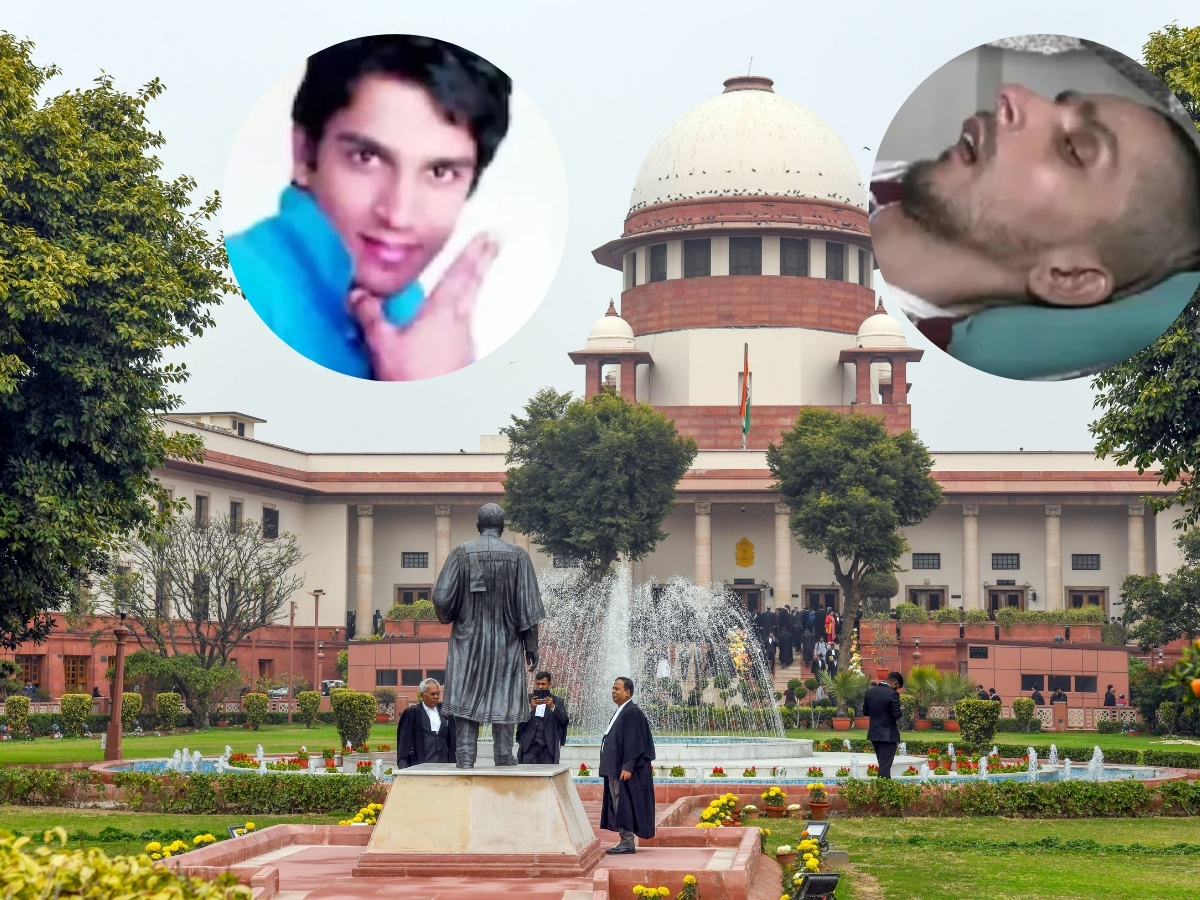
Harish Rana euthanasia case: Supreme Court to decide passive mercy killing plea of Delhi family after 13 years of suffering. Photos: ANI,X.
Harish Rana and his family from Delhi have been sufferering from last 13 years. Rana has been in a permanent vegetative state, unable to breathe or eat without medical intervention. His parents have since turned to the Supreme Court, seeking permission for passive euthanasia, also referred to as mercy killing.
Now, the Supreme Court has reserved its judgment, saying that it would not use the word passive euthanasia.
“We decide matters everyday but these issues are delicate. We are also mortals. Who are we to decide who lives or dies?” the court said. “Will consider withdrawing life-sustaining medical treatment,” Justice JB Pardiwala said.
Harish Rana met with an accident on August 20, 2013, on the day of Raksha Bandhan. He was a civil engineering student at Chandigarh University at the time when he fell from the fourth-floor balcony of his paying guest accommodation.
The fall caused severe head injuries, leaving him with 100 per cent disability. Doctors treating him at the time said Harish was unable to open his eyes or move any of his limbs. He never recovered.
Since that day, Harish has remained in a permanent vegetative state.
Over the years, Harish Rana and his family’s world has been limited to the All India Institute of Medical Sciences (AIIMS) hospital in New Delhi. He survives through a tracheostomy tube that aids breathing and a gastrostomy tube that provides nutrition.
Even after more than a decade, Harish has shown no signs of improvement.
In July 2024, Harish’s parents approached the Delhi High Court seeking permission for passive euthanasia.
However, the High Court rejected their plea. It held that Harish was “able to sustain himself without any extra external aid,” noting that while he depended on a tracheostomy and feeding tube, he was not on a mechanical ventilator.
The court further observed that removing the feeding tube would result in death by starvation, which it classified as active euthanasia, illegal under Indian law.
Following the High Court setback, the parents moved to the Supreme Court in November 2024. The apex court also declined to grant permission.
Then Chief Justice of India DY Chandrachud observed that Harish was not “completely dependent” on life-support machines. However, acknowledging the family’s hardship, the court directed the Centre to consider arrangements for Harish’s treatment and lodging.
A year later, in December 2025, Harish’s parents returned to the Supreme Court. This time, they argued that their son’s condition had deteriorated further and that he was being kept “artificially alive” with no possibility of recovery.
The court noted that it had to make a “final call.”
Since Harish did not have a living will or advance medical directive, the court followed the revised euthanasia guidelines issued in 2023.
A bench comprising Justices JB Pardiwala and KV Viswanathan ordered the constitution of both primary and secondary medical boards to independently assess Harish’s condition.
The primary medical board concluded that Harish had a negligible chance of recovery and described his state as “pathetic.”
On December 18, the Supreme Court examined the secondary board’s report, which echoed the same assessment.
“It is a very sad report. We cannot keep this boy in this stage,” Justice JB Pardiwala observed during the hearing.
The court subsequently fixed January 15 for pronouncing its final order. Two days earlier, on January 13, the judges met Harish’s parents in person.
Euthanasia, often referred to as mercy killing, involves intentionally hastening a person’s death to relieve suffering caused by an incurable or terminal illness.
Types of euthanasia include:
Directly causing death, such as through a lethal injection.
Voluntary: Patient consents
Non-voluntary: Patient lacks capacity to consent
Involuntary: Without patient consent
Withholding or withdrawing life-sustaining treatment when recovery is impossible, allowing death to occur naturally. This is aimed at protecting the right to die with dignity and preventing futile suffering.
Active euthanasia is illegal in India. Under the Bharatiya Nyaya Sanhita (BNS), 2023, acts intended to cause death are classified as culpable homicide or murder under Sections 100 and 101.
Passive euthanasia, however, has gradually found legal recognition.
The Supreme Court first allowed withdrawal of life-sustaining treatment for patients in a vegetative state, even without decision-making capacity.
The court held that the right to die with dignity is an intrinsic part of Article 21 of the Constitution and legalised advance medical directives or living wills.
In 2023, the Supreme Court modified its earlier guidelines to simplify the process for granting passive euthanasia.
Zubair Amin is a Senior Journalist at NewsX with over seven years of experience in reporting and editorial work. He has written for leading national and international publications, including Foreign Policy Magazine, Al Jazeera, The Economic Times, The Indian Express, The Wire, Article 14, Mongabay, News9, among others. His primary focus is on international affairs, with a strong interest in US politics and policy. He also writes on West Asia, Indian polity, and constitutional issues. Zubair tweets at zubaiyr.amin
British Defence Secretary John Healey pointed out that even though Cyprus may not have been…
UK PM Keir Starmer said British armed forces stationed in the region were also at…
19 Minute 34 Second Viral MMS: Is There A Season 2 Of The Video? Everything You Should Know
19 Minute 34 Second Viral MMS: Is There A Season 2 Of The Video?
