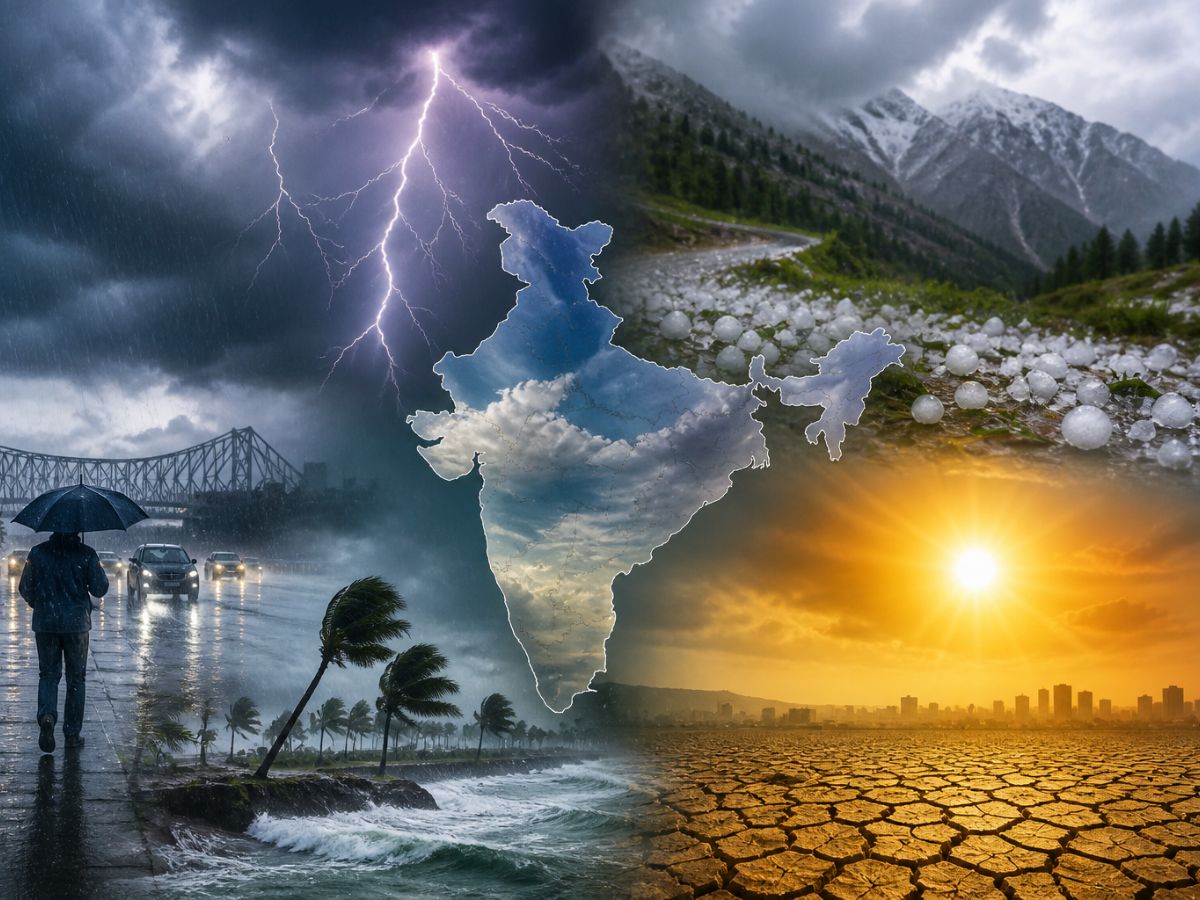
IMD heavy rainfall forecast (Image: AI-generated)
IMD Heavy Rainfall Forecast: The India Meteorological Department (IMD) has come out with its latest weather warnings for Sunday, May 3, which foresee an unusual mix of weather events and even include extreme weather events across many states/UTs. These extremes are occurring at the same time in different parts of the country.
As per reports, according to the IMD, “heavy to very heavy rainfall is very likely” over parts of the northeast and eastern regions. The warning covers states like Arunachal Pradesh, Assam, Meghalaya, Nagaland, Manipur, Mizoram, Tripura, along with West Bengal and Sikkim, where intense rain activity is expected.
As per reports, IMD data shows that its heavy rainfall forecast also extends down south. Rain-producing areas such as Kerala, Tamil Nadu, or Puducherry will also be impacted by heavy rain.
While rain hits some areas, hailstorm activity is expected over Jammu and Kashmir and Ladakh. In contrast, Andhra Pradesh is likely to experience heatwave conditions.
Reports say that Meteorologists have stated that this type of situation can appear contradictory, but it is not. The IMD’s prediction of heavy rain indicates that heat wave conditions will still remain through May, but “intermittent thunderstorms and rainfalls may also randomly occur” throughout the northern, eastern, and central regions of India.
The main factor contributing to this abnormal occurrence is the active western disturbances and local weather systems. These two types of weather systems have had a significant impact on shaping the overall weather pattern, therefore allowing for both heat and storms to occur at the same time in different parts of the country.
India’s vast area allows multiple kinds of weather systems to function simultaneously. One main contributing factor to the IMD’s heavy rain forecasts is the interaction between the western disturbances and the heated summer air over northern India.
Western disturbances originate in and from the Mediterranean area. When the western disturbances bring moist air from near the Mediterranean to northern India, it results in a very unstable atmosphere with respect to heated surface air. Very severe thunderstorms with lightning, strong winds, hail, and intense rainfall can occur as a result of the interaction between these factors.
While regions without these weather systems endure extreme degrees of heat, the IMDs heavy rain forecast indicates heavier than normal precipitation this season, supported by their April through June seasonal forecast of above average, heat wave days throughout Northwest India, Central India, and certain sections of the Eastern & Southwestern peninsula of India.
Many of these long-term warming trends due to climate change are also causing an increase in the number of days where temperatures exceed 40°C (104°F) in May. Extreme heat in conjunction with a large amount of moisture creates a lot of warm, upward moving air. When moisture is brought into this warm air, it forms large storm clouds very quickly, which can then create hail and cause heavy rains in very short periods of time.
Looking at the IMD’s heavy rain forecast and these rising climate trends shows a strong relationship between warm weather, heavy rain, and overall weather intensity. The amount of extreme weather caused by both means will likely increase across South Asia because of a continued warming climate, an increase in energy participating in weather systems, and increased climate variability making the prediction of what types of storms could be coming more challenging.
The IMD heavy rain forecast is another measure showing us how our current and future climatic conditions are causing the creation of more frequent instances of extreme weather from either or both the variables of warm temperatures and heavy rain occurring together.
Khalid Qasid is a media enthusiast with a strong interest in documentary filmmaking. He holds a Master’s degree in Convergent Journalism from AJK MCRC. He has also written extensively on esports at Sportsdunia. Currently, he covers world and general news at NewsX Digital.
Why Air India Cut International Flights And Which Routes Are Affected
Air India cuts international flights due to high fuel costs, longer routes; Europe, US, Australia,…
CSK vs MI: Why Rohit Sharma and MS Dhoni Are Not Playing In Today IPL 2026 Match?
Find out why MS Dhoni and Rohit Sharma are missing from the CSK vs MI…
UP Shocker: Woman Kills Her Four children Over Property Dispute, Then flees home
Similar tragic cases in states like Maharashtra and Tamil Nadu have been linked to family…
