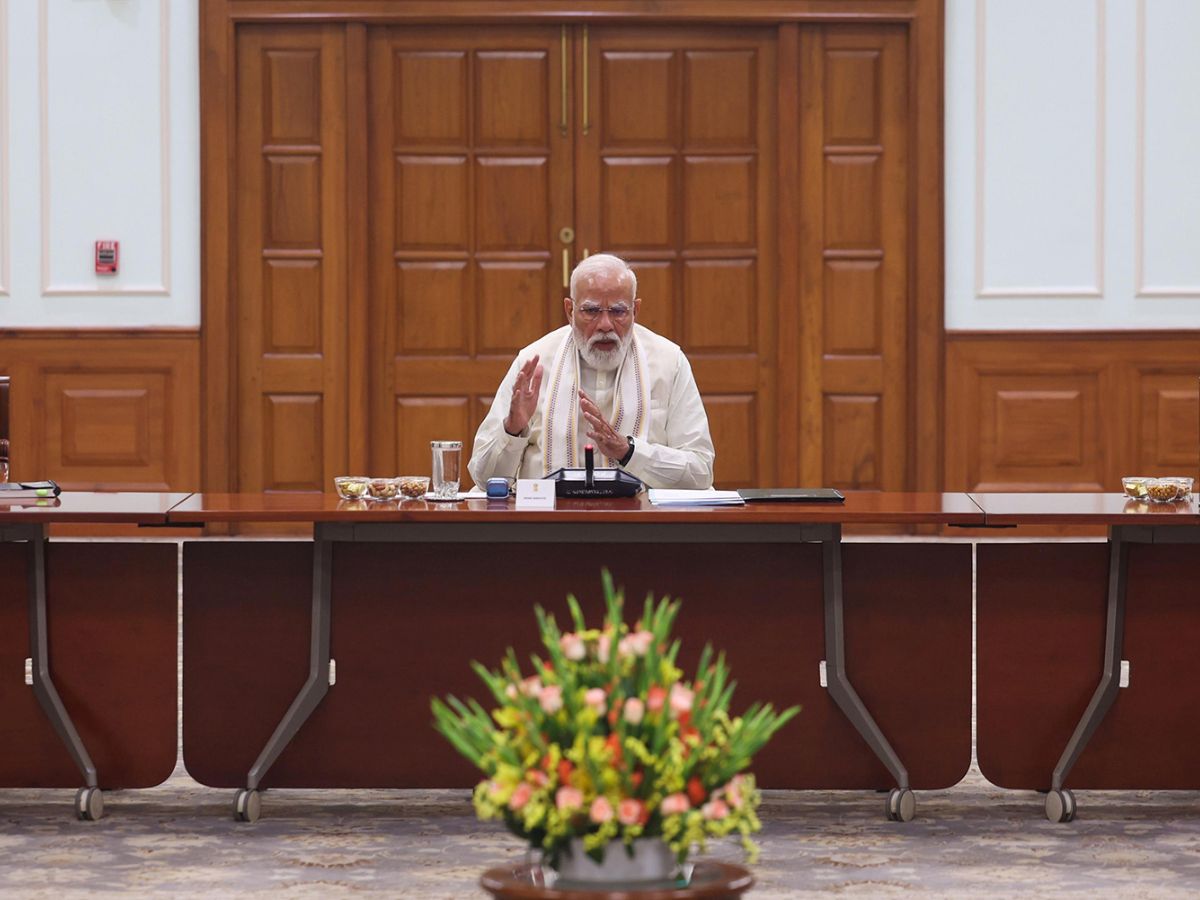
PM Modi Meets Economic Advisory Council Amid West Asia Crisis, Reviews India's Growth Strategy (Via ANI)
Prime Minister Narendra Modi on Saturday chaired a meeting with members of the Economic Advisory Council to the Prime Minister (EAC-PM), focusing on strategies to sustain India’s growth momentum amid rising global economic and geopolitical challenges. The meeting centered on measures aimed at strengthening the country’s economic resilience, improving the ease of living for citizens, and further enhancing the ease of doing business. Council members also shared their assessment of the ongoing West Asia conflict and its potential implications for India and the global economy.
The discussions took place against the backdrop of continuing geopolitical tensions, trade disruptions, and uneven economic recovery across several regions of the world. With uncertainty affecting global markets, the government reviewed possible policy measures to maintain economic stability and support long-term growth.
Members of the Economic Advisory Council explored ideas to help India navigate external challenges while continuing its development trajectory.
Last month, the Prime Minister urged citizens to contribute to the country’s economic resilience in light of the West Asia crisis. He called for reducing dependence on imported fuel and encouraged the adoption of sustainable alternatives.
Among his suggestions were increased use of public transport, carpooling, electric vehicles, and railway freight services to reduce fuel consumption. He also advocated greater support for Swadeshi products, natural farming practices, lower cooking oil consumption, and restraint in non-essential expenditures such as foreign travel and gold purchases.
The Prime Minister emphasized that collective efforts by citizens could help cushion the impact of global volatility on the domestic economy.
The high-level meeting came a day after official data showed India’s economy growing faster than expected during the fourth quarter of FY 2025-26. According to government estimates released on June 5, real Gross Domestic Product (GDP) expanded by 7.8 per cent year-on-year in the January-March quarter, while full-year GDP growth is projected at 7.7 per cent.
Real GDP at constant prices rose to ₹87.77 lakh crore in the fourth quarter from ₹81.40 lakh crore a year earlier. Nominal GDP for the quarter stood at ₹94.65 lakh crore, reflecting a growth rate of 9.1 per cent.
For the entire financial year 2025-26, real GDP is estimated at ₹323.12 lakh crore, compared to ₹299.89 lakh crore in FY25. Nominal GDP is projected at ₹346.36 lakh crore, marking an annual growth of 8.9 per cent.
Data released by the government highlighted the strong contribution of the secondary and tertiary sectors to overall economic growth.
The secondary sector is estimated to have grown by 8.8 per cent during FY26, while the tertiary sector recorded an estimated growth of 9.3 per cent. The primary sector, led largely by agriculture and fisheries, expanded by 3.2%.
Gross Value Added (GVA), another key indicator of economic activity, is projected to rise 7.9 per cent during FY26, while nominal GVA is expected to grow by 9.1 per cent. In the fourth quarter alone, real GVA growth stood at 7.9 per cent and nominal GVA growth at 9.9 per cent.
(Via Agency Inputs)
Mumbai CEO Overpays Auto Driver
In a widely praised Mumbai auto driver honest return incident, entrepreneur Shubham Gune accidentally transferred…
The 2026 Maruti Suzuki Fronx facelift is expected to introduce a strong hybrid powertrain with…
Mamata Banerjee Reins In Abhishek Banerjee
Mamata Banerjee has moved to curb the influence of Abhishek Banerjee amid growing unrest within…
