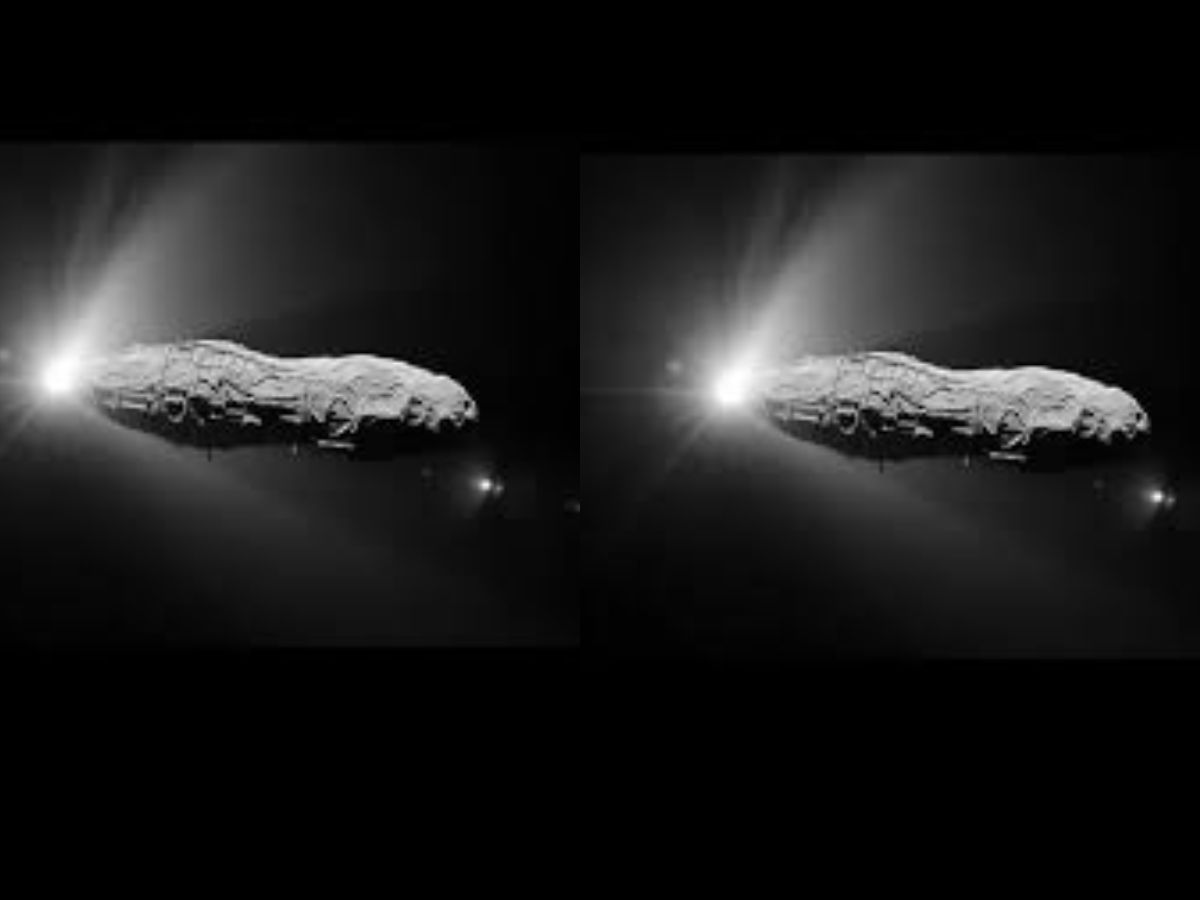
Interstellar object 3I/ATLAS accelerates unexpectedly, baffling NASA and scientists as it approaches Earth with no clear cause. Photo: X.
3I/ATLAS, a mysterious object from outside our Solar System, has drawn global attention after astronomers observed an unexplained change in its speed and trajectory. The object appears to be accelerating as it moves away from the Sun, a behavior that current scientific models cannot fully account for.
NASA confirmed the anomaly in the object’s motion, noting that the observed acceleration cannot be explained by solar gravity alone. This deviation from its predicted path has raised new questions about the object’s nature and the forces influencing it.
3I/ATLAS already ranks among the fastest interstellar objects ever detected.
According to reports cited by the Daily Mail, it entered the Solar System traveling at more than 130,000 mph. After passing its perihelion, its closest point to the Sun, on October 29, its speed increased further, reaching approximately 152,000 mph.
NASA states that the Sun’s gravitational pull accounts for much of this acceleration. However, the object’s subsequent shift away from the Sun has left scientists searching for additional explanations.
Under typical conditions, a comet nearing the Sun warms, causing ice on its surface to vaporize and release jets of gas. These jets can alter the comet’s direction and speed.
But 3I/ATLAS has not displayed clear signs of such gas release.
Harvard physicist Avi Loeb noted that astronomers have not detected evidence of the gas emissions expected from a standard comet.
3I/ATLAS is projected to reach its closest point to Earth in six weeks, and Loeb suggested that if it continues to show no surrounding gas cloud, the explanation may lie outside natural processes. The unusual acceleration, he indicated, might point to something far more advanced at work.
NASA’s updated tracking shows that although the acceleration weakened after perihelion, it remains present, and does not align with gravitational forces.
Scientists estimate that, for the object to shift in this way, it would have needed to lose at least 13% of its mass during its close pass with the Sun. A loss of that scale would typically produce a large dust and gas cloud around the object.
No such cloud has been detected.
In December, the James Webb Space Telescope will conduct further observations in an attempt to identify any residual gas or material.
Also Read: Interstellar Comet 3I/ATLAS to Reappear Soon: When It Will Emerge from the Sun’s Glare
Zubair Amin is a Senior Journalist at NewsX with over seven years of experience in reporting and editorial work. He has written for leading national and international publications, including Foreign Policy Magazine, Al Jazeera, The Economic Times, The Indian Express, The Wire, Article 14, Mongabay, News9, among others. His primary focus is on international affairs, with a strong interest in US politics and policy. He also writes on West Asia, Indian polity, and constitutional issues. Zubair tweets at zubaiyr.amin
Bhooth Bangla teaser out: Akshay Kumar returns with Paresh Rawal and Rajpal Yadav in a…
New Delhi [India], March 12: We are thrilled to announce the official launch of the…
Atlassian plans to lay off about 10% of its workforce (around 1,600 employees) to fund…
