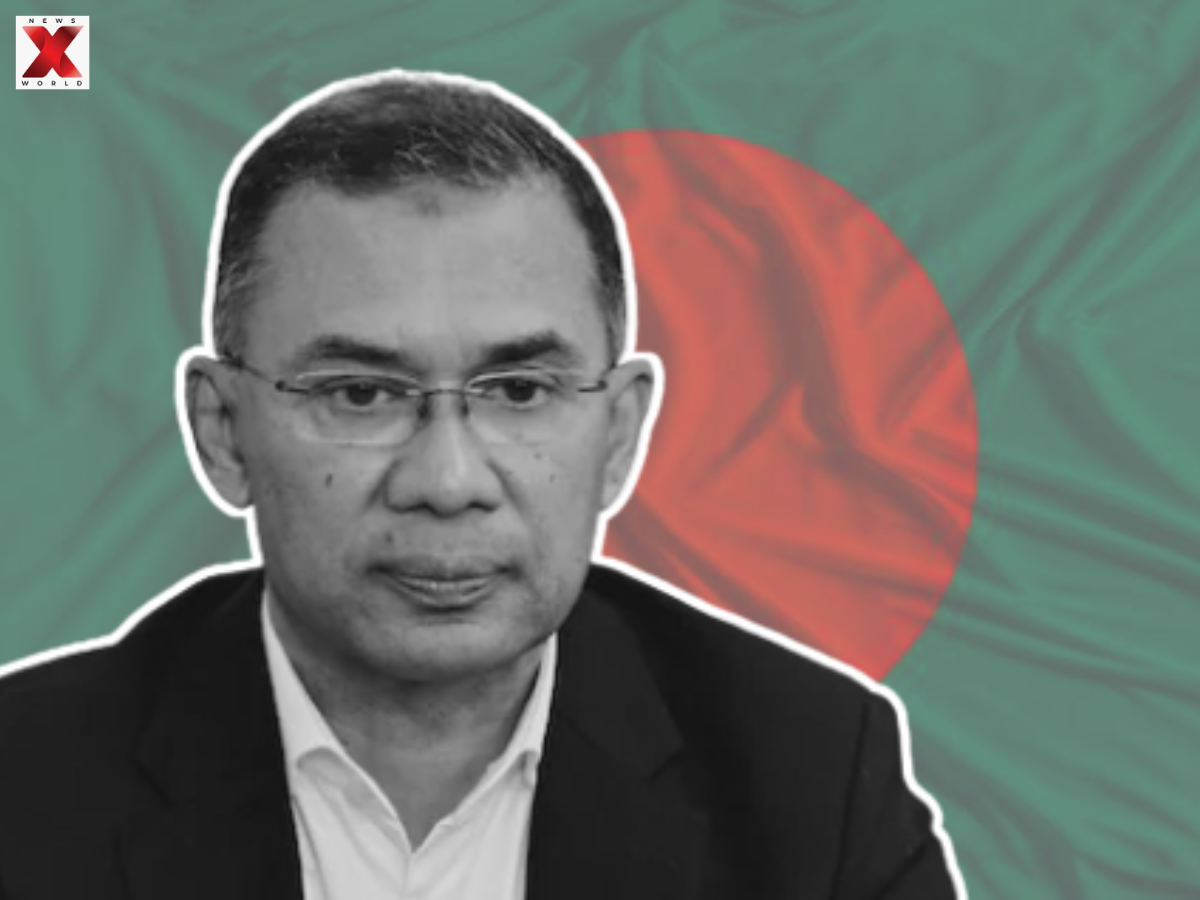
Tarique Rahman sworn in as Bangladesh Prime Minister (IMAGE: CANVA)
Tarique Rahman sworn in as Bangladesh PM: Power is shifting again in South Asia, and Bangladesh is right in the middle of it. With Tarique Rahman on the verge of taking over as prime minister after the Bangladesh Nationalist Party’s big win, the country’s heading into a whole new political era.
People used to call Rahman the “Dark Prince.” Now he’s trying on a new image, practical, all about reforms, promising stability, better protection for minorities, and a more balanced approach to foreign policy.
Rahman steps in at a tense moment between India and Bangladesh. The two countries share almost 4,000 kilometres of border, and their economies are pretty tied together through trade, shared electricity, and big infrastructure projects.
But things got rocky after Hasina left for India during the 2024 student protests. Dhaka keeps asking for her extradition, but India hasn’t budged, and it’s making things worse.
Back home, most people know Rahman as Tarique Zia. He’s pushing a “Bangladesh First” foreign policy, saying he wants to keep equal distance from India, China, and Pakistan.
When he finally came back after 17 years in exile in London, he put it bluntly:
“Not Dilli, not Pindi, Bangladesh before everything.”
Even though the BNP’s manifesto didn’t mention India, Rahman says he’ll fight for Bangladesh’s fair share of water from the Teesta and Padma rivers — an old dispute that still stings.
Born November 20, 1965, he’s the oldest son of former Prime Minister Khaleda Zia and former President Ziaur Rahman, the BNP’s founder. He was just 15 when his father was killed in 1981.
During the 1971 Liberation War, Rahman was briefly detained as a child. His party later called him one of the youngest prisoners of war, at least according to AFP.
He officially jumped into politics in 1988, starting out with the BNP in Bogra at the upazila level. Over time, he moved up through the ranks, eventually becoming senior joint secretary general, and then acting chairman when his mother, Khaleda Zia, went to jail in 2018 and her health forced her out of the spotlight.
Inside the party, pretty much everyone saw Rahman as the obvious heir to the Zia legacy.
When the BNP-led coalition government ruled between 2001 and 2006, Rahman was known as the Dark Prince as the party ruled in coalition with Jamaat-e-Islami.
Critics and political analysts tended to refer to Rahman as the power centre of the day, even though Khaleda Zia was the prime minister at that time.
A caretaker government arrested Rahman in May 2007 and imprisoned the leader over several counts in 17 months. He was convicted in absentia in several cases later, such as, money laundering, in a case involving an alleged conspiracy to shoot down then Prime Minister Sheikh Hasina.
Rahman had always insisted that the charges were political in nature. He relocated to London where he received medical care on claims of torture in custody.
In 15 years of the leadership of Sheikh Hasina, there were several convictions issued to him in the courts on corruption and terrorism-related charges. His supporters demanded that the cases were included in a political crackdown on the opposition.
With the removal of Sheikh Hasina, the legal situation changed radically in August 2024 as a result of a student-led uprising. Later decisions of the court reversed the previous convictions of Rahman, paving the way back.
In December 202,5 several months after mass protests overthrew the Hasina government, he returned to Bangladesh. As the BNP now starts heading to a massive electoral victory, the very man who was pushed to the periphery by jail and exile is all set to assume the top office in the country.
BNP chief Tarique Rahman wants minorities to know they’re not forgotten. After a wave of communal violence last year, especially against Hindus, who make up about 8% of Bangladesh, he’s trying to calm nerves.
In his first big speech back in Dhaka, Rahman put it simply:
“Religion is individual, but the state belongs to everyone. We will build a safe Bangladesh for all.”
He’s not just talking to his supporters. He’s sending a message to anyone worried about their place in the country.
Even while he was in exile, Rahman kept a tight grip on the BNP. Loyalists listened, and his messages kept the party machine running. When he finally came back last December, the crowds were huge. Clearly, the base still believes in him.
Now comes the real challenge. People are watching to see if Rahman can turn his words, especially about protecting minorities, into something real.
BNP chief will have to tackle big issues like water-sharing and security deals, too. The speeches are done; it’s what he does next that counts.
Sidharth Malhotra’s father, Sunil Malhotra, passed away in Delhi after a prolonged illness. The actor…
Veteran screenwriter Salim Khan has been admitted to Lilavati Hospital’s ICU in Mumbai. Doctors say…
Bhupen Borah meets Himanta after Congress exit drama, fuelling BJP switch buzz ahead of Assam…
