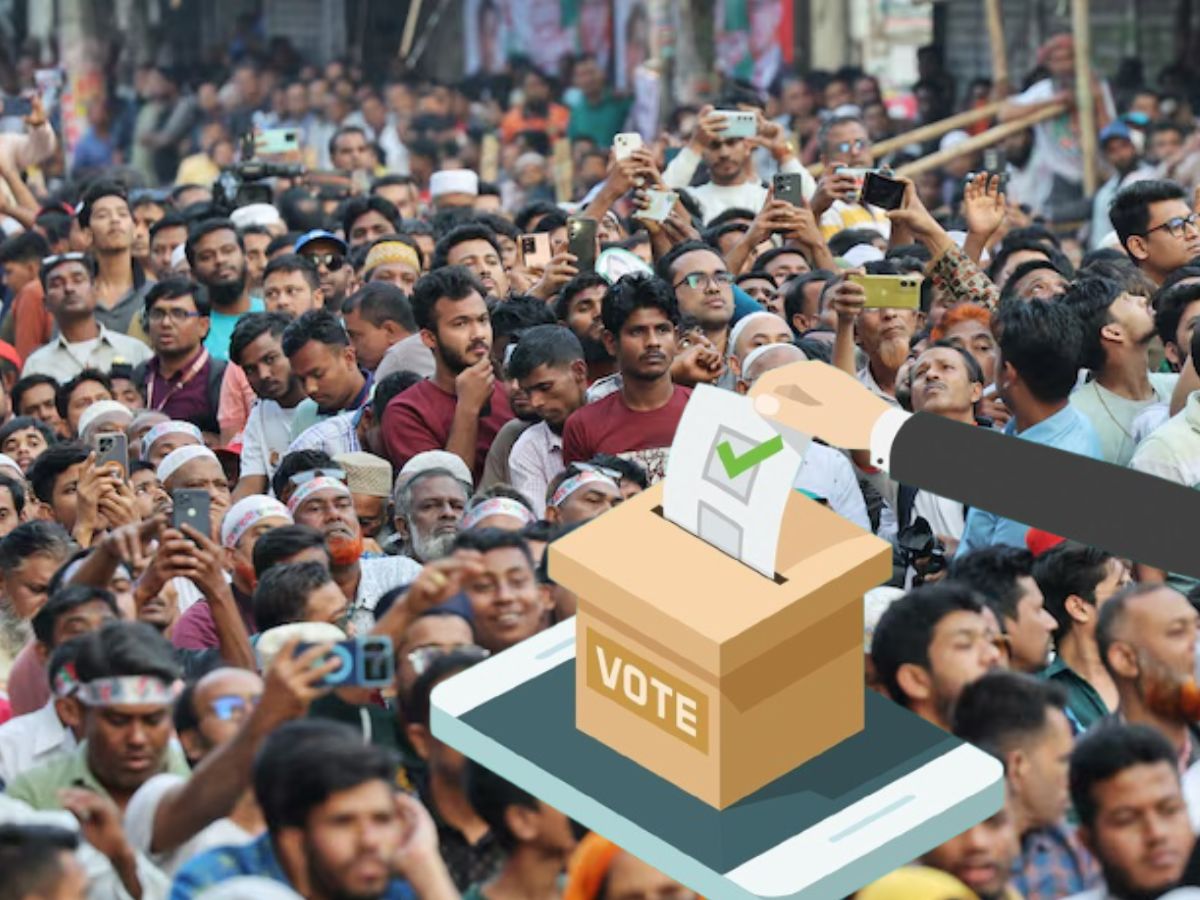
Bangladesh Elections Today: Who Are The Key Parties And Why India, China, & Pakistan Are Watching (Pic Credits: X, Canva Modified)
Bangladesh Election 2026: After months of political unrest, violent street protests, and upheaval, Bangladesh faces its critical moment of reckoning. What began in July 2024 as a student agitation over public sector job quotas escalated into a nationwide revolt against Prime Minister Sheikh Hasina’s government, culminating in her resignation and flight to India.
The unrest claimed more than 1,000 lives and dismantled a political order entrenched in Dhaka for over a decade.
Today, on February 12, 2026, Bangladesh heads to its first general election since the uprising, a ballot that will test the strength of its democracy and the country’s national identity. Nobel laureate Muhammad Yunus, who took charge after Hasina’s ouster, stated that the interim government “will hand over the responsibility to the newly elected government with deep pleasure and pride.”
With the Awami League sidelined, the field is open for a resurgent Bangladesh Nationalist Party (BNP) under Tarique Rahman and an emboldened Jamaat-e-Islami seeking renewed legitimacy. This election is not only about restoring stability after a period of turbulence, but it also has strategic implications for South Asia, where governments have fallen, and leaders fled faster than Pakistan’s military has overturned administrations.
In 2024, student protests over public sector job quotas quickly turned into a nationwide revolt. By early July, violent clashes erupted between protesters and police across Dhaka and other major cities. The unrest peaked in August when security forces opened fire on demonstrators. On August 5, 2024, Sheikh Hasina resigned and fled to India, leaving the country in turmoil. Over 1,000 people were killed, the deadliest violence since Bangladesh’s independence in 1971.
An interim caretaker government was formed under Nobel laureate Prof. Muhammad Yunus, including ex-bureaucrats, civil society figures, and student leaders. This interim cabinet took power in late August 2024, pledging to maintain order, prosecute crimes from the protests, and prepare for fresh elections. Among its first actions was introducing a provisional “July Charter” of reforms to advocate constitutional changes and term limits aimed at curbing executive power. A referendum on this charter accompanies today’s election.
By law, elections had to be conducted by early 2026. The once-dominant Awami League (AL) was effectively excluded and banned amid allegations of crimes during the protests. The electoral race now centers on the BNP-led coalition, several smaller parties, including the new National Citizen Party (NCP) founded by student activists, and a re-entering Jamaat-e-Islami.
Professor Harsh V. Pant, Vice President at the Observer Research Foundation, highlighted the pragmatism expected of any new government. “Whoever comes to power in Bangladesh is likely to be pragmatic in its engagement with both India and China,” he told The Times of India. Pant emphasized that balancing ties with these Asian powers is a strategic necessity, helping Bangladesh strengthen capabilities and maintain regional equilibrium.
Bangladesh Nationalist Party (BNP) under Tarique Rahman
Founded in the late 1970s by President Ziaur Rahman, the BNP has been one of Bangladesh’s two major political forces. Led by Khaleda Zia from 1984 until her death in December 2025, the party faces a leadership vacuum now filled by her eldest son, Tarique Rahman. Tarique returned from 18 years in exile on December 25, 2025, immediately energizing the BNP base.
Tarique is positioned as the BNP’s prime ministerial candidate if the alliance wins a majority. In early campaign speeches, he focused on national pride, stability, and criticism of Islamist rivals exploiting religion. Tarique vowed to uphold national sovereignty and work for women and young people.
The BNP’s challenges include decades-long political suppression under AL rule, fragile alliances, and internal restructuring after Khaleda’s prolonged illness. Nonetheless, with the AL sidelined, the BNP is the front-runner in the race for power. Indian officials have engaged with the new BNP leadership, signaling continuity in bilateral relations.
Jamaat-e-Islami’s Resurgence
Jamaat-e-Islami (JeI), Bangladesh’s largest Islamist party, was banned in 2013 due to constitutional violations and war crime convictions of its leaders. However, on June 1, 2025, Bangladesh’s Supreme Court restored Jamaat’s registration, allowing participation in the 2026 elections. The party formed an electoral alliance with ten other groups, including the Gen-Z-led NCP.
Under Dr. Shafiqur Rahman, Jamaat has moderated its platform, emphasizing welfare, anti-corruption measures, medical camps, and flood relief. The party fielded a Hindu candidate for the first time and publicly condemned attacks on minorities.
Professor Pant cautioned that Jamaat’s growing influence could attract Pakistan’s strategic interest, though historical context limits Islamabad’s ambitions. While Islamist mobilisation has increased, a strong societal pushback remains, containing extremist sway.
National Citizen Party (NCP) and Gen-Z Activism
The NCP emerged from the 2024 protests, led by 27-year-old Nahid Islam, aiming to break decades-long political dominance by the AL and BNP. Its platform focuses on anti-corruption, judicial independence, press freedom, governance reform, justice for protest victims, lowering the voting age to 16, job creation, and women’s representation.
Polls suggest the NCP trails BNP and Jamaat. The party formed an electoral alliance with Jamaat for strategic reasons, sparking internal dissent and resignations. Critics argue this dilutes NCP’s centrist identity and reduces the number of women candidates.
India’s Perspective
Bangladesh’s ties with India have fluctuated with domestic politics. Khaleda Zia’s BNP governments often opposed India, citing sovereignty concerns. Hasina’s secular AL maintained closer cooperation. With the AL sidelined, India’s priority is continuity, connectivity, and regional security.
Infrastructure projects linking India’s northeastern states via the Siliguri Corridor, as well as access to Bangladeshi ports under the Act East Policy, remain central to New Delhi’s strategy. Meetings between Modi, Jaishankar, Tarique Rahman, and Yunus signal India’s intent to engage with the incoming government regardless of the party in power.
China’s Interests
China has expanded its presence in Bangladesh through infrastructure projects, investment, and diplomatic engagement since 2024. A BNP-led government is likely to continue major initiatives, potentially recalibrating partnerships with Western investors while maintaining Beijing’s strategic access.
Pakistan’s Role
Pakistan views Jamaat’s resurgence symbolically, as historical ties to Islamism and the 1971 Liberation War shape Islamabad’s approach. A stronger Jamaat or a BNP government may create limited diplomatic openings, but economic dependencies and regional realities constrain Pakistan’s influence.
Economic Implications
Bangladesh’s export-driven economy, particularly the garment sector, depends on stability and investor confidence. Unrest or policy uncertainty could disrupt supply chains, affecting China, India, and Pakistan. A government that reassures international buyers will protect both domestic growth and regional trade flows.
Election Outlook
The February 12 election is more than a transfer of power; it is a test of governance, stability, and democratic credibility. For BNP, it is restoration under Tarique Rahman; for Jamaat-e-Islami, a return to legitimacy; for voters, a choice between stability, ideology, and democratic limits.
The outcome will signal Bangladesh’s future political direction, regional alignment, and approach to domestic challenges. With India, China, and Pakistan closely observing, the stakes are not just national but regional.
Police also stated that since the daughter of the victims is residing in the United…
Former Google CEO Eric Schmidt, 70, has been romantically linked to 27-year-old model and academic…
Stock Market Today: Indian markets opened weak despite positive global cues, with Sensex and Nifty…
