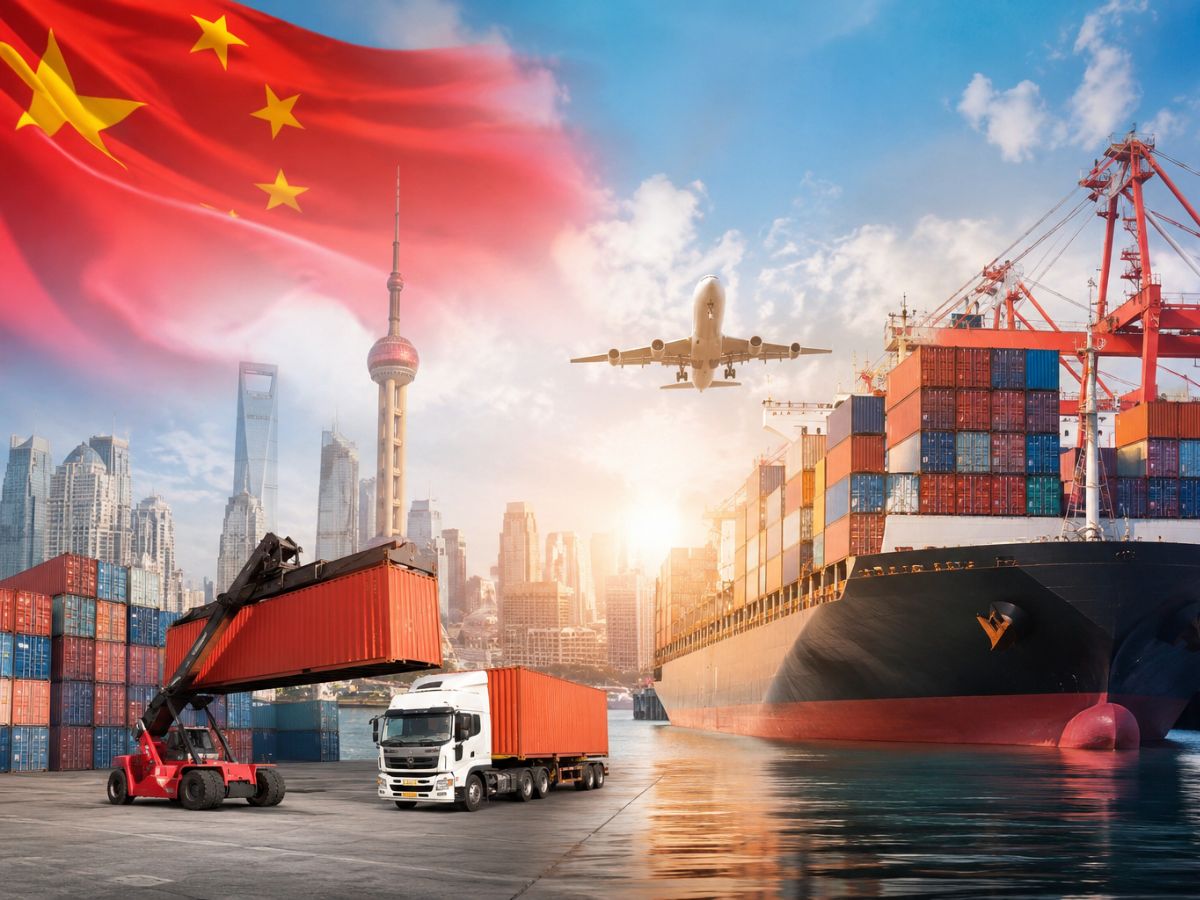
China’s exports grew faster in April, the strong export growth has pushed China’s trade surplus with the United States to $87.7 billion this year. Photo: AI Generated
China’s exports grew faster in April as factories rushed to complete orders from AI companies and other buyers who wanted to store extra components. Many businesses feared that the Iran war could increase global production and shipping costs.
The strong export growth has pushed China’s trade surplus with the United States to $87.7 billion this year. The issue is expected to be discussed next week when President Donald Trump visits Beijing for a summit that could continue last year’s trade agreement between the two countries.
While Chinese exporters have so far weathered the fallout from the Middle East conflict economists warn that the longer the war drags on and energy prices rise, the greater the risk that external demand fades away — leaving sluggish domestic consumption unable to plug the gap.
For now economists are watching the pace of the AI manufacturing boom and whether shipments of related equipment can keep the Chinese export engine purring.
“The conflict in the Middle East pushed up demand for global manufacturing inventory replenishment, and under the upward cycle of semiconductors, imports and exports maintained a boom,” according to Xing Zhaopeng, senior China strategist at ANZ.
“There is still room for expansion in this round of manufacturing cycle driven by AI, and it is expected that the annual export growth rate will be about 10%.”
Exports expanded 14.1% from a year earlier in U.S. dollar value terms, customs data showed on Saturday, outpacing the 2.5% gain in March and a 7.9% rise tipped by economists.
New export orders rose to their highest level in two years, separate factory activity data for April showed last month.
Imports notched another strong month, climbing 25.3% versus 27.8% in March. Economists had forecasted growth of 15.2%.
That boosted China’s trade surplus last month to $84.8 billion, from $51.13 billion in March.
Broader momentum in the Chinese economy was solid in the first quarter, with GDP growth hitting 5% year-on-year, the top of the government’s full-year target range, and lessening the need for immediate stimulus.
But even China, long criticised by trading partners for subsidy-backed, cut-price manufacturing, is not insulated from the hit to buyers’ purchasing power as fuel and transport costs rise.
The factory data published last month showed input prices remained elevated, particularly for refined goods and petroleum, coal and chemicals.
Unemployment rates also edged higher and retail sales – a gauge of consumption – continued to underperform industrial output.
Trump is scheduled to meet Chinese President Xi Jinping during his May 14-15 visit to Beijing, as both countries seek to stabilise a relationship strained by tensions over trade, Taiwan and the Iran war.
Trump will be keen for trade concessions from Beijing ahead of November’s U.S. midterm elections, though company executives and analysts are not expecting big breakthroughs.
Faced with U.S. levies that briefly rose to the triple digits, Chinese exporters last year chased new markets such as South America by offering lower prices. China ended 2025 with a record trade surplus of $1.2 trillion.
(Inputs from Reuters)
Also Read: Trump Slams Obama-Era Iran Policy, Says Tehran Was Given A ‘New Lease of Life’
India Has 60-Day Crude, LNG Reserves And 45 Days Of LPG; No Supply Concerns: Hardeep Singh Puri
Hardeep Singh Puri said the government managed the energy supply problems caused by the West…
Lawrence Bishnoi gang has claimed responsibility for the firing outside the house of singer-actor Diljit…
Can Cristiano Ronaldo finally lift the Saudi Pro League trophy? Explore the title race scenarios…
