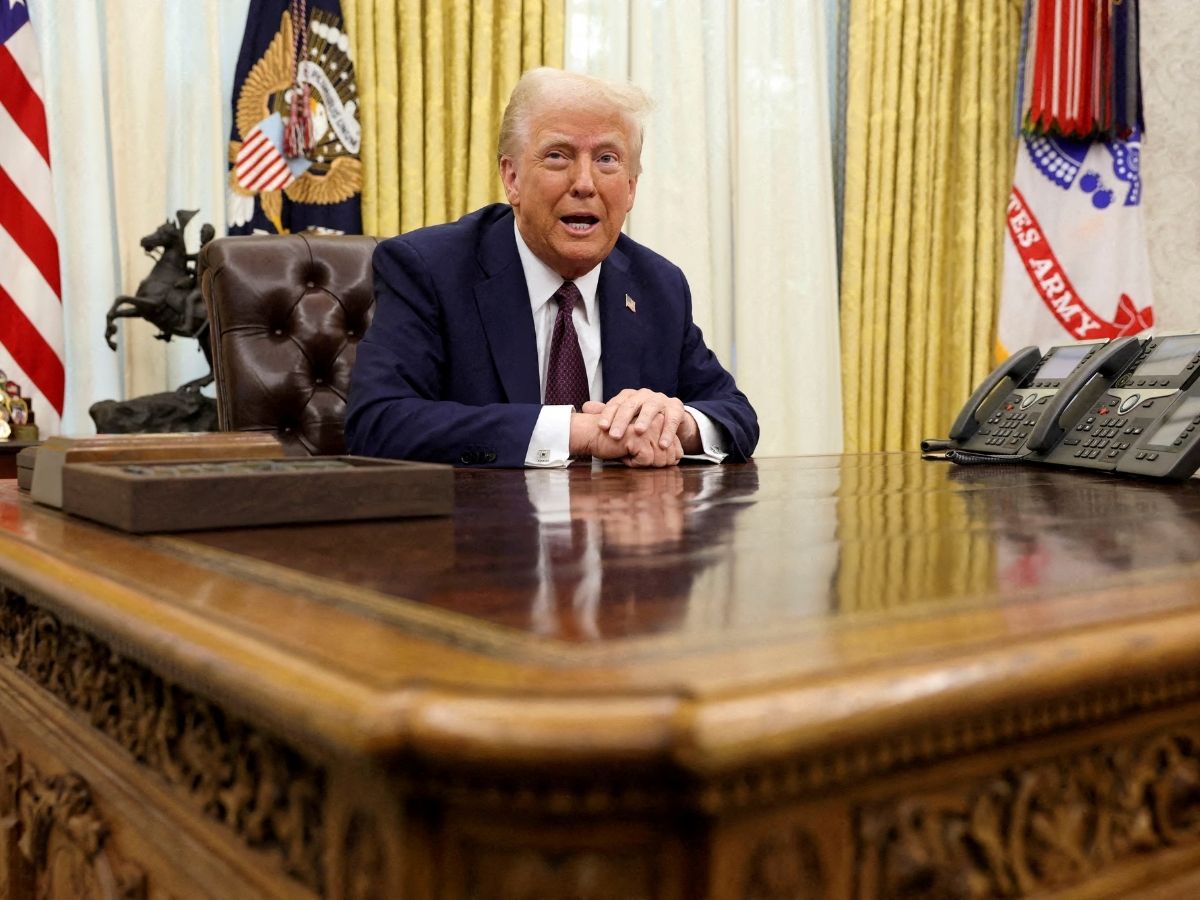
According to the US Senate website, the Constitution explicitly grants the US Congress the sole power to declare war.
As the conflict between Israel and Iran escalates, with both seemingly unrelenting sides reporting hostilities, White House Press Secretary Karoline Leavitt recently announced that US President Donald Trump will decide on the possibility of a direct action against Tehran “within the next two weeks”.
“Based on the fact that there’s a substantial chance of negotiations that may or may not take place with Iran in the near future, I will make my decision whether or not to go within the next two weeks,” Leavitt quoted Trump as saying during a media briefing.
Trump, for his part, hasn’t ruled out a potential US strike on Iran, as he told reporters on Wednesday, “I may do it, I may not do it. I mean, nobody knows what I’m going to do.” So, can the US president alone authorise a declaration of war or is there a more complex process behind it? Here is all you need to know about what the US Constitution says and what the likely scenarios are that could play out should Trump decide to materialise his threats against Iran.
According to the US Senate website, the Constitution explicitly grants the US Congress the sole power to declare war. Historically, the US Congress has declared war 11 times—first in 1812 against Great Britain and most recently during World War II.
Since the Congress approved the last formal declaration of war during World War II, it has “agreed to resolutions authorising the use of military force”, as part of its efforts to “shape American military policy through appropriations and oversight”.
Since World War II, Congress hasn’t formally declared war but has authorised military actions through resolutions and appropriations.
While the American Constitution empowers Congress with war-declaring power, US presidents have, over the course of history, launched military strikes without formal war declarations.
Recently, the Trump administration considered strikes against Iran amid rising tensions, raising the question: Can he authorise such strikes without Congress?
Senator Tim Kaine (D-Va.), who has been seeking to repeal the post-9/11 authorisation for the use of military force that past US presidents have leaned on to launch military strikes, told CNN, “We shouldn’t go to war without a vote of Congress.”
Notably, presidents from both Republican and Democratic parties have relied on prior congressional authorisations—such as the 2001 Authorisation for Use of Military Force (AUMF)—to justify military action without a new vote, CNN reported. However, the 2001 AUMF targets groups associated with 9/11, and given Iran wasn’t involved in those attacks, its applicability in today’s time has reportedly raised concerns.
Following the Vietnam War and presidential military actions preceding it, the US Congress passed the War Powers Resolution of 1973, a law that limits the president’s ability to deploy troops without congressional consent except in
According to the CNN report, the law requires the president to notify Congress within 48 hours of military action and limits the duration before Congress must approve continued engagement.
However, the law’s wording leaves room for ambiguity in terms of how it is interpreted, the report said, adding that presidents often “consult” Congress in ways that don’t require formal approval, and lawyers within the Department of Justice have issued memos supporting broad presidential authority under the “national interest” standard.
Amid Washington’s tensions with Tehran and the Israel-Iran conflict, several US lawmakers are pushing back against what they see as unchecked presidential military power.
Rep. Thomas Massie (R-Ky.) and Rep. Ro Khanna (D-Calif.) introduced a war powers resolution to require congressional approval before committing American forces to military action in the Middle East, as reported by CNN.
“This is not our war. But if it were, Congress must decide such matters according to our Constitution,” Massie said on X.
According to a TIME report, Senator Kaine introduced a similar resolution to end unauthorised military actions against Iran, reportedly saying, “I am deeply concerned that the recent escalation … could quickly pull the United States into another endless conflict.”
Senator Bernie Sanders (I-Vt.), with support from Senators Elizabeth Warren and Chris Van Hollen, also proposed legislation to block federal funding for any military action against Iran without congressional approval, except in cases of self-defense, per the TIME report.
Some lawyers from the Office of Legal Counsel (OLC) in the Justice Department have argued that presidents have inherent constitutional authority to order military strikes if deemed in the national interest, even without explicit congressional approval, CNN reported.
This “national interest” test effectively gives presidents a wide berth, although it also raises questions given that the American Constitution vests the war declaration power with Congress.
For instance, when Trump ordered the killing of Iranian General Qasem Soleimani in 2020, the OLC reportedly justified it under the president’s broad authority while also acknowledging that Congress can effectively curb those powers by cutting funding for military operations, even though the process is deemed complex, especially with Republican control of Congress.
Debates over whether an action constitutes “war” or “hostilities” complicate efforts to limit presidential power. While some argue that limited airstrikes don’t amount to war and thus don’t require congressional approval, others, including former national security lawyers Brian Egan and Tess Bridgeman, have asserted that these semantic distinctions have allowed presidents to conduct military operations without formal declarations or votes, per CNN.
Some Republicans, including Senator Lindsey Graham, have urged a robust military response, telling CBS News, “If diplomacy is not successful… I would urge President Trump to go all in to make sure that… there’s nothing left standing in Iran regarding their nuclear program.”
Meanwhile, others, including members of the “America First” faction and Democrats like Rep. Alexandria Ocasio-Cortez, have pushed to limit military involvement and demanded congressional debate.
Trump himself has sent mixed signals, warning Iran’s Supreme Leader that “our patience is wearing thin,” while also saying he has not reached out to Iran for peace talks.
(With inputs from US Senate website, CNN and TIME)
Amid intensifying efforts to end the ongoing Iran war, US President Donald Trump has claimed…
The Trump administration has shared a 15-point peace plan with Iran through intermediaries, including Pakistan,…
Alan Ritchson, star of Reacher and War Machine, is under investigation after a physical altercation…
