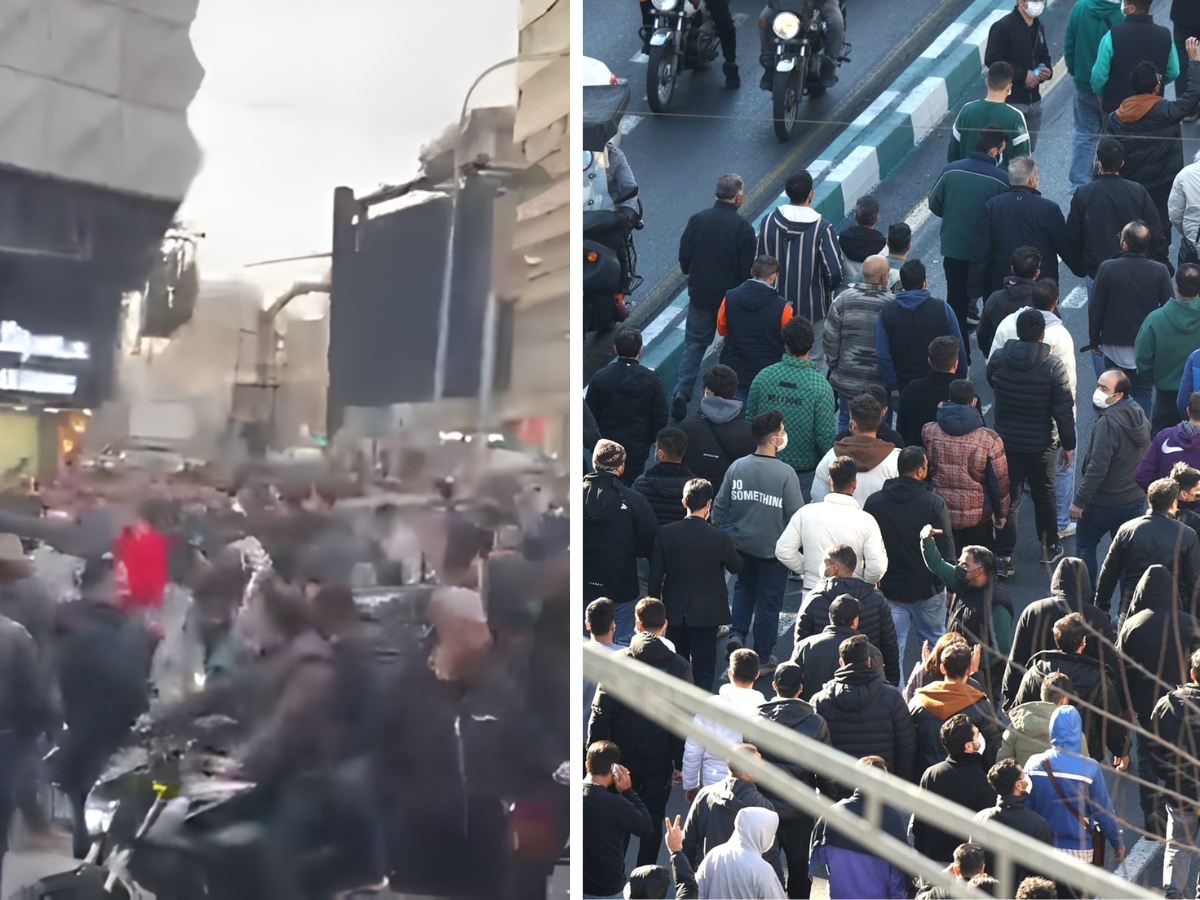
Massive protests sweep Iran as students, merchants march over economic crisis, inflation, and government response. Photos: X.
Iran is witnessing a wave of massive protests, with participation spanning shopkeepers, bazaar merchants, and students. What began as demonstrations in Tehran’s bazaars has spread to at least four universities.
Hundreds of students have joined the protest, marching through streets while chanting slogans such as “Rest in peace Reza Shah,” a reference to the founder of Iran’s former monarchy.
Social media platforms have been flooded with posts supporting the demonstrators, while Iranian state television aired footage showing large gatherings in central Tehran. On Tuesday, President Pezeshkian met with trade unions and market activists, promising that the government would strive to address their grievances, according to state media reports.
Economic Crisis: At the heart of the protests is Iran’s economic crisis. The dollar surged to roughly 144,000 tomans over the weekend before slightly easing to 136,000 tomans on Monday, creating volatility that has made pricing goods and maintaining supply chains increasingly difficult for shopkeepers.
Iran’s Central Bank Governor Resigns: The crisis deepened with the resignation of Iran’s central bank governor, after which President Pezeshkian appointed Abdolnaser Hemmati as the new chief. The move is widely seen as an attempt to stabilize markets and calm public unrest.
Inflation: The depreciation of the currency fuels inflation, pushing up prices of food and essentials and further straining household budgets. Recent changes to gasoline prices and reports of planned tax hikes in the Iranian New Year (starting March 21) have exacerbated public anxiety.
In response to the unrest, Iranian President Masoud Pezeshkian acknowledged the protests via a social media post on X, urging authorities to listen to citizens’ concerns.
“The livelihood of the people is my daily concern. We have fundamental actions on the agenda to reform the monetary and banking system and preserve the purchasing power of the people. I have tasked the Minister of the Interior to hear the legitimate demands of the protesters through dialogue with their representatives, so that the government can act with all its might to resolve problems and respond responsibly,” Pezeshkian said.
Government spokesperson Fatemeh Mohajerani echoed the president’s commitment to dialogue, announcing that talks with protest leaders would be established.
“We officially recognise the protests … We hear their voices and we know that this originates from natural pressure arising from the pressure on people’s livelihoods,” she stated.
The ongoing protests are said to be the largest since 2022, following the death of 22-year-old Mahsa Jina Amini in police custody. Amini’s death, after being arrested for allegedly improper hijab wearing, sparked nationwide demonstrations, highlighting enduring tensions between the state and the public.
Also Read: ‘Will Knock The Hell Out’: Trump Warns Iran On Nuclear, Missile Program During Netanyahu Meeting
Zubair Amin is a Senior Journalist at NewsX with over seven years of experience in reporting and editorial work. He has written for leading national and international publications, including Foreign Policy Magazine, Al Jazeera, The Economic Times, The Indian Express, The Wire, Article 14, Mongabay, News9, among others. His primary focus is on international affairs, with a strong interest in US politics and policy. He also writes on West Asia, Indian polity, and constitutional issues. Zubair tweets at zubaiyr.amin
Thousands Rally In Toronto In Support Of Iran Protests, Call For Regime Change | WATCH
Toronto: Tens of thousands of demonstrators poured onto Yonge Street in North York on Saturday,…
Heer Ranjha: Filmmakers Imtiaz Ali and Ektaa Kapoor have reunited to bring the legendary love…
Punjabi actor and singer Himanshi Khurana has reportedly received a ₹10 crore extortion threat allegedly…
