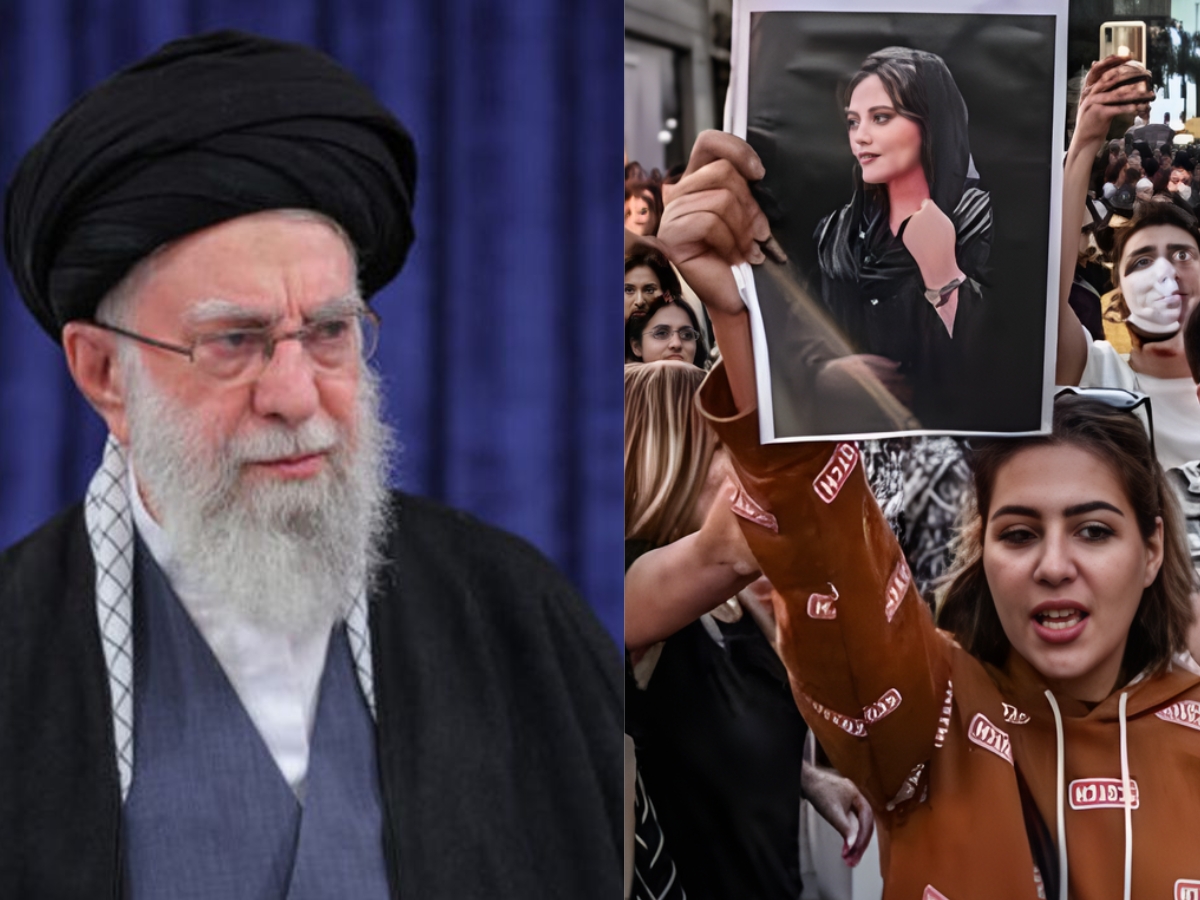
Iranian women celebrate Khamenei’s death, marking hope against decades of oppression, hijab laws, and custodial violence. Photos: X.
The assassination of Iran’s Supreme Leader, Ayatollah Ali Khamenei, following joint US and Israeli airstrikes on Tehran, has sparked widespread reactions across Iran and within the global Iranian diaspora. While celebrations broke out in the streets, the reaction was particularly notable among Iranian women, many of whom have suffered under Khamenei’s decades-long rule.
Videos circulating on social media show crowds taking to streets in Tehran and other cities, celebrating Khamenei’s death with dancing, flag-waving, car honking, and fireworks. Some chanted slogans like “freedom, freedom” while rooftop shouts called out, “Khamenei went to hell.”
A woman who previously went viral in January for lighting a cigarette using a photograph of Khamenei resurfaced online, rejoicing over news of his death.
The New York Times reported “large crowds” in multiple cities engaging in celebrations, even as some supporters mourned privately and others expressed fear of potential retaliatory strikes.
Iranian-American journalist Masih Alinejad described the scene to Fox News, highlighting the irony of public joy despite U.S. involvement. She said,
“I grew up in a country where I was brainwashed to say ‘Death to America,’ the same country that saved my life three times and is now helping my people in Iran. They’re celebrating out of joy.”
Khamenei’s tenure, beginning in 1989 after the death of Ruhollah Khomeini, was marked by strict domestic control and suppression of dissent. He oversaw the growth of the Islamic Revolutionary Guard Corps (IRGC) and Iran’s network of state and non-state proxies in Iraq, Syria, Lebanon, Gaza, and Yemen.
Under Khamenei, however, the women were the primary victims of the regime’s systemic opression. The most notable and gruesome case is that of Mahsa (Jina) Amini, who was killed in custody. She was arrested by Iran’s morality police for allegedly violating the hijab rules. Her custodial killing sparked countrywide protests, commonly known as the ” Women’s Life Freedom” uprising. The uprising is infamous for how the Iranian regime used sexual violence as a weapon of repression.
Her death triggered nationwide protests, commonly referred to as the “Woman Life Freedom” uprising, highlighting the regime’s use of sexual violence as a weapon of repression.
Reports document that women protesters were beaten, sexually assaulted, gang-raped, tortured, stripped naked, and abused during arrests, transfers, and interrogations, both in official detention centers and clandestine facilities.
A 2023 Amnesty International report confirmed that agents from the Revolutionary Guards, Basij paramilitary force, Ministry of Intelligence, and various police branches perpetrated these abuses. Survivors included women and girls who removed their headscarves in defiance, as well as men and boys protesting gender-based oppression.
Since the 1979 Islamic Revolution, Iran has the most brutal hijab laws. Women are legally required to cover their hair in public. The Guidance Patrols (Gasht-e Ershad) enforce compliance. They monitor the clothing, hairstyles, and makeup of the women. If the women violate the law, heavy penalties ranging from fines and imprisonment to flogging are imposed. Past reports have highlighted how authorities have shut down businesses, failing to enforce hijab rules. Women who were seen driving without hijabs have had their vehicles confiscated.
A 2024 United Nations Human Rights Commission report documented widespread human rights violations in Iran, including violent suppression of peaceful protests and pervasive institutional discrimination against women. The Independent International Fact-Finding Mission on the Islamic Republic of Iran described many of these abuses as crimes against humanity.
Mahsa Amini’s death ignited mass protests, with more than 500 protesters killed and over 20,000 arrested. Seven were executed following convictions for assaulting security personnel. Reports also indicated toxic gas attacks at nearly 300 girls’ schools nationwide.
Against this backdrop of decades-long repression, many Iranian women view Khamenei’s death as a potential turning point. The women hope and yearn for a future free from custodial sexual violence, compulsory hijab enforcement, and systemic oppression.
Zubair Amin is a Senior Journalist at NewsX with over seven years of experience in reporting and editorial work. He has written for leading national and international publications, including Foreign Policy Magazine, Al Jazeera, The Economic Times, The Indian Express, The Wire, Article 14, Mongabay, News9, among others. His primary focus is on international affairs, with a strong interest in US politics and policy. He also writes on West Asia, Indian polity, and constitutional issues. Zubair tweets at zubaiyr.amin
Israel says it killed Hezbollah’s intelligence chief Hussein Makled in an overnight airstrike in Beirut,…
NSE, BSE shut on March 3 for Holi 2026 after Sensex crash; MCX reopens in…
Kerala Board Postpones SSLC, Plus Two Exams in Gulf Amid Middle East Security Crisis
The Kerala government has deferred the Secondary School Leaving Certificate (SSLC) and Higher Secondary Plus…
