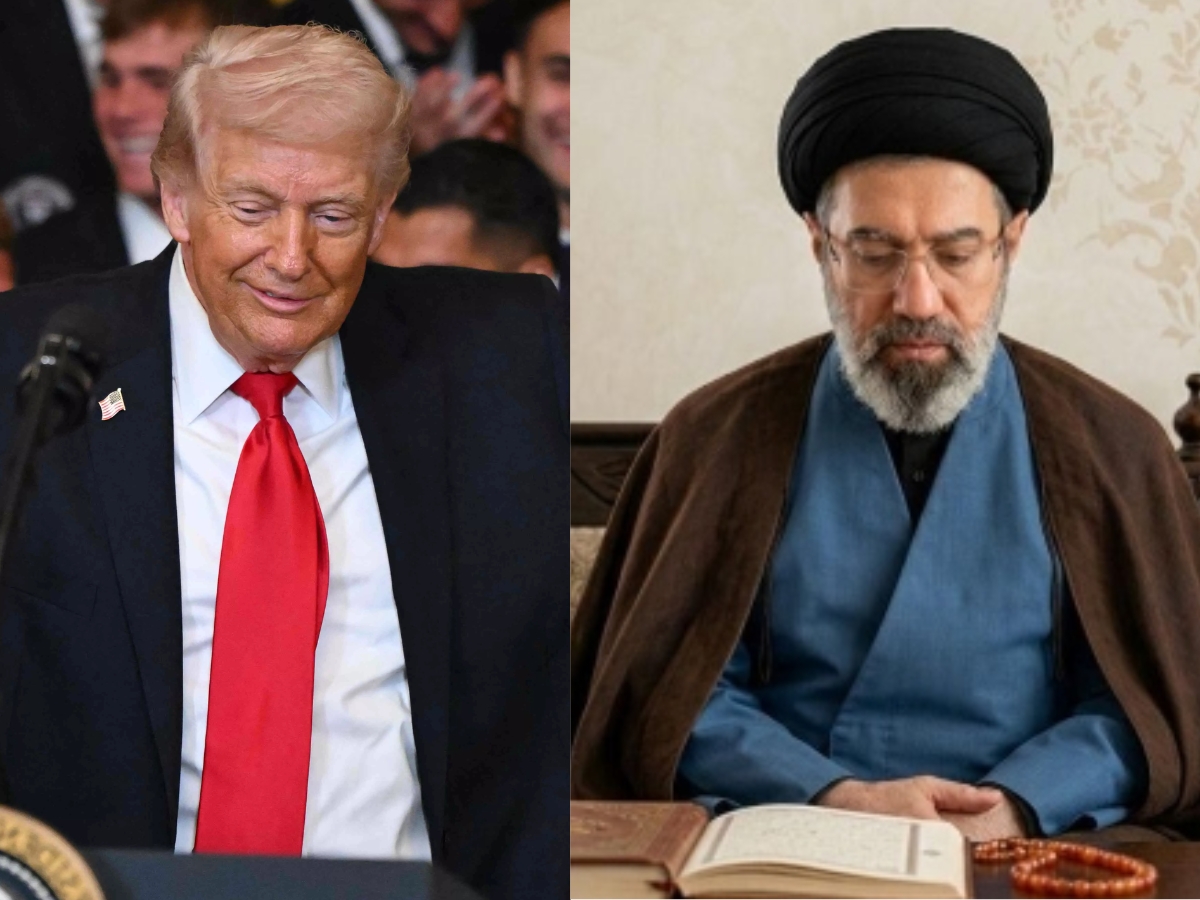
US-Israel strikes on Iran intensify as Gulf tensions rise. Officials say the war could last weeks. Photos: X.
The Middle East war involving the United States and Israel against Iran intensified on Monday, with fresh airstrikes reported in multiple Iranian cities and retaliatory attacks spreading across the Gulf region. The escalation comes amid mounting uncertainty over how long the war could last, with officials warning the confrontation may continue for weeks.
Explosions were reported in the Iranian cities of Tehran and Qom as the United States and Israel continued bombing operations across Iran.
The latest attacks came only hours after earlier Israeli strikes targeted oil facilities, triggering thick toxic smoke that spread across the capital.
In the newest wave of operations, Israel carried out strikes in central Iran aimed at key security and missile infrastructure. According to reports, the targets included “a rocket engine production facility and several long-range ballistic missile launch sites.”
The regional fallout from the conflict has already spread beyond Iran’s borders, with Gulf states reporting Iranian attacks.
Bahrain activated nationwide sirens and urged residents to move to safety amid growing security threats.
“The siren has been sounded. Citizens and residents are urged to remain calm and head to the nearest safe place,” the country’s interior ministry said.
Earlier in the day, Iranian strikes reportedly hit the country’s largest oil refinery, BAPCO. Following the attack, the state oil company declared force majeure.
The United States and Israel had also struck oil facilities across Iran earlier, including targets in Tehran.
Meanwhile, Saudi Arabia said it intercepted four drones heading toward the Shaybah oilfield. The United Arab Emirates also confirmed that its air defence systems were responding to an incoming missile attack.
Amid the escalating conflict, Iran remains under a sweeping internet shutdown that has now lasted for 216 consecutive hours.
Cybersecurity watchdog NetBlocks reported that the country’s connectivity has dropped to just one percent of normal levels.
“Some 90 million Iranians are silenced and cut off from the global internet under a state-imposed shutdown,” the organisation said in its latest update.
In a major political development during the conflict, Iran’s Assembly of Experts has elected Mojtaba Khamenei as the country’s new Supreme Leader, according to Iranian state television.
Mojtaba Khamenei, 56, is the second-eldest son of the late Supreme Leader Ali Khamenei and was born in Mashhad in 1969.
His early childhood coincided with his father’s rise as a revolutionary figure opposing the monarchy of Mohammad Reza Pahlavi, the Shah of Iran.
As the fighting continues, a key question dominating discussions among observers is how long the war between Israel and Iran might continue.
According to the Israeli daily Yedioth Ahronoth, the Israeli military is preparing for a scenario in which the conflict with Iran and its allied forces could last at least a month.
A senior official in the Israeli General Staff told the newspaper that the military has increased readiness levels across multiple combat branches in anticipation of further escalation.
The report said preparations include strengthening air defence systems, deploying additional forces, and planning for extended military operations if the clashes continue or spread to additional fronts.
Trump said the decision on when to end the war would be made jointly with Israeli Prime Minister Benjamin Netanyahu.
Speaking to The Times of Israel in a telephone interview on Sunday, the US president said the decision would be “mutual,” though he indicated he would ultimately have the final say.
“I think it’s mutual… a little bit. We’ve been talking. I’ll make a decision at the right time, but everything’s going to be taken into account,” Trump said.
Trump also claimed that Iran would have destroyed Israel if he and Netanyahu had not intervened.
“Iran was going to destroy Israel and everything else around it… We’ve worked together. We’ve destroyed a country that wanted to destroy Israel,” he said.
When asked whether Israel might continue the war even if Washington decides to halt its own strikes, Trump declined to consider the possibility.
“I don’t think it’s going to be necessary,” he added.
While avoiding committing to a fixed timeline, the US administration has suggested the war may continue for several weeks.
Karoline Leavitt, the White House press secretary, said on Friday that Washington expects the conflict to last between four and six weeks.
Zubair Amin is a Senior Journalist at NewsX with over seven years of experience in reporting and editorial work. He has written for leading national and international publications, including Foreign Policy Magazine, Al Jazeera, The Economic Times, The Indian Express, The Wire, Article 14, Mongabay, News9, among others. His primary focus is on international affairs, with a strong interest in US politics and policy. He also writes on West Asia, Indian polity, and constitutional issues. Zubair tweets at zubaiyr.amin
Samsung will launch the Samsung Galaxy M17e 5G in India on March 17, featuring a…
Sanju Samson's comeback into the side as an opener proved to be a masterstroke for…
UP Scholarship 2026 Phase 2 Payment on March 18: Check Verification Status Details Here
The Uttar Pradesh government is preparing to release the UP Scholarship 2026 Phase 2 payment…
