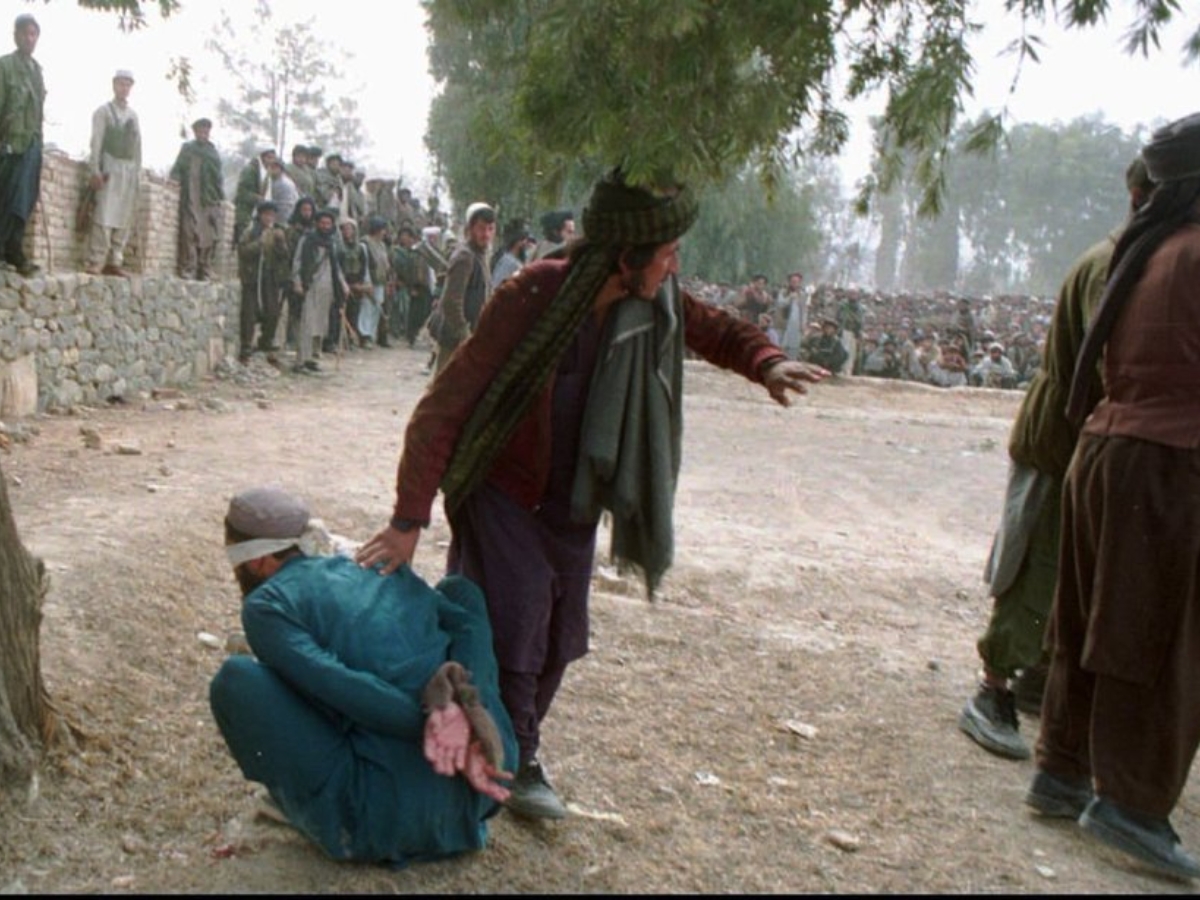
Taliban publicly executed Mangal in Khost for killing 13 family members, drawing global criticism including UN condemnation. Photo: X.
Taliban authorities on Tuesday executed a man publicly in Khost, accused of killing 13 members of a single family. This is the 11th execution carried out in Kabul since the Taliban assumed power in 2021. The public killing was carried out under the strict terms of Sharia law, which has been implemented in Afghanistan post Taliban capture. The regime has banned education for women and girls following the withdrawal of US and NATO forces four years ago. The execution has drawn sharp criticism worldwide, even prompting the United Nations (UN) to issue a statement.
According to a statement from the Supreme Court of Afghanistan, the man, identified as Mangal, was sentenced to death for the murders of Abdul Rahman and 12 other family members, including women and children.
The court added that the execution order received approval from Hibatullah Akhunzada, Afghanistan’s supreme leader.
“The family of the victim was offered the option of forgiveness and reconciliation, but after they refused and insisted on Qisas, the order for the implementation of the divine ruling of Qisas was issued,” the statement read on the social media platform X.
According to reports, approximately 80,000 people, including Taliban officials and relatives of the victims, attended the execution. Mangal was reportedly shot by a relative of the family he had murdered. According to Amu News, a 13-year-old boy from the victims’ family carried out the execution, though HT.com could not independently verify this claim.
A witness told TOLO News, “They brought the killer in front of everyone. Doctors came and followed their procedures. Then the complainant arrived and, in accordance with what Sharia permits, fired at him and shot him.”
Alongside Mangal, two others, reportedly his sons, were also convicted. Their executions have been postponed as the victims’ family members currently reside abroad.
The Supreme Court clarified, “In this murder case, the three courts and the honorable leadership of the Islamic Emirate had also ordered the implementation of the divine ruling of Qisas against two other criminals. However, since some of the heirs of the victims reside outside the country and were not present, the implementation of the divine ruling of Qisas against those criminals was postponed, in accordance with Sharia provisions, until the presence of the heirs of the victims.”
Shortly before the execution, United Nations Special Rapporteur for Afghanistan Richard Bennet called for the punishment to be halted.
“Public executions are inhumane, a cruel and unusual punishment, and contrary to international law,” he wrote on X.
Following the execution, Bennet added, “Such executions are a gross violation of human rights and dignity, and incompatible with Islamic law.”
Zubair Amin is a Senior Journalist at NewsX with over seven years of experience in reporting and editorial work. He has written for leading national and international publications, including Foreign Policy Magazine, Al Jazeera, The Economic Times, The Indian Express, The Wire, Article 14, Mongabay, News9, among others. His primary focus is on international affairs, with a strong interest in US politics and policy. He also writes on West Asia, Indian polity, and constitutional issues. Zubair tweets at zubaiyr.amin
The ICC Men’s T20 World Cup 2026 Closing ceremony at Narendra Modi Stadium in Ahmedabad…
Realme C83 5G launched in India with a 7,000mAh battery, 6.7-inch 144Hz display, and MediaTek…
The new sci-fi action thriller War Machine, directed by Patrick Hughes, is set to release…
