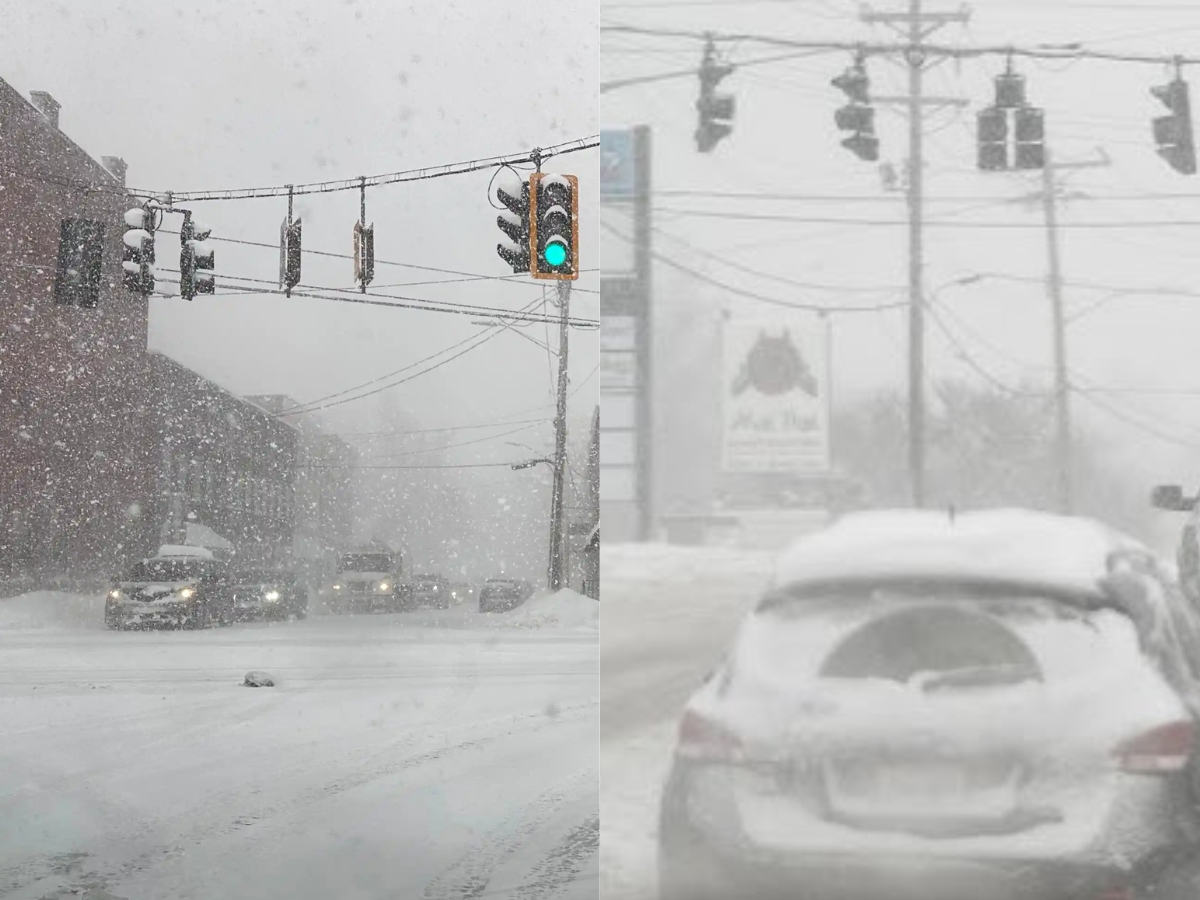
Massive US snow storm hits 180M people. Flights cancelled, roads blocked, and states declare emergencies amid winter storm. Photos: X
Snow Storm Warning: More than 180 million people across the United States are on alert as a massive winter storm stretches from New Mexico to Maine, threatening to cripple large parts of the country with heavy snow, dangerous ice and prolonged power outages. The storm, expected to peak over the weekend, has already disrupted travel, forced emergency declarations, and raised fears of damage comparable to a major hurricane in ice-hit regions.
The scale of disruption is already evident. More than 8,300 flights scheduled to depart across the US over the weekend have been cancelled as the storm bears down, with airlines bracing for widespread airport closures and unsafe flying conditions.
Major roadways are also expected to be snarled or shut down entirely as snow and ice accumulate across vast regions.
Roughly 180 million people were under winter storm warnings stretching from New Mexico to New England, according to the National Weather Service (NWS). Forecasters warned of widespread heavy snowfall accompanied by a catastrophic band of ice extending from east Texas to North Carolina.
Weather experts cautioned that damage in areas battered by ice, where freezing rain coats power lines, trees and roads, could rival the destruction typically seen during hurricanes.
By Friday night, the outer edge of the storm had already begun impacting parts of the South. Freezing rain and sleet were reported in Texas, while snow and sleet fell across Oklahoma.
After sweeping through the southern states, the storm is expected to push into the Northeast, where the National Weather Service forecasts up to a foot (30 centimeters) of snow from Washington, D.C., through New York City and Boston.
Governors in more than a dozen states issued urgent warnings, declared states of emergency, or urged residents to stay off roads and remain indoors as conditions deteriorated.
At least 18 states have declared states of emergency:
Alabama, Arkansas, Delaware, Georgia, Kansas, Kentucky, Louisiana, Maryland, Mississippi, Missouri, New Jersey, New York, North Carolina, Pennsylvania, South Carolina, Tennessee, Texas and Virginia.
Washington, D.C., has also declared a state of emergency.
The snow storm began Friday afternoon with snow and ice developing across New Mexico and the Texas Panhandle. By Friday evening, Dallas was expected to experience a wintry mix, while Oklahoma City saw snowfall.
Saturday is forecast to be the most dangerous day for the South, with widespread heavy snow and severe icing. By Saturday morning, snow and ice were expected to stretch from Texas through Arkansas to Tennessee.
By Saturday afternoon, snowfall was forecast to spread north and east, affecting cities including St. Louis, Indianapolis, Cincinnati and Charleston, West Virginia.
By Saturday evening, snow and ice were expected to blanket a massive swath of the country, from New Mexico to the Carolinas. Farther south, freezing rain or a wintry mix was forecast for Dallas, Shreveport in Louisiana, Memphis in Tennessee, and Raleigh in North Carolina.
Early Sunday, the storm is expected to move eastward, bringing snow from Wichita, Kansas, through Cincinnati, Washington, D.C., and Philadelphia. Freezing rain is likely by sunrise in Houston, Memphis, Atlanta and Raleigh.
By midday Sunday, snow is expected to reach New York City, while precipitation in Washington, D.C., is forecast to transition into a wintry mix as temperatures rise slightly.
The federal government has mobilised extensive resources in anticipation of the storm’s impact. Nearly 30 search and rescue teams have been placed on standby, while more than 7 million meals, 600,000 blankets and 300 generators have been pre-positioned along the storm’s projected path, according to the Federal Emergency Management Agency (FEMA).
President Donald Trump said on social media on Friday that his administration was coordinating closely with state and local authorities. “FEMA is fully prepared to respond,” he said.
Even after the storm passes, officials warn that recovery could be slow. Thick ice can add hundreds of pounds to power lines and tree branches, making them especially vulnerable to snapping — particularly during high winds.
In at least 11 southern states from Texas to Virginia, the majority of homes rely on electricity for heating, according to the US Census Bureau, increasing the risk to residents if power failures occur.
Zubair Amin is a Senior Journalist at NewsX with over seven years of experience in reporting and editorial work. He has written for leading national and international publications, including Foreign Policy Magazine, Al Jazeera, The Economic Times, The Indian Express, The Wire, Article 14, Mongabay, News9, among others. His primary focus is on international affairs, with a strong interest in US politics and policy. He also writes on West Asia, Indian polity, and constitutional issues. Zubair tweets at zubaiyr.amin
The White House confirmed that the US Navy has not escorted any oil tanker through…
Atletico Madrid vs Tottenham Live Streaming: Where to Watch UCL Match on TV and Online In India?
Check out the Live Streaming and Telecast details of Atletico Madrid vs Tottenham UCL match…
Tehran witnessed a highly unusual public display of loyalty as supporters gathered to pledge allegiance…
