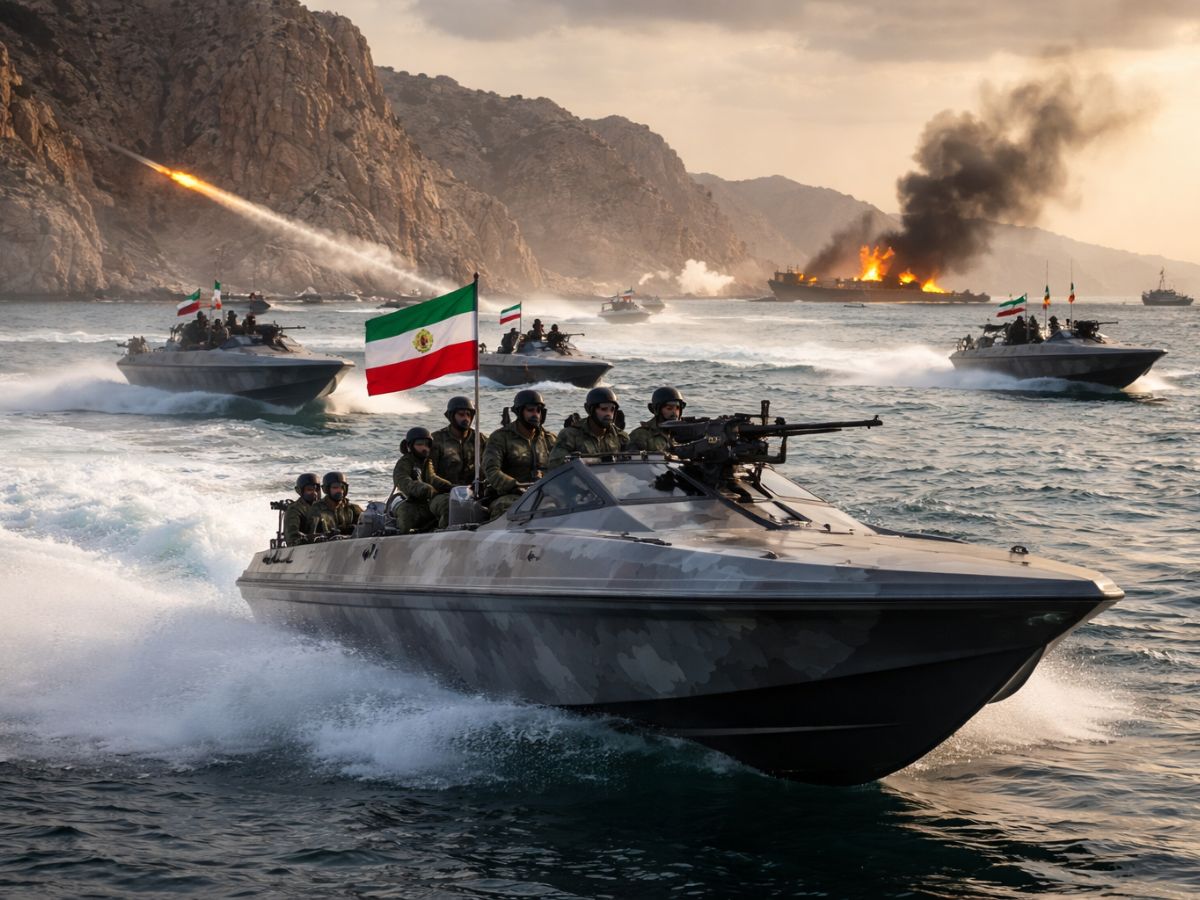
What is Iran’s ‘Mosquito Fleet’? (Image: AI-generated)
The Iran-U.S. war conflict may have brought out Iran’s Mosquito Fleet as an unexpected capability during this conflict. Washington expected to complete this military engagement quickly, in four or five weeks; however, this conflict has exposed significant vulnerabilities in US situational awareness pertaining to the military potential of Iran.
Although drones and air defence systems are sized and proportioned to compete effectively against advanced fighter types (i.e., the F-35), experts claim that Iran’s Mosquito Fleet of small and/or fast maritime attack vessels is the root cause for the disruptions that have occurred within the Strait of Hormuz.
Despite US and Israeli claims of having destroyed a portion of Iran’s conventional Navy, the Mosquito Fleet continues to pose a significant hazard for vessels stranded near the Persian Gulf’s Strait of Hormuz. Iran maintains the Mosquito Fleet through the procurement of anti-ship missiles and UAVs launched from hidden locations along the coastline of Iran.
Unlike conventional navies, the Mosquito Fleet comprises small vessels that can operate at high speeds and deliver surprise attacks with a low likelihood of being engaged effectively by larger naval forces.
The Mosquito Fleet is made up of very small, fast vessels utilized by Iran’s naval wing of the Islamic Revolutionary Guard Corps (IRGC), which is a separate military organization. The Mosquito Fleet is designed for conducting military operations in narrow waterways such as the Strait of Hormuz.
The Mosquito Fleet concept originated in 1986 when Iran began to develop Non-Traditional Naval Warfare capabilities. By the middle of 1987 and continuing through the next decade, Iran created its Mosquito Fleet by modifying small, recreational vessels, and then added weapons such as RPGs and M60 machine guns to these vessels.
In addition to enhancing the original Mosquito Fleet vessels, Iran has since added other capabilities such as mini submarines and aquatic drones, as well as developing new capabilities that allow the Mosquito Fleet to carry out more complex and coordinated attacks in this region.
Mosquito Fleet vessels are some of the fastest on the water, able to exceed 100 knots (approximately 185 km/hour). The high speed of the vessels provides the opportunity for quick attack and then quickly retreating out of the area before a significant response can be launched against the attacking vessel(s).
Experts refer to the Mosquito Fleet as utilizing guerrilla-type naval warfare. Rather than using larger warships, they utilize speed, surprise, and repeated small attacks to overwhelm their opponents.
According to Saeid Golkar, “The IRGC navy functions more like a guerrilla force at sea,” focusing on “hit-and-run type attacks” instead of traditional type warfare. Because of this style, the Mosquito Fleet is now an ongoing threat in the area.
At least 20 vessels have reportedly been attacked during the ongoing conflict, demonstrating just how effective the Mosquito Fleet is at disrupting global shipping through the Strait of Hormuz.
Even following US-Israel strikes that destroyed about half of Iran’s fast attack boats, hundreds, if not thousands, of these vessels are still believed to be operational. This ensures that pressure remains on the Iranian Navy in the region.
The Mosquito Fleet has the advantage of being able to remain concealed in their launching points. Many of these boats are stored in extreme underground facilities dug into the rocky parts of Iran’s coastline, making them virtually impossible to spot via satellite surveillance.
Sources say there may be 10+ fortified locations from which the Mosquito Fleet can launch strikes in just minutes. According to retired U.S. Navy Admiral Gary Roughead, “It is a disruptive force, but you never know what they are going to do.” Commercial ships are particularly vulnerable to the Mosquito Fleet because they do not have military capabilities.
Khalid Qasid is a media enthusiast with a strong interest in documentary filmmaking. He holds a Master’s degree in Convergent Journalism from AJK MCRC. He has also written extensively on esports at Sportsdunia. Currently, he covers world and general news at NewsX Digital.
Who Is Dawa Sherpa? Missing Everest Guide Found Alive After Six Days Against All Odds
Veteran Nepali guide Dawa Sherpa, who went missing on Mount Everest during a summit attempt,…
Punjab on High Alert After Bomb Threat Email Targets Chandigarh Secretariat
Punjab has been placed on high alert after a bomb threat email targeted the Punjab…
Amazon Lays Off 30,000 Employees In 8 Months, Plans $200 Billion AI Investment In 2026
Amazon has cut around 30,000 corporate jobs in the past eight months while ramping up…
